
SEO for driving instructors and driving schools increases online visibility, attracts qualified students, and enhances brand authority across local and regional searches. Driving schools that optimize websites, Google Business Profiles, and lesson-specific pages capture high-intent traffic from learners seeking road test preparation, driving lessons, and advanced driving courses. Local SEO for driving schools ensures that service areas, class schedules, and instructor profiles rank prominently in “near me” and city-specific queries, generating measurable lead growth.
Implementing structured SEO strategies involves claiming and verifying business listings, defining target students, creating dedicated pages for lessons, and optimizing on-page elements such as titles, meta descriptions, and schema markup. Technical audits, server log analysis, and performance monitoring maintain indexability and search engine compliance, while content marketing, link acquisition, and reputation management enhance authority.
Selecting the right SEO and marketing services for driving schools and instructors ensures consistent enrollment growth and competitive differentiation. Expert guidance delivers measurable improvements in bookings, local rankings, and engagement for all types of driving instruction businesses.

What Does SEO Mean for Driving Instructors?
SEO for driving instructors defines a systematic optimization process that elevates driving schools, instructor services, and training programs within organic search results. Driving school SEO aligns indexing signals, ranking signals, and content relevance with search queries that target learner permits, defensive driving courses, and advanced driving lessons. SEO for driving instructors organizes structured pages that describe instructor qualifications, lesson durations, class schedules, and test preparation services.
Driving instructor SEO strengthens local visibility for individual instructors, corporate training programs, and mobile training units. It coordinates keyword clusters, entity references, and location-based signals that match city-specific lessons, regional road test preparation, and age-specific training requirements. Internal linking frameworks within SEO for driving instructors to direct search engines to core service offerings, instructor profiles, and registration forms.
Driving school SEO increases exposure for online booking, lesson requests, and training material downloads. It establishes credibility through verified student reviews, licensing verification, and authentic class documentation. Optimized metadata, schema markup, and structured course pages reinforce relevance, improve map pack inclusion, and drive measurable lead acquisition for driving schools, instructor services, and educational programs.
Is SEO Necessary for Driving Instructor Websites?
Yes, SEO is necessary for driving instructor websites because it increases visibility for local learners, corporate clients, and specialized driving courses. Driving instructor SEO directs traffic toward lesson booking forms, test preparation schedules, and class registration pages. Optimized websites for driving schools, individual instructors, and training programs improve discovery across search engines, maps, and directories.
Driving school SEO aligns keyword clusters with intent-based queries, including beginner driving lessons, defensive driving courses, and advanced driver training. Local SEO for driving instructors elevates map pack rankings, regional search relevance, and location-specific visibility. Optimized instructor profiles, class descriptions, and student reviews strengthen trust signals and attract qualified leads.
Driving instructor websites without SEO lose exposure to nearby students and corporate clients. SEO reduces reliance on paid advertising campaigns that fluctuate seasonally. Consistent optimization maintains lead flow for driving schools, instructor services, and training programs. Regular technical audits, structured content, and local search signals improve indexing, user engagement, and measurable enrollment growth.
What Are the Main Benefits of Implementing SEO Strategies for Driving Instructors?
The key advantages of implementing SEO strategies for driving instructors revolve around increased visibility, higher student engagement, and measurable business growth. Driving school SEO, instructor website optimization, and local search marketing combine to generate qualified leads, improve credibility, and ensure sustainable growth for both individual instructors and driving schools. The key benefits of implementing SEO strategies for driving instructors.
- Boost Local Visibility: Local SEO places driving instructors in search results for nearby learners, city-specific courses, and regional driving programs. It increases exposure to students actively searching for lessons.
- Increase Website Traffic: Optimized websites attract more visitors, directing learners to booking forms, test preparation schedules, and class registration pages.
- Attract Qualified Leads: SEO connects instructors with students who are ready to enrol in lessons, defensive driving programs, or advanced courses.
- Generate More Bookings: Higher visibility and qualified leads directly translate into increased lesson registrations and driving course enrollments.
- Build Competitive Advantage and Reputation: Optimized websites, professional profiles, and positive reviews elevate credibility and outrank competing driving schools.
- Ensure Long-Term Growth and User Experience SEO provides sustainable marketing results while improving website usability, navigation, and overall student experience.
These benefits establish measurable business outcomes, increased enrollments, and lasting authority for driving schools and instructors.
How Can Driving Schools Effectively Get Started with SEO?
To get started effectively with SEO, driving schools or instructors should focus on local visibility, optimized website structure, and measurable lead generation. Implementing structured strategies ensures higher search engine rankings, increased student engagement, and improved conversion rates. Driving school SEO integrates business profile optimization, content organization, technical auditing, and local search signals to attract qualified learners.
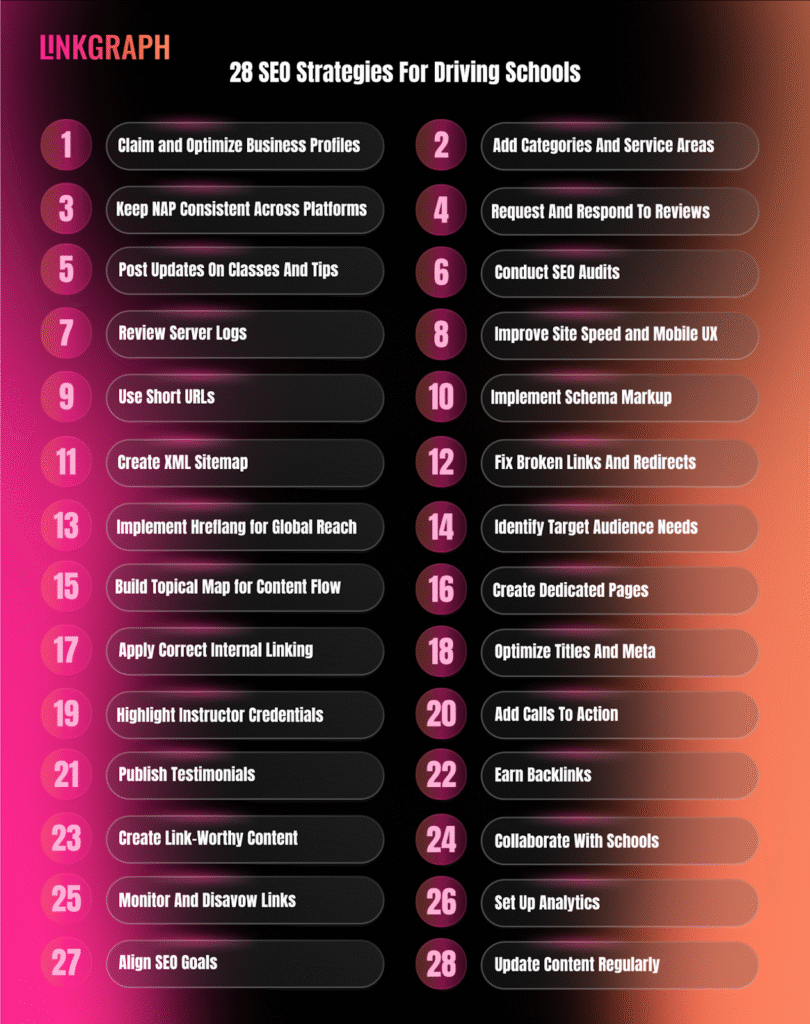
There are 28 SEO strategies for driving schools. The 28 SEO strategies for driving schools are listed below.
- Claim, Verify, and Optimize Business Profiles on Google, Bing, and Apple Maps
- Add Accurate Categories Like “Driving School” and Include Service Areas
- Keep Business Name, Address, and Phone Number Consistent Across All Directories
- Encourage Students to Leave Reviews After Lessons and Respond Promptly
- Post Regular Updates About New Classes, Offers, and Driving Tips on Profiles
- Conduct a Technical SEO Audit to Identify Crawl and Indexing Issues
- Review Server Logs to Understand How Search Engines Crawl Your Website
- Improve Site Speed and Core Web Vitals for Mobile and Desktop Users
- Use Short, Descriptive URLs for Lessons, Locations, and Instructors
- Implement Schema Markup for LocalBusiness, DrivingSchool, Courses, and Reviews
- Create an XML Sitemap for Lesson Pages, Instructor Profiles, and Blog Articles
- Fix Broken Links, Redirect Errors, and Duplicate Pages
- Use Hreflang Tags if Targeting Audiences in Multiple Languages
- Define Target Students Based on Age, Experience Level, and Training Goals
- Construct Topical Map Around Driving Lessons, Test Preparation, and Safety Guides
- Create Dedicated Pages for Lessons and Important Locations
- Interlink Pages Logically Following Correct Hierarchy (Root, Seed, Node)
- Optimize Each Page Title, Meta Description, and Alt Text
- Highlight Instructor Qualifications, Licenses, and Student Pass Rates
- Include Clear Calls to Action Like “Book a Lesson” or “Schedule Now”
- Publish Student Testimonials and Success Stories with Photos or Videos
- Earn Backlinks from Local Schools, Blogs, and Driving Safety Organizations
- Create Link-Worthy Content Like Driving Test Checklists and Study Guides
- Collaborate with High Schools, Colleges, and Community Programs for Visibility
- Monitor Backlinks Regularly and Disavow Harmful or Irrelevant Links
- Set Up Google Analytics and Search Console to Track Traffic and Leads
- Align SEO Goals with Enrollment Numbers and Lesson Bookings
- Keep Content Updated and Maintain an Ongoing SEO Strategy for Growth
Following these steps, driving schools optimize their websites, attract qualified learners, and achieve measurable enrollment growth. We have broken down the 28 SEO strategies for driving schools below.
1. Claim, Verify, and Optimize Business Profiles on Google, Bing, and Apple Maps
Business profile management involves claiming and verifying driving school listings on platforms such as Google, Bing, and Apple Maps. Verified profiles establish authority for driving schools, instructors, and driving academies. Listings include business name, address, phone number, lesson types, instructor details, class schedules, and service areas. Verification improves local search visibility, ensures listing accuracy, and increases appearance in map packs. Driving schools gain exposure for beginner lessons, advanced driving courses, and defensive driving programs.
Profile optimization requires detailed service descriptions, high-resolution images of classrooms, vehicles, and instructors, and video demonstrations of lessons. Accurate categorization aligns driving services with local search queries and increases discoverability for students seeking specific course types. Regular updates about promotions, seasonal courses, or safety tips strengthen student engagement and ranking signals. Directory management tools maintain consistency, detect duplicates, and verify profile accuracy.
Verified and optimized profiles improve local search ranking, map pack inclusion, and click-through rates. Monthly updates of content, images, and reviews strengthen authority, attract high-intent students, and increase lesson bookings.
2. Add Accurate Categories Like “Driving School” and Include Service Areas
Accurate categorization ensures driving schools, instructors, and training academies appear in relevant local searches. Categories such as “Driving School,” “Defensive Driving,” and “Advanced Lessons” clarify services for search engines and prospective students. Proper classification increases visibility for beginner courses, refresher lessons, and specialized driving programs. Service area inclusion specifies geographic coverage, enhancing exposure for city-specific or district-specific searches and improving local map pack placement.
Optimizing categories requires auditing current listings, analyzing competitor profiles, and mapping services to available platform options. Each course type, instructor specialty, and lesson format should align with the selected categories. Adding service areas with precision, including neighborhoods, towns, or counties, ensures students searching in specific locations locate the school. Updating attributes for specialized lessons, such as senior driving programs or intensive courses, strengthens relevance for high-intent searches.
Correct categorization and service area definition improve local search ranking, map visibility, and click-through rates. Regular audits maintain alignment with course offerings and geographic coverage, increasing lesson inquiries and student enrollment.
3. Keep Business Name, Address, and Phone Number Consistent Across All Directories
Consistency of business name, address, and phone number (NAP) establishes credibility for driving schools, instructors, and training academies across search platforms. Uniform NAP ensures search engines accurately associate listings with the correct entity, increasing local search visibility and map pack inclusion. Inconsistent information confuses students, reduces trust, and decreases the likelihood of lesson bookings.
Maintaining consistency requires auditing all directory listings, citation sites, and local platforms. Verify that every profile displays the same business name, street address, postal code, phone number, and email. Include suite numbers or branch locations where applicable. Standardizing formatting, abbreviations, and punctuation eliminates discrepancies that affect indexing and search relevance. Regular checks detect outdated or incorrect information.
Accurate NAP improves ranking signals, boosts map pack performance, and increases click-through rates for driving lesson pages. Schools that maintain precise listings across directories reduce bounce rates, increase student trust, and attract high-intent learners actively searching for driving instruction.
4. Encourage Students to Leave Reviews After Lessons and Respond Promptly
Collecting reviews enhances credibility for driving schools, instructors, and training academies across local search platforms. Positive student feedback strengthens trust signals, increases visibility in map packs, and improves organic ranking for lesson-related queries. High-quality reviews attract prospective learners who rely on verified experiences when selecting a driving school.
Implementing review collection involves requesting feedback immediately after lessons through email, SMS, or automated CRM notifications. Encourage detailed reviews that mention specific instructors, course types, and lesson locations. Responding to reviews promptly, whether positive or negative, demonstrates professionalism and engagement. Addressing concerns with clarity reassures prospective students about course quality and instructor reliability.
Active review management improves local search relevance, click-through rates, and student conversion. Driving schools that consistently gather and respond to feedback build authority, increase enrollment inquiries, and reinforce their reputation in competitive local markets. Schedule weekly review checks and responses to maintain consistent online credibility.
5. Post Regular Updates About New Classes, Offers, and Driving Tips on Profiles
Regular updates on business profiles increase visibility for driving schools, instructors, and training academies across search platforms. Sharing new classes, promotions, or driving tips signals activity to search engines and attracts potential students actively seeking lessons. Fresh content keeps the school relevant in local search results and enhances engagement with prospects.
Updating profiles involves creating posts that highlight course schedules, seasonal discounts, safety tips, or exam preparation guides. Include images, short videos, or infographics to make updates more engaging. Maintain a consistent posting schedule to reinforce authority and demonstrate reliability. Profiles with frequent updates appear more credible to both search engines and students evaluating lesson quality.
Active posting boosts local search performance, increases student inquiries, and improves enrollment rates. Driving schools that maintain updated profiles maintain a visible presence in map packs, attract high-intent learners, and strengthen trust signals. Schedule biweekly updates to sustain engagement and maximize local discoverability.
6. Conduct a Technical SEO Audit to Identify Crawl and Indexing Issues
Technical SEO audits identify issues that affect driving schools, instructors, and course providers in search visibility. Audits examine site structure, page hierarchy, crawl efficiency, and indexing patterns for lesson pages, instructor profiles, and location pages. Optimizing technical SEO improves map pack inclusion, local search ranking, and organic lead generation.
A complete audit addresses over nine critical areas. Reduce server response time to under 100ms to improve crawl efficiency. Ensure HTML crawl requests exceed 95% to maximize index coverage. Maintain a refresh rate of around 20% to allow updated content discovery. Target a discovery rate of 7–8% to identify new pages effectively. Perform log file analysis to detect crawl budget loss and determine under-visited pages. Fix broken links and redirect chains to preserve link equity. Resolve duplicate content and canonical issues. Optimize XML sitemap and robots.txt for proper indexing. Implement structured data for lessons, instructors, and locations. Verify mobile usability, internal linking, and site security.
Technical audits improve local search prominence, organic rankings, and user experience. Optimizing server response, crawl coverage, and discovery rates increases page indexation. Log file analysis identifies high-value pages, reduces wasted crawl budget, and strengthens authority for driving lessons and courses. Fixing redirects, duplicates, and indexing errors ensures search engines interpret lesson offerings accurately. Structured data enhances relevance, boosting qualified student inquiries and bookings.
7. Review Server Logs to Understand How Search Engines Crawl Your Website
Reviewing server logs identifies how search engines interact with driving school websites, lesson pages, and instructor profiles. Logs record every crawl request, response status, and page access, revealing patterns that influence indexing efficiency and site visibility. Driving schools gain insights into crawl frequency, under-visited pages, and potential bottlenecks affecting lesson, location, and course pages.
Analyzing server logs involves examining HTTP status codes, crawl frequency by search engine bots, and the distribution of requests across page types. Detect pages with excessive crawl errors, slow responses, or blocked resources that reduce discoverability. Track patterns where search engines focus heavily on low-value pages and neglect high-priority lesson or instructor content. Audit redirects, canonical tags, and robots.txt directives to ensure correct crawling paths.
Proper log analysis improves crawl allocation, reduces wasted search engine resources, and increases the likelihood of lesson pages and instructor profiles appearing in local search and map packs. Insights from logs enable targeted fixes, enhance indexing efficiency, and strengthen visibility for driving lessons, student bookings, and location-specific queries.
8. Improve Site Speed and Core Web Vitals for Mobile and Desktop Users
Optimizing site speed increases visibility for driving schools, instructors, and lesson services while improving user engagement. Fast-loading lesson pages, instructor profiles, and booking forms reduce bounce rates and increase the likelihood of student conversions. Core Web Vitals measure loading performance, interactivity, and visual stability, signaling search engines about page quality and relevance.
Improvement requires compressing images, reducing render-blocking scripts, caching static assets, and implementing lazy loading for media content. Mobile responsiveness ensures lesson pages and schedules display correctly across all devices. Performance monitoring identifies slow pages and bottlenecks for targeted fixes. Continuous focus on speed and Core Web Vitals strengthens page authority, enhances ranking signals, and improves the experience for potential students seeking driving lessons.
Optimized page performance directly increases organic search visibility, enhances map pack inclusion, and improves user retention. Pages that respond quickly, interact seamlessly, and remain visually stable reinforce topical authority for driving lessons, test preparation, and safety guidance. Higher Core Web Vitals scores correlate with increased engagement, qualified traffic, and booking completion rates.
9. Use Short, Descriptive URLs for Lessons, Locations, and Instructors
Short, descriptive URLs improve visibility for driving schools, instructors, and lesson services while enhancing user navigation. URLs that include lesson names, city locations, or instructor identifiers allow search engines to understand the page context and content hierarchy. Clear URL structures communicate page relevance and intent for residential learners, new drivers, and advanced students.
Implementing concise URLs involves removing unnecessary parameters, avoiding long strings of numbers, and using keywords that reflect lesson types, locations, or instructor names. Consistent URL naming across pages ensures search engines and users recognize the structure of lesson offerings, test preparation guides, and driving tips. Well-formed URLs improve indexing efficiency and reduce confusion caused by duplicate or dynamic URLs.
Optimized URLs increase local search prominence, map pack placement, and organic rankings. Driving schools that maintain logical, descriptive URLs strengthen topical relevance for driving instruction, course offerings, and safety guides. Users benefit from intuitive navigation, which improves engagement, reduces bounce rates, and increases completed lesson bookings.
10. Implement Schema Markup for LocalBusiness, DrivingSchool, Courses, and Reviews
Schema markup defines structured data for driving schools, instructors, and course offerings, allowing search engines to interpret content accurately. Marking up business details, lesson types, and review ratings ensures driving schools, driving instructors, and training programs appear in rich snippets, local packs, and enhanced search results. Structured data signals relevance for residential learners, teen drivers, and advanced students seeking driving lessons.
Implementing schema involves adding JSON-LD or microdata to pages for business name, address, phone number, course descriptions, schedules, and student reviews. Using consistent markup for instructor profiles, lesson pages, and local branches improves indexing and enhances visibility in search results. The schema for reviews highlights pass rates, testimonials, and ratings, strengthening credibility for driving schools and lesson programs.
Structured markup increases click-through rates, local search prominence, and organic ranking. Driving schools that implement schema attract qualified students, highlight key course offerings, and improve perceived trustworthiness. Rich snippets for lessons, instructors, and reviews encourage higher engagement and more lesson bookings.
11. Create an XML Sitemap for Lesson Pages, Instructor Profiles, and Blog Articles
An XML sitemap organizes all driving school pages, including lesson pages, instructor profiles, and blog articles, into a structured format for search engines. Sitemaps improve visibility for driving schools, driving instructors, and training programs by ensuring search engines discover every relevant page. Complete sitemaps enhance indexing for teen drivers, adult learners, and specialized driving courses.
Creating a sitemap involves listing URLs for lesson pages, instructor profiles, location pages, and educational content. Each URL should include metadata such as last modification date, priority, and change frequency. Regular updates reflect new lessons, added instructors, or fresh blog content, ensuring that driving schools and course offerings remain visible. Submission to search consoles ensures accurate crawling and indexing.
XML sitemaps improve site structure comprehension, increase page discovery, and boost organic search performance. Driving schools that maintain updated sitemaps maximize visibility, enhance course page indexing, and attract more students efficiently. Search engines interpret content hierarchy accurately, enabling higher rankings and better user engagement.
12. Fix Broken Links, Redirect Errors, and Duplicate Pages
Broken links, redirect errors, and duplicate pages hinder search engine crawling and reduce visibility for driving schools, instructors, and course pages. Dead links and incorrect redirects create poor user experiences, lower trust signals, and decrease engagement from prospective students. Duplicate content confuses search engines and weakens page authority for lessons, instructor profiles, and blog articles.
Auditing the website identifies broken links, redirect chains, and duplicate content. First, remove or replace links pointing to missing pages. Second, implement proper 301 redirects for outdated URLs to relevant lessons or profiles. Third, resolve duplicate content by consolidating similar pages or using canonical tags. Maintaining consistent internal linking ensures search engines interpret content hierarchy accurately and avoids indexation issues.
Correcting link and content errors improves crawl efficiency, increases page authority, and strengthens overall website performance. Driving schools that fix broken links and duplicates enhance student navigation, maintain trust, and ensure that lessons, instructors, and resources achieve maximum organic visibility.
13. Use Hreflang Tags if Targeting Audiences in Multiple Languages
Hreflang tags indicate the language and regional targeting of web pages for driving schools, instructors, and course content. Proper implementation ensures search engines display the correct version of lessons, locations, and instructor profiles to users in different regions or languages. Incorrect or missing tags cause duplicate content issues and reduce visibility in international or multilingual searches.
Implementing hreflang requires mapping each page to its corresponding language or regional variant. First, add hreflang attributes in the page header or sitemap. Second, link each language version to its alternate equivalents on the site. Third, verify implementation using search engine testing tools to ensure proper indexing and regional targeting.
Hreflang tags improve user experience, increase international search visibility, and reduce content duplication penalties. Driving schools that optimize multilingual and multi-regional content attract more students, ensure lessons and courses appear to the correct audience, and strengthen organic performance for diverse target markets.
14. Define Target Students Based on Age, Experience Level, and Training Goals
Defining target students assists driving instructors in shaping lesson plans, service descriptions, and course structures around specific learner needs. Age brackets, experience levels, and training goals create natural segments that inform how each page should communicate value. Search engines recognize clear topical alignment between audiences and services, improving page ranking for beginner lessons, refresher training, defensive driving, and test-day preparation.
Building this structure requires identifying your most common learner categories and assigning each segment a dedicated content area. Beginners might need foundational lessons, mature learners focus on confidence building, and near-test students often look for targeted preparation. These distinctions guide keyword selection, page outlines, related articles, FAQs, and visual elements. The process forms part of your broader topical map, where each learner group connects to related topics, lesson types, and geographic pages.
A well-defined audience system strengthens relevance signals, improves conversion rates, and organizes your website into clear, purpose-driven clusters. This clarity allows search engines to link queries to precise content pathways, while students quickly find lessons aligned with their goals. This page-to-topic network becomes a foundational part of your topical map, mapping each student segment to its related subtopics, training modules, and location-specific offerings.
15. Construct Topical Map Around Driving Lessons, Test Preparation, and Safety Guides
A topical map outlines every subject within driving lessons, test preparation, and road safety instruction. A topical structure organizes queries that relate to learner training, student progression, and lesson planning. A topical network links subjects that shape instructional depth across each learning stage.
A strong map groups core themes into lesson modules that cover skills for beginners, intermediates, and advanced learners. A structured map constructs clusters for hazard perception, maneuver control, situational awareness, and exam readiness. A connected map links nodes that present mock tests, safety checklists, regional routes, and examiner expectations.
A complete topical map increases semantic clarity, improves hierarchical flow, and strengthens relevance for instructional queries. Students access clear subject paths that guide reading across each topic. Driving instructors gain a content system that improves keyword coverage for lesson pages, preparation guides, and safety briefings.
16. Create Dedicated Pages for Lessons and Important Locations
A dedicated page defines each lesson type for driving instruction and forms a clear on-page SEO element. A focused page presents lesson structure for beginners, intermediates, and advanced learners across the driving curriculum. A location page displays service regions for training routes, pickup zones, and examiner test areas.
A structured lesson page outlines objectives for core skills that cover control, awareness, and assessment preparation. A focused layout groups topics that relate to hazard perception, maneuver drills, dual-control practice, and exam tasks. A regional page presents road types, traffic patterns, and route conditions that frame local driving requirements.
A complete set of dedicated pages increases semantic accuracy across the driving website. Students gain direct access to lessons that match their level and region. Driving instructors gain an organized set of URLs that strengthen internal relevance for training modules, location coverage, and exam-related navigation.
17. Interlink Pages Logically Following Correct Hierarchy (Root ⇒ Seed ⇒ Node)
A clear interlink structure defines navigation for every driving lesson resource and forms a core on-page SEO element. A hierarchy starts at the root page that presents the full driving syllabus. A seed page then groups topics for lessons, test preparation, and safety instruction across the training network.
A node page delivers focused material for each subject that relates to maneuvers, controls, or exam tasks. A structured link pathway connects root pages with seed pages that classify themes for regional training or learner stages. A node link then passes relevance signals between detailed lesson topics for higher semantic strength.
A logical link framework shapes predictable movement across the driving website. Students reach lesson material through short routes that match intent. Driving instructors gain structured authority clusters that strengthen clarity for skills training, regional coverage, and test preparation.
18. Optimize Each Page Title, Meta Description, and Alt Text
Optimized page titles communicate lesson focus, location relevance, and instructor credentials for driving schools. Meta descriptions summarize course offerings, test preparation, and safety guidance for search engines and potential students. Alt text describes images of lessons, vehicles, and safety demonstrations, improving accessibility and indexing for visual content.
Each element aligns with keyword intent, service specificity, and location targeting for driving lessons, advanced training, and learner safety content. Titles should include lesson type and location while remaining concise. Meta descriptions highlight student benefits, instructor experience, and booking options. Image alt text conveys instructional context, vehicle type, and safety procedures.
Proper optimization improves click-through rates, local search visibility, and organic rankings for driving schools and instructors. Pages with structured metadata and descriptive visuals gain relevance signals for search engines. Consistent application across all lesson pages, instructor profiles, and location-specific content strengthens topical authority and increases qualified student engagement.
19. Highlight Instructor Qualifications, Licenses, and Student Pass Rates
Instructor qualifications establish credibility for driving schools, learner programs, and advanced driving courses. Displaying professional licenses, certifications, and years of experience signals competence to prospective students and search engines. Student pass rates reflect training effectiveness and instructional quality, enhancing trust and reliability.
Presenting this information clearly across lesson pages, instructor profiles, and location-specific content reinforces service relevance for driving instruction, defensive driving, and test preparation. Structured presentation of credentials, certifications, and success statistics improves user comprehension and search indexing. Highlighting achievements with visual badges, tables, or icons increases engagement and transparency.
Showcasing qualifications, licenses, and pass rates enhances local search visibility, map pack performance, and organic ranking for driving schools. Accurate and consistent details demonstrate professionalism, attract high-intent learners, and strengthen topical authority. Students are more likely to choose instructors whose experience and success rates are clearly displayed.
20. Include Clear Calls to Action Like “Book a Lesson” or “Schedule Now”
Calls to action guide prospective students, learner groups, and parents toward booking driving lessons, scheduling assessments, or enrolling in courses. Prominent placement of buttons or links increases interaction with lesson pages, instructor profiles, and location-specific offerings. Clear CTAs signal conversion intent to search engines, reinforcing page relevance and engagement metrics.
Effective CTAs use precise action verbs and concise language that conveys the next step for learners. Placement near key information, such as lesson descriptions, pass rates, or instructor credentials, improves visibility and encourages prompt action. Consistency across website pages and directories ensures a seamless user journey for first-time and returning visitors.
Well-crafted calls to action improve local search performance, map pack presence, and overall ranking. Driving schools that implement CTAs experience higher booking rates, increased inquiries, and enhanced lead quality. Strategic wording and visual prominence strengthen user engagement and increase high-intent conversions for driving lessons.
21. Publish Student Testimonials and Success Stories with Photos or Videos
Student testimonials and success stories establish credibility for driving schools, instructors, and training centers. Displaying reviews, quotes, and experience narratives strengthens trust signals for prospective learners, parents, and guardians. Visual elements such as photos and videos highlight lesson experiences, pass achievements, and instructor engagement, which enhances perceived authenticity and relevance.
Publishing testimonials involves collecting verified feedback from completed lessons, learner milestones, or exam successes. Integrating multimedia content on service pages, location pages, and instructor profiles improves user engagement and dwell time. Structured presentation of reviews with names, locations, and achievement details signals quality and reliability to search engines.
Consistent testimonial publication increases local search visibility, map pack performance, and organic ranking. Driving schools that showcase success stories experience higher inquiry rates, increased student enrollment, and improved website credibility. Visual storytelling through images or videos reinforces user trust and encourages high-intent learners to schedule lessons.
22. Earn Backlinks from Local Schools, Blogs, and Driving Safety Organizations
Backlinks from authoritative sources strengthen credibility for driving schools, instructors, and training academies. Links from local schools, education blogs, and driving safety organizations signal trustworthiness and relevance to search engines. High-quality backlinks improve domain authority, increase referral traffic, and enhance visibility for lesson pages, location pages, and instructor profiles.
Earning backlinks involves forming partnerships with local educational institutions, contributing guest posts to niche blogs, or collaborating on driving safety initiatives. Sponsoring events, sharing research-based guides, and providing useful resources encourage other websites to link naturally. Proper anchor text, contextual placement, and relevance of linking content amplify SEO impact.
Strategic backlink acquisition increases search engine ranking, local map inclusion, and organic traffic. Driving schools with authoritative links experience higher inquiry rates, better student acquisition, and improved reputation. Consistent collaboration with credible local and industry sources establishes long-term online visibility for driving courses and instructor services.
23. Create Link-Worthy Content Like Driving Test Checklists and Study Guides
High-value content strengthens authority for driving schools, instructors, and training academies. Checklists, study guides, and preparation materials attract links from educational sites, local blogs, and student forums. Well-structured content increases engagement, encourages sharing, and signals expertise to search engines, improving organic visibility for lesson pages and location-specific offerings.
Content creation involves developing comprehensive driving test guides, safety tip resources, and lesson preparation materials. Visual aids, infographics, and downloadable PDFs make content more appealing and shareable. Clear formatting, relevant keywords, and actionable instructions ensure usability and relevance. Linking internally to courses, instructors, and blog articles maximizes SEO benefits.
Link-worthy content boosts local search rankings, referral traffic, and domain authority. Driving schools producing valuable resources experience higher student inquiries, a stronger reputation, and increased website visits. Regular updates to guides, checklists, and tips maintain relevance and sustain long-term engagement for prospective learners.
24. Collaborate with High Schools, Colleges, and Community Programs for Visibility
Partnerships with educational institutions, community centers, and training programs increase exposure for driving schools, instructors, and lesson providers. Collaborating with high schools, colleges, and local programs connects instructors with potential students and strengthens authority in the driving education sector. These collaborations generate referral traffic, expand brand presence, and enhance community recognition.
Collaboration involves offering guest lectures, workshops, safety seminars, and sponsored events tailored to students and local communities. Sharing lesson materials, study guides, or test preparation resources builds trust and encourages institutional endorsements. Highlighting achievements, certifications, and successful program outcomes creates credibility and signals expertise to both students and search engines.
Strategic partnerships improve local search visibility, attract high-intent leads, and increase student enrollment. Driving schools that maintain active engagement with schools and community programs experience enhanced reputation, stronger backlinks from authoritative sources, and sustained growth in inquiries and bookings for lessons and driving courses.
25. Monitor Backlinks Regularly and Disavow Harmful or Irrelevant Links
Backlink monitoring maintains authority for driving schools, instructors, and lesson providers. Regular review of inbound links identifies low-quality, spammy, or irrelevant backlinks that negatively impact search engine rankings. Tracking link profiles ensures that only credible and relevant sources contribute to domain authority and visibility for driving lessons, safety courses, and instructor profiles.
The process involves auditing backlinks from websites, blogs, local directories, and educational partners. Disavowing harmful links prevents penalties and protects reputation in search engines. Thirdly, maintain records of outreach, link acquisition, and removal requests to verify the integrity of link profiles over time. Prioritize high-authority, relevant backlinks that align with lesson types, driving courses, and local education programs.
Consistent backlink management strengthens organic ranking, increases referral traffic, and improves search visibility for local searches. Driving schools that actively monitor and disavow irrelevant links maintain credibility, improve high-intent student acquisition, and protect long-term SEO performance for instructor services, driving lessons, and training programs.
26. Set Up Google Analytics and Search Console to Track Traffic and Leads
Tracking and analytics establish measurable performance for driving schools, instructors, and lesson providers. Google Analytics (GA4) captures visitor behavior, traffic sources, and conversions, including lesson bookings, contact form submissions, and test preparation downloads. Search Console monitors indexing status, crawl errors, and keyword performance, providing insight into visibility for driving lessons, instructor profiles, and safety guides.
Implementation requires accurate account setup, domain verification, and placement of tracking codes across the website. Configure goals for lesson inquiries, booking requests, or material downloads. Segment traffic by location, course type, and device to assess the performance of local and specialized driving lessons. Regularly reviewing analytics identifies high-performing pages, underperforming content, and technical issues affecting search rankings.
Data-driven insights optimize lesson pages, instructor profiles, and course content for higher visibility. Driving schools that track traffic and leads improve targeting of potential students, enhance website usability, and refine marketing strategies for sustainable enrollment growth across locations and course types.
27. Align SEO Goals with Enrollment Numbers and Lesson Bookings
SEO strategy for driving schools must correspond with actual enrollment and lesson booking metrics. Optimizing pages for driving lessons, instructor profiles, and location-specific courses increases qualified traffic and improves student acquisition rates. Correlating search performance with enrollment ensures each SEO effort translates into measurable business outcomes.
Tracking keywords, local visibility, and landing page performance allows driving schools to quantify which pages contribute to bookings. Adjusting content, meta elements, and internal linking based on high-converting pages strengthens course-specific and instructor-specific relevance. This alignment ensures lessons, test preparation guides, and safety training resources attract the intended audience.
Linking SEO goals with enrollment numbers provides actionable insight into return on investment. Driving schools that analyze lessons booked per keyword, course type, and location allocate resources efficiently. Optimized visibility, targeted content, and focused strategy increase overall enrollment, strengthen brand credibility, and maximize lead-to-student conversion for driving lessons and safety programs.
28. Keep Content Updated and Maintain an Ongoing SEO Strategy for Growth
Maintaining fresh content for driving schools ensures lesson pages, instructor profiles, and blog articles remain relevant for search engines and students. Updated content increases page authority, improves local search visibility, and attracts learners looking for the latest driving tips, course schedules, and safety guides. Regular revisions reinforce the value of existing pages while signaling activity to search engines.
Ongoing SEO strategy involves auditing existing pages, updating meta elements, refreshing blog posts, and adding new course information. Analyzing performance metrics from Google Analytics and Search Console highlights high-performing content and areas that require enhancement. Prioritizing updates for high-traffic pages ensures that driving lessons and test preparation resources retain strong search rankings.
Continuous content updates improve organic traffic, increase student inquiries, and boost lesson bookings over time. Driving schools that maintain active SEO practices strengthen topical authority, demonstrate expertise in driving instruction, and consistently attract new learners across local and regional search results.
Can One SEO Strategy Work for All Types of Driving Schools and Instructors?
No, one SEO strategy cannot fit all driving schools or instructors because each training model uses distinct signals. Local instructors target neighbourhood searches, while multi-branch driving schools target wider intent ranges and varied lesson categories. Specialist instructors target terms linked with advanced driving modules, night training, or test-focused preparation.
Different student groups, location density, and lesson formats shape unique ranking pathways. Tailored campaigns reflect real query patterns and produce stronger visibility for every instruction service.
When Should Driving Schools Start Investing in SEO?
Driving schools start SEO at the moment they launch a website or publish business listings. Early optimisation builds authority signals that shape future visibility for every lesson category. A new driving school gains faster traction because search engines index pages before competitors form stronger positions.
A running school gains value through SEO once enrollment periods fluctuate or local demand rises across test seasons. Organic visibility stabilises bookings because students discover lesson pages through consistent queries.
Performance data strengthens early work because keyword patterns reveal student intent across each location. Strong foundations reduce acquisition costs and improve traffic flow for every instructor involved in the training service.
Is Optimizing a GBP Enough for Driving Instructors to Get Consistent Students?
No, optimizing a Google Business Profile (GBP) alone is not enough for driving instructors to attract students consistently. While a well-optimized GBP boosts local visibility, rankings rely on website quality, reviews, local citations, content relevance, and ongoing SEO. In competitive areas, instructors who combine GBP optimization with strong on-site SEO, helpful content, and continuous reputation building see far more stable bookings and long-term growth than those relying on GBP alone.
How Long Does It Take for SEO to Deliver Results for a Driving School?
SEO for driving schools typically shows measurable results within four to six months. High competition in urban areas or regions with many driving instructors extends this timeframe. Website quality, including page speed, structure, and content relevance, directly influences ranking progress.
Consistent publishing of optimized content, local citations, and review acquisition accelerates outcomes. Smaller towns with lower competition see improvements in three to four months, while large cities often require six to nine months for noticeable organic traffic growth and increased student bookings.
Which Online Directories Are Most Valuable for Driving Schools to Be Listed In?
Listing driving schools in authoritative online directories increases local visibility, builds trust, and drives qualified student leads. Directories allow driving instructors and schools to appear in searches for lessons, test preparation, and safety courses while enhancing credibility through verified profiles and reviews. The most valuable online directories for driving schools to be listed in are listed below.
- TakeDrivingLessons: Aggregates driving instructors and schools, increasing visibility for prospective students searching for lessons.
- DrivingLessonsSchool USA: Focused directory providing niche exposure to learners and parents seeking local instructors.
- Driving-Schools.org: Offers structured school listings, reviews, and course information to boost trust.
- Lessons.com: Connects students to instructors, enhancing lead generation through detailed profiles.
- Driving Academy Directory: Lists schools by region and service type, improving local discoverability.
- Google Business Profile: Essential for appearing in local searches, maps, and “near me” queries.
- State DMV Websites: Adds credibility, showing official registration and compliance.
- Apple Business Connect: Supports map visibility for iOS users and local search results.
- Bing Places: Expands reach to Microsoft search users and map searches.
- Facebook: Social proof through reviews and community engagement drives student inquiries.
- Yelp: Displays verified reviews, increasing trust and lead conversion.
- AAA School Locator: Targets travelers and learners seeking verified driving courses.
Listing in these directories improves local search prominence, drives high-intent traffic, and strengthens online authority for driving schools.
Can Driving Instructors Successfully Manage SEO on Their Own?
Driving instructors rarely achieve consistent SEO success independently. SEO requires technical knowledge, ongoing optimization, content strategy, and backlink management that extend beyond basic website updates. Managing local SEO, structured data, and analytics without expertise often results in underperforming visibility and lost student leads.
Instructors focusing on teaching cannot dedicate sufficient time to tracking algorithm changes, competitor strategies, and technical audits. Engaging a professional SEO agency ensures accurate implementation, continuous monitoring, and measurable results, increasing organic traffic, lead generation, and overall online authority for driving schools and instructors.
What Should Driving Schools Check Before Hiring an SEO Agency?
Driving schools must evaluate agencies carefully to ensure SEO efforts generate measurable results. Key factors include local expertise, proven performance, transparent reporting, and alignment with business goals. Agencies should show success in improving local rankings, driving student inquiries, and increasing lesson bookings. Reviewing case studies, client testimonials, and pricing models ensures long-term value and ethical practices.
The factors to consider before hiring an SEO agency for driving schools are listed below.
- Experience with Local SEO for Driving Schools: Agencies must target potential students in specific geographic areas, optimizing profiles, maps, and local directories to drive relevant traffic.
- Proven Track Record and Case Studies: Demonstrates consistent improvement in search visibility, student inquiries, and lesson bookings for comparable clients.
- Transparent Reporting and Metrics: Agencies must provide regular reports detailing keyword rankings, website traffic, backlink growth, and conversions for accountability.
- Customized Strategy Alignment: Confirms that tactics will match driving school offerings, lesson types, instructor profiles, and target student demographics.
- Ethical SEO Practices: Agencies must adhere to search engine guidelines, avoiding black-hat techniques that lead to penalties or lost visibility.
- Pricing Models and Contract Terms: Clear pricing and flexible contracts ensure sustainable marketing investment without unexpected costs.
Driving schools that examine these factors select agencies capable of delivering measurable, long-term growth in student acquisition and enrollment.
Who Offers the Best SEO Services for Driving Schools Near Me?
LinkGraph delivers specialized SEO and marketing services for driving schools, driving instructors, and training academies. The company optimizes websites, Google Business Profiles, local citations, and backlinks to increase visibility for relevant search queries. LinkGraph’s expertise in local search engine optimization ensures higher rankings in map packs and organic results, directly driving student inquiries and lesson bookings. Case studies demonstrate measurable improvements in traffic, conversions, and enrollment rates for driving schools across multiple regions.
Client testimonials highlight LinkGraph’s ability to align SEO strategies with business goals, create content targeting test preparation, safety guides, and driving lessons, and implement technical SEO fixes for fast, accessible websites. Metrics from past projects show consistent improvements in organic traffic, local visibility, and qualified lead acquisition.
As the best local SEO agency for driving schools and instructors, LinkGraph stands out as a proven SEO and marketing services provider for driving instructors. Their tailored strategies, data-driven approach, and measurable results justify their position as the best SEO agency for driving schools.
Which Types of SEO Services Does LinkGraph Provide for Driving Schools?
LinkGraph offers a full suite of SEO and marketing services designed specifically for driving schools, driving instructors, and training academies. These services focus on increasing local visibility, driving qualified student leads, and improving website performance. Each service is tailored to the unique needs of driving schools, covering technical fixes, content strategy, user engagement, and search engine optimization for local, national, and international search queries.
The types of SEO services offered by LinkGraph to driving schools are listed below.
- Local SEO for Driving Schools: Optimizes Google Business Profiles, local citations, and location-based search visibility to attract nearby students.
- On-Page SEO for Driving Schools: Enhances page titles, meta descriptions, headers, and content structure to improve ranking and user experience.
- Technical SEO for Driving Schools: Identifies crawl, indexing, speed, and Core Web Vitals issues to maximize search engine performance.
- Content Strategy and Marketing for Driving Schools: Develops lesson guides, test preparation content, and driving tips to attract students and backlinks.
- Link Building for Driving Schools: Secures high-quality backlinks from local schools, blogs, and driving safety organizations to improve authority.
- Off-Page SEO for Driving Schools: Manages citations, social mentions, and external signals to enhance ranking and trust.
- Reputation Management for Driving Schools: Collects and showcases positive student reviews and testimonials to strengthen credibility.
- Conversion Rate Optimization for Driving Schools: Optimizes call-to-actions, booking forms, and landing pages to increase student enrollments.
- Holistic SEO for Driving Schools: Integrates all SEO elements, which include technical, on-page, and off-page strategies for complete optimization.
- LLM Optimization for Driving Schools: Enhances content for AI search engines and language models to capture evolving search traffic.
These services collectively increase student acquisition, enrollment, and long-term growth for driving schools.
Can All Types of Driving Schools and Instructors Benefit from LinkGraph’s SEO Services?
Yes. Small independent instructors, multilingual driving schools, multi‑branch academies, and specialized driving‑test prep programs all benefit from LinkGraph’s services. Local schools gain visibility for nearby students. Multi‑location academies get optimized for each service area. Specialized instructors receive tailored content for niche services like night driving or advanced courses. Broad adaptability of keyword targeting, content strategy, and technical SEO allows serving low‑volume instructors or large training centers with equal effectiveness.
How Much Does LinkGraph Charge for Driving School SEO Services?
LinkGraph’s managed SEO packages for small to enterprise‑level clients range from US $1,500/month to US $12,000/month based on scope, size of site, and competition level. Basic plans suit small driving schools needing local visibility. Higher-tier plans include extensive content creation, link building, technical optimizations, and ongoing performance tracking. Costs reflect workload, complexity of service area targeting, and desired growth. Schools in competitive regions often invest more to gain significant search visibility and lead volume.
Does LinkGraph Only Offer SEO Marketing Services for Driving Schools?
No. LinkGraph provides SEO and digital marketing services to multiple industries beyond driving schools. Clients include healthcare providers, insurance companies, e‑commerce brands, professional services, and local businesses. Each industry receives customized SEO strategies tailored to its target audience, service offerings, and competition.
For example, healthcare practices benefit from local SEO and content optimization for patient acquisition, while e‑commerce brands gain keyword-targeted product pages and technical SEO enhancements. This cross-industry expertise allows LinkGraph to apply proven strategies from diverse sectors to optimize visibility, traffic, and conversions for driving schools and instructors.
What Other Types of Businesses Can Get SEO Services from LinkGraph?
LinkGraph provides SEO solutions for a wide range of industries, customizing strategies to each business type. Other types of businesses that can get SEO services from LinkGraph are listed below.
- Healthcare Providers: Clinics, dentists, and therapy centers improve local search visibility, content engagement, and patient acquisition.
- Insurance Companies: Agencies optimize policy pages, blogs, and local SEO for higher lead generation.
- E‑Commerce Brands: Online retailers enhance product pages, technical SEO, and content marketing to increase sales.
- Professional Services: Lawyers, accountants, and consultants receive on-page, technical, and local SEO for client acquisition.
- Local Businesses: Restaurants, salons, and home service providers gain map pack inclusion and local search prominence.
- Real Estate Agencies: Brokers and property managers boost visibility for property listings and location-based searches.
- Education Providers: Schools, tutoring centers, and online course platforms improve enrollment through targeted SEO campaigns.
- Travel and Hospitality: Hotels, tour operators, and travel agencies optimize for booking conversions and local searches.
- Automotive Services: Car dealerships, repair shops, and auto rentals improve local SEO and lead capture.
- Technology and SaaS Companies: Software providers, tech startups, and B2B platforms enhance organic search, technical SEO, and content marketing for user acquisition.
LinkGraph’s industry diversity highlights its ability to tailor SEO strategies for maximum traffic, visibility, and conversion.
What Are Other Effective Marketing Methods for Driving Schools Besides SEO?
Driving schools increase student enrollment and brand visibility using multiple marketing channels beyond SEO. These methods complement online presence, generate leads, and strengthen reputation in local communities. Other effective marketing methods for driving schools besides SEO are listed below.
- Social Media Marketing: Platforms like Facebook, Instagram, and TikTok allow driving schools to post lesson highlights, student success stories, and promotional offers.
- Paid Advertising (PPC): Google Ads and social media ads target high-intent learners searching for driving lessons, generating immediate leads.
- Email Marketing: Sending newsletters, promotions, and reminders to past and prospective students maintains engagement and encourages repeat bookings.
- Partnerships with Schools and Colleges: Collaborations with local educational institutions increase visibility among young learners seeking driving instruction.
- Referral Programs: Incentivizing current students to refer friends or family expands the customer base organically.
- Community Events and Workshops: Hosting safety workshops, driving demonstrations, and open houses builds trust and awareness in the local area.
Integrating these strategies alongside SEO provides a multi-channel approach, enhancing enrollment, brand authority, and long-term student acquisition.
Is SEO More Cost-Effective Than Paid Advertising for Driving Schools?
SEO provides long-term cost efficiency for driving schools compared to paid advertising campaigns. Search engine optimization attracts organic traffic consistently without ongoing ad spend, lowering the cost per lead over time. Paid ads, such as PPC for driving companies, deliver immediate results but require continuous investment for sustained visibility. Schools that invest in SEO experience compounding benefits as high-quality content, optimized pages, and local search authority maintain rankings and drive inquiries over months.
Long-term ROI favors SEO because optimized websites continue generating student leads even after initial implementation. Organic visibility builds trust with prospective students, increasing conversion rates more effectively than paid ads. Consistent content updates, technical optimization, and local targeting strengthen search presence while reducing dependency on recurring advertising costs. Driving schools that combine strategic SEO with occasional paid campaigns achieve balanced marketing efficiency and sustainable enrollment growth.
How Can Driving Schools Use Social Media to Support Their SEO Strategy?
Driving schools use social media platforms to increase visibility, attract potential students, and strengthen their search presence. Posting content about lessons, safety tips, and promotions drives engagement, which signals relevance to search engines. Sharing links to blog posts, instructional videos, or landing pages increases referral traffic and encourages backlinks from local partners or education communities.
Profiles on Facebook, Instagram, and LinkedIn enhance local search authority by maintaining consistent business information across platforms. Engaged followers leave reviews, comments, and shares, which amplifies brand recognition. Coordinating social content with website updates ensures search engines index fresh content and connects user activity with ranking improvements. Regular performance monitoring allows adjustment of posts to align with high-value keywords, service areas, and lesson types, strengthening broader SEO goals for driving schools and instructors.
How Can Influencer Marketing Improve SEO for Driving Instructors?
Influencer marketing strengthens online visibility for driving instructors by generating authentic backlinks, social signals, and student referrals. Local bloggers, automotive experts, or educational influencers create content linking to the school’s website, increasing domain authority and referral traffic. Featured mentions in trusted communities signal relevance to search engines, improving local ranking for targeted searches.
Collaborations with influencers highlight course offerings, success stories, and test preparation tips, amplifying content reach. User engagement from influencer campaigns boosts online activity metrics such as shares, clicks, and comments. Combining influencer outreach with keyword-aligned landing pages ensures content relevance and topical authority. Driving instructors who integrate influencer marketing achieve measurable SEO benefits, including higher rankings, increased inquiries, and stronger local reputation.
Can Small or Independent Driving Instructors Compete with Large Driving Schools Through SEO?
Small or independent driving instructors compete effectively with large driving schools through targeted SEO strategies. Local SEO, optimized service pages, and niche keyword focus allow smaller instructors to capture high-intent student searches. Precise content for lesson types, locations, and test preparation positions them as authorities in specific markets.
Consistent reviews, optimized Google Business Profiles, and backlinks from local partners strengthen credibility. Independent instructors achieve measurable ranking gains and increased student bookings despite larger competitors, demonstrating that scale does not prevent effective SEO performance.
How Can Driving Schools Measure the ROI of Their SEO Campaigns?
Driving schools measure SEO ROI by tracking key metrics such as organic traffic, lead conversions, and revenue from new students. Analytics platforms capture visitor sources, page performance, and user engagement on lesson pages. Conversion tracking measures quote requests, lesson bookings, and course inquiries.
Calculating cost per lead against SEO investment provides insights into campaign efficiency. Regular reporting using tools like Google Analytics and Search Console highlights trends, identifies high-performing pages, and informs strategy adjustments. This structured approach quantifies SEO effectiveness and links online visibility directly to enrollment growth.
