Educational institutions, which include schools, colleges, and universities, require a strong digital presence to attract prospective students and maintain authority in the academic domain. SEO for educational institutions, or education SEO, enhances visibility across search engines, optimizes online campus profiles, and targets both local and global audiences. SEO for schools, SEO for colleges, and SEO for universities use personalized strategies, which include local SEO for educational institutions, technical optimization, and content development, to increase enrollment and engagement.
Implementing education SEO delivers measurable advantages, such as improved website ranking, targeted student traffic, and stronger institutional credibility. Holistic SEO for educational institutions integrates on-page optimization, link building, structured data, and user experience improvements. Local SEO for educational institutions ensures that campuses appear in nearby searches, which boosts regional engagement and inquiries.
Selecting the right SEO agency is essential for executing these strategies effectively. Professional SEO services for schools, colleges, and universities provide technical audits, content planning, backlink acquisition, and campaign tracking. Strategic education SEO aligns with marketing and enrollment objectives, which enables institutions to achieve long-term visibility, student retention, and competitive advantage.

What Is an Educational Institution?
An educational institution refers to an organized establishment that delivers structured learning and formal education. It includes schools, colleges, universities, and training centers that operate under defined academic frameworks. Each institution functions as a system that transfers knowledge, skills, and ethical values through standardized curricula.
Schools focus on primary and secondary education, which shapes foundational understanding. Colleges specialize in advanced studies that prepare students for specific fields or professions. Universities emphasize research, innovation, and interdisciplinary learning across multiple departments and faculties.
Every educational institution operates under academic regulations and administrative structures. These frameworks define admission standards, evaluation systems, and academic hierarchies. Institutions maintain accreditation that verifies the authenticity of their programs and the credibility of awarded qualifications.
Education centers act as key contributors to intellectual development and workforce readiness. Structured pedagogy, qualified faculty, and organized governance distinguish formal institutions from informal learning platforms or independent training providers.
What Does SEO Mean for Educational Institutions?
SEO for educational institutions, known as SEO for schools, colleges, and universities, involves optimizing academic websites to achieve higher visibility in search engine results. This strategy ensures that prospective students, parents, and researchers discover programs, faculty, and campus information efficiently. SEO for educational websites uses targeted keywords, structured content, and technical enhancements to align with search intent and maximize qualified traffic that converts into applications or inquiries.
SEO for schools and universities emphasizes indexing, crawlability, and page relevance. Implementing schema markup, optimized meta titles, and descriptive URLs allows SEO for educational institutions to highlight program details, faculty expertise, and campus features clearly. Each page represents a distinct academic offering while maintaining technical precision for search engines.
For colleges and universities, SEO for educational institutions strengthens digital authority through high-quality backlinks, local optimization, and performance tracking. Continuous optimization ensures that SEO for academic websites maintains visibility across competitive regions, which expands reach to international students and reinforces institutional reputation online.
Is SEO Necessary for All Educational Institutions?
Yes, SEO for educational institutions proves necessary for all types of schools, colleges, and universities. Academic websites that rank higher on search engines attract prospective students, faculty, and researchers, which increases enrollment and engagement.
Smaller schools or private academies benefit from SEO for educational institutions by targeting niche programs and local audiences, which establishes a digital presence against larger competitors. Larger universities leverage SEO for educational websites to highlight specialized departments, research programs, and international student recruitment.
SEO for educational institutions ensures optimized content, technical performance, and local visibility. Institutions without a structured SEO strategy risk losing potential applicants, diminished brand authority, and reduced discoverability compared to optimized competitors.
What Are the Main Benefits of SEO for Educational Institutions?
The key benefits of SEO for educational institutions enhance visibility, engagement, and enrollment while strengthening digital authority across academic platforms, which ensures websites reach the right audiences effectively. The key benefits of SEO for educational institutions are listed below.
- Increased Online Visibility: Higher search rankings allow prospective students, parents, and faculty to discover academic programs and campus offerings efficiently, which drives qualified traffic to the digital assets of the institution.
- Targeted Traffic: SEO attracts visitors who search for specific courses, degrees, or institutional information, which ensures the audience consists of high-intent users likely to convert into applicants.
- Enhanced Credibility: Well-optimized websites establish authority and trustworthiness among prospective students, alumni, and academic collaborators, which reinforces the reputation of the institution.
- Cost-Effective Enrollment Growth: Organic search reduces reliance on paid campaigns, which generates sustainable, long-term exposure that attracts applicants without continual advertising expenses.
- Local Engagement: Local SEO boosts discoverability among nearby students, parents, and community members, which increases participation in events, open houses, and local programs.
- Global Reach: International SEO, which includes multilingual content and country-specific targeting, expands recruitment efforts across regions and countries.
- Data-Driven Insights: Performance analytics from SEO provide actionable insights on popular programs, user behavior, and search trends, which guide marketing and enrollment strategies.
- Competitive Advantage: Institutions with strong SEO outperform rivals in online visibility, which attracts more qualified students and builds authority in niche academic domains.
Overall, SEO for educational institutions strengthens digital presence, drives enrollments, and establishes lasting credibility across local and global academic markets.
Is SEO for Schools the Same as SEO for Private Schools?
SEO for schools and SEO for private schools share foundational principles yet differ in their audience targeting, content focus, and ranking objectives. SEO for schools centers on local visibility, academic curriculum promotion, and parent engagement. Public institutions often rely on location-based optimization, which highlights accessibility, extracurricular activities, and district-level programs to attract local families.
SEO for private schools emphasizes prestige, exclusivity, and specialized academic value. Keyword strategies highlight terms such as “top private schools near me” or “boarding schools with international programs.” Content focuses on faculty credentials, admission standards, and student success stories that reinforce brand differentiation.
Both require optimized metadata, structured data, and consistent local listings. However, SEO for private schools demands brand-driven storytelling, stronger link-building strategies, and persuasive calls-to-action to influence enrollment decisions.
Is SEO for Colleges the Same as SEO for Universities?
SEO for colleges and SEO for universities align in technical execution yet differ in search intent, keyword depth, and institutional objectives. SEO for universities targets a broader academic audience, which focuses on global visibility, research prominence, and postgraduate enrollment. High-authority backlinks from academic publications and research portals strengthen SEO for universities by validating institutional expertise.
SEO for higher education at the college level prioritizes localized outreach and undergraduate recruitment. Colleges rely on course-specific keywords, regional link acquisition, and structured program pages to attract nearby students. In contrast, universities require multi-language targeting, international keyword research, and content highlighting faculty research and global collaborations.
Both strategies rely on structured data, internal linking, and mobile usability. Yet SEO for universities demands a more diversified approach that aligns with academic reputation and international student acquisition.
What Are the Best Ways for Educational Institutions to Get Started with SEO?
The best ways for educational institutions to get started with SEO involve a structured process that strengthens visibility, improves engagement, and increases qualified student inquiries. SEO for educational institutions combines technical optimization, local visibility, and content development to attract students, parents, and researchers searching for credible academic programs online.
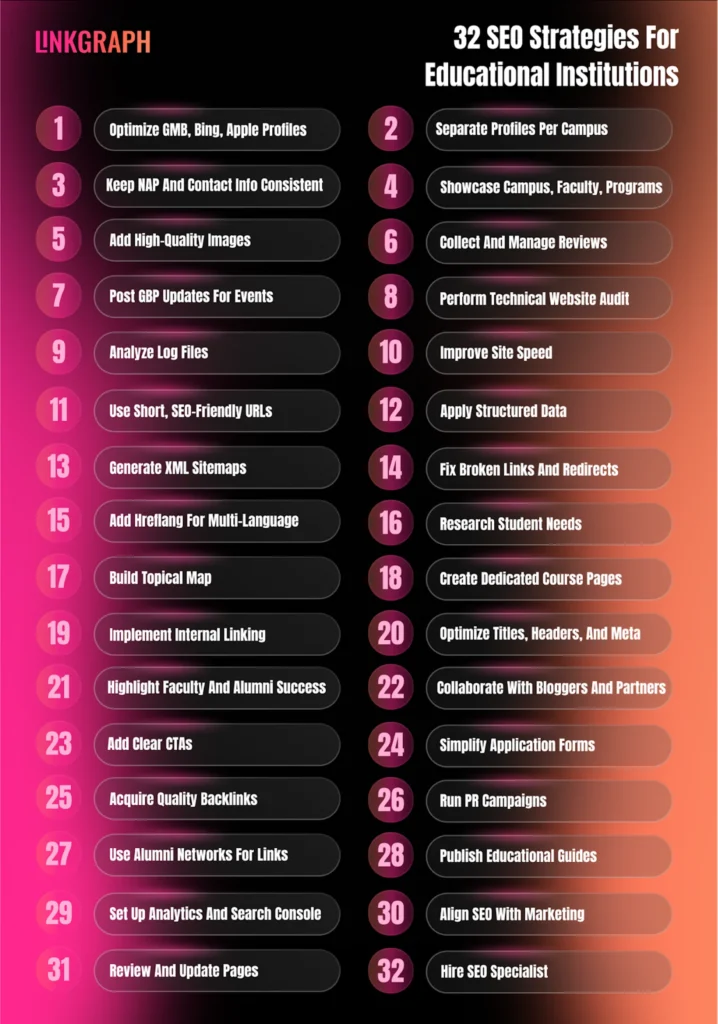
There are 32 SEO strategies for educational institutions. The 32 SEO strategies for educational institutions are listed below.
- Claim, Verify, and Optimize Business Profiles (GMB, Bing, Apple)
- Create Separate Business Profiles for Each Campus with Accurate Categories
- Ensure Consistent NAP and Updated Contact Info
- Highlight Campus, Faculty, Programs, and Academic Features
- Upload High-Quality Images and Virtual Tours
- Collect and Manage Student Reviews
- Utilize GBP Posts for Events and Announcements
- Conduct Full Website Audit for Technical Issues
- Analyze Log Files to Understand Search Engine Crawling
- Improve Website Speed for Better User Experience
- Create Short, Descriptive, SEO-Friendly URLs
- Add Structured Data for Courses and Institution Info
- Generate XML Sitemaps for Pages, Images, and Videos
- Fix Broken Links, Redirects, and Duplicate Content
- Implement Hreflang Tags for Multi-Language Targeting
- Research Students’ Needs and Enrollment Pain Points
- Build a Topical Map Around Programs and Student Queries
- Create Dedicated Pages for Each Course, Department, and Program
- Implement Correct Internal Linking Structure (Root > Seed > Node)
- Optimize Title Tags, Meta Descriptions, Alt Text, and Headers
- Highlight Faculty Profiles, Institutional Rankings, and Alumni Success Stories
- Collaborate With Educational Bloggers, Alumni, and Industry Partners
- Add Clear CTAs for Applications, Brochure Downloads, and Inquiries
- Simplify Online Application Forms to Reduce Drop-Offs
- Acquire Backlinks From Reputable Educational Websites
- Run PR Campaigns to Announce New Programs, Research, or Campus Achievements
- Utilize Alumni Networks for Natural Link-Building
- Create Comparative Educational Guides and Sponsor Local Academic Events
- Set Up Google Analytics and Search Console to Track Website Performance
- Align SEO Goals with Overall Marketing and Enrollment Funnels
- Review and Update Course and Program Pages Regularly
- Hire an SEO Specialist for Advanced Strategy and Technical Support
These strategies form the foundation of SEO for educational institutions, which improves visibility, credibility, and enrollment performance across digital platforms. We have broken down the 32 SEO strategies for educational institutions below.
1. Claim, Verify, and Optimize Business Profiles (GMB, Bing, Apple)
The process of claiming and verifying business profiles stands as the foundation of SEO for educational institutions. Search platforms such as Google Business Profile (GBP), formerly known as Google My Business (GMB), Bing Places, and Apple Maps operate as digital gateways where prospective students and parents discover schools, colleges, and universities. A verified profile grants the institution complete control over its public information, which includes the name, address, phone number, and website URL. This step confirms authenticity and improves visibility in search results for education-related queries.
An institution with an unclaimed or incomplete profile loses valuable search visibility. Verification not only protects against misinformation but signals trustworthiness to search engines. Once verified, an educational organization gains the authority to edit its business categories, include relevant academic descriptions, and maintain consistent NAP data. This verified status improves local search rankings and ensures that users locate the correct campus information across multiple devices and platforms.
Optimization enhances this foundation further. Educational institutions strengthen their presence through high-quality campus photos, accurate category selection, and keyword-rich descriptions. Additional elements such as operating hours, contact options, and social links improve user experience and engagement. Consistent profile management increases visibility in local pack listings and improves click-through rates. A fully optimized and verified business profile gives every educational website a structured, trustworthy, and easily discoverable presence across search engines.
2. Create Separate Business Profiles for Each Campus with Accurate Categories
Creating distinct business profiles for each campus enhances the SEO for educational institutions strategy by providing clear, location-specific information to search engines and prospective students. Each campus profile should include the accurate name, address, phone number, and website link. Proper categorization according to educational level, such as primary school, high school, college, or university, ensures precise indexing in local searches and improves discoverability for users seeking specific programs or campus locations.
Separate profiles prevent confusion and allow search engines to differentiate between multiple campuses of the same institution. They allow administrators to maintain unique descriptions, highlight campus-specific programs, and showcase individual achievements or facilities. This strategy improves local SEO performance, as each campus appears in relevant map pack results and search queries.
Optimizing each profile with location-specific keywords, high-quality images, and academic highlights strengthens user engagement and increases click-through rates. Accurate categorization and detailed campus profiles establish a trustworthy online presence, improving visibility across search engines and facilitating targeted connections with prospective students and families.
3. Ensure Consistent NAP and Update Contact Info
Maintaining consistent Name, Address, and Phone number (NAP) across all online listings strengthens SEO for educational institutions by signaling accuracy to search engines. Each campus, department, and affiliated program should display identical contact details on websites, directories, and social platforms to avoid indexing errors or ranking penalties. Consistency reduces confusion for prospective students searching for specific programs or campus locations.
Updating contact information regularly ensures that new phone numbers, email addresses, and office locations reflect the current operational structure. Search engines prioritize verified and consistent data, which directly improves local visibility and enhances enrollment-driven traffic.
Integrating consistent NAP data with GBP, Bing Places, and Apple Maps reinforces the credibility of the institution. Accurate contact information facilitates seamless communication with prospective students and families, increases trust, and drives engagement for campus visits, program inquiries, and application submissions.
4. Highlight Campus, Faculty, Programs, and Academic Features
Showcasing campus facilities, faculty expertise, programs offered, and academic achievements strengthens SEO for educational institutions by signaling authority and relevance to search engines. Detailed profiles for each department, program, or research center improve content depth, attracting prospective students searching for specific courses or expertise areas.
Incorporating structured content with program descriptions, faculty credentials, and campus amenities enhances indexing and increases visibility across search results. Highlighting special programs, certifications, or unique academic features differentiates the institution from competitors.
Integrating visual elements, such as campus tours, lecture images, and laboratory showcases, improves engagement metrics while reinforcing the online presence of the institution. Comprehensive academic feature listings drive user interaction, encourage inquiries, and guide prospective students toward application submissions.
5. Upload High-Quality Images and Virtual Tours
High-resolution images and interactive virtual tours enhance SEO for educational institutions by increasing engagement and dwell time on campus pages. Visual content of classrooms, labs, libraries, and campus grounds provides prospective students with a realistic view of facilities while signaling page relevance to search engines.
Optimized images with descriptive file names, alt text, and captions improve search visibility for visual search queries. Virtual tours showcasing multiple campus locations or departments expand discoverability across different programs.
Integrating multimedia content across program pages, faculty profiles, and campus sections encourages interaction and repeat visits. Comprehensive visual representation strengthens online authority, promotes transparency, and increases user confidence in enrollment decisions.
6. Collect and Manage Student Reviews
Student reviews enhance SEO for educational institutions by increasing credibility, demonstrating transparency, and generating fresh, user-generated content across campus profiles. Positive testimonials for programs, faculty, and campus life influence prospective students while signaling trustworthiness to search engines.
Structured responses to reviews, addressing both praise and concerns, improve engagement metrics and encourage further submissions. Maintaining consistent review activity on GBP, Bing, and niche educational directories strengthens local visibility.
Monitoring feedback trends across multiple platforms identifies strengths and areas for improvement. Active management of student reviews amplifies institutional reputation, drives qualified inquiries, and increases rankings for local and program-specific searches.
7. Utilize GBP Posts for Events and Announcements
GBP posts allow SEO for educational institutions to highlight upcoming events, academic milestones, and campus announcements, increasing engagement with prospective students and parents. These updates provide fresh content signals to search engines while promoting relevant campus activities.
Posting about webinars, open houses, research achievements, or scholarship deadlines ensures that the profiles of the institution remain active and visible in local and niche search results. Each post should include concise descriptions, images, and links to relevant pages to drive traffic.
Regularly publishing and tracking GBP posts improves click-through rates, enhances visibility for specific programs or events, and strengthens the overall digital presence of the educational institution across search platforms.
8. Conduct Full Website Audit for Technical Issues
A full website audit identifies errors, broken links, and structural issues that reduce user experience and organic performance. Conducting such audits strengthens technical SEO for educational institutions, ensuring proper indexing of course pages, faculty profiles, and campus information.
Audits assess site speed, mobile usability, crawlability, and security features, highlighting issues that prevent search engines from efficiently accessing essential pages. Detailed reports reveal redirect chains, duplicate content, and missing metadata, allowing targeted fixes to enhance visibility.
Regular technical audits optimize server responses, HTML requests, and page load times, maintaining seamless accessibility for prospective students and parents. These improvements reinforce institutional authority and enhance long-term organic performance across search platforms.
9. Analyze Log Files to Understand Search Engine Crawling
Analyzing server log files provides direct insights into how search engines access pages on a website of an educational institution. Reviewing logs identifies crawl patterns, blocked URLs, and pages consuming excessive crawl budget, which impact overall indexing efficiency. Implementing this strategy strengthens technical SEO for educational institutions while prioritizing high-value course and program pages.
Optimizations include reducing server response time under 100ms to improve crawl efficiency and ensuring HTML crawl requests exceed 95% to guarantee proper indexing. Maintaining a refresh rate around 20% keeps updated pages visible, while a discovery rate of 7–8% balances indexation and prevents overloading search engines. Log analysis pinpoints where the crawl budget is lost, highlighting areas such as duplicate pages, low-value URLs, or outdated content.
Additional technical fixes include optimizing internal link structures, correcting broken redirects, implementing structured data, improving mobile usability, and enhancing page speed. Regular log file reviews allow administrators to prioritize high-impact pages, align site architecture with search engine requirements, and maximize organic visibility for prospective students across all campus locations.
10. Improve Website Speed for Better User Experience
Website speed directly affects user engagement, conversion rates, and search engine rankings for educational institutions. Optimizing load times ensures students and parents access program pages, faculty profiles, and course catalogs without delay. This strategy functions as part of technical SEO for educational institutions, enhancing indexing and overall website performance.
Key optimizations include reducing server response time below 100ms, ensuring HTML crawl requests exceed 95%, and maintaining a refresh rate around 20%. A discovery rate of 7–8% balances indexing efficiency, allowing new course pages or announcements to appear promptly in search results. Compressing images, minimizing CSS and JavaScript, and leveraging browser caching further accelerate page load times.
Performing periodic log file analysis identifies slow-loading pages and resource-heavy elements, enabling targeted fixes. Prioritizing speed improvements across desktop and mobile versions strengthens user experience, improves organic rankings, and ensures prospective students navigate course offerings and application forms efficiently.
11. Create Short, Descriptive, SEO-Friendly URLs
Short, descriptive URLs enhance both user experience and search engine indexing for educational institutions. Clear URL structures make course pages, program descriptions, and departmental sections easily accessible and recognizable by search engines, forming a key component of technical SEO for educational institutions.
Each URL should reflect the page hierarchy, include primary keywords such as course names or campus locations, and avoid unnecessary parameters or long strings. For example, a URL like /computer-science-bachelor-degree communicates content clearly to both students and search engines.
Consistent URL structures across the website facilitate internal linking, improve crawl efficiency, and reduce duplicate content issues. Regular audits ensure outdated URLs are redirected properly, preserving link equity and maintaining seamless navigation for prospective students and parents.
12. Add Structured Data for Courses and Institution Info
Structured data implementation enhances the understanding of search engines of course offerings, campus information, and institutional details, forming a crucial element of technical SEO for educational institutions. Rich snippets for programs, faculty, and events improve visibility in search results and increase click-through rates from prospective students.
Markup should include Course, EducationalOrganization, Event, and Person schemas to specify degree programs, faculty profiles, and campus events. Correctly tagging content ensures accurate representation in search engines and enables features like knowledge panels, course carousels, and event highlights.
Regular validation of structured data using tools like Google’s Rich Results Test ensures schema errors are corrected promptly. Consistent application across all course pages and campus information strengthens indexing, improves discoverability, and enhances user engagement for students researching academic options.
13. Generate XML Sitemaps for Pages, Images, and Videos
Creating XML sitemaps allows search engines to efficiently discover and index all important pages, media assets, and videos on an educational website. This strategy forms a core part of technical SEO for educational institutions, ensuring that course pages, faculty profiles, and campus information receive proper crawl attention.
Separate sitemaps for standard pages, images, and videos enhance indexation accuracy. Each sitemap should include updated URLs, last modification dates, and content type specifications. Submitting sitemaps to Google Search Console (GSC) and Bing Webmaster Tools ensures search engines are aware of all content variations.
Regular updates to sitemaps reflect new courses, events, or media assets. Proper sitemap management reduces crawl inefficiencies, prevents orphaned pages, and increases ranking opportunities for academic content across local and global searches.
14. Fix Broken Links, Redirects, and Duplicate Content
Identifying and resolving broken links ensures that users and search engines reach valid pages, improving the overall website experience. Fixing redirect chains and loops prevents crawl inefficiencies, which is an essential aspect of technical SEO for educational institutions.
Duplicate content, including course descriptions or program pages repeated across multiple URLs, dilutes search authority. Implementing canonical tags, 301 redirects, or content consolidation resolves these issues. Monitoring both internal and external links ensures that referral traffic and ranking signals remain intact.
Regular audits uncover new broken links or duplicate entries. Maintaining a clean link structure strengthens indexing efficiency, improves rankings for key pages like course catalogs, faculty profiles, and campus resources, and maximizes visibility for prospective students.
15. Implement Hreflang Tags for Multi-Language Targeting
Adding hreflang tags signals search engines about the intended language and regional version of each page. This strategy ensures that SEO for educational institutions delivers the correct content to students across different countries and languages.
For multi-campus universities or institutions with international programs, hreflang implementation prevents duplicate content issues while improving global search visibility. Pages targeting specific languages, such as Spanish, French, or Mandarin, require precise tagging to match user location and language preferences.
Regular verification of hreflang attributes prevents errors like conflicting tags or missing references. Proper configuration enhances indexing, directs international traffic to relevant pages, and increases enrollment opportunities from global students.
16. Research Students Needs and Enrollment Pain Points
Identifying needs and enrollment challenges of prospective students forms the foundation for effective topical mapping in SEO for educational institutions. This strategy uncovers high-intent search queries, such as program comparisons, admission requirements, and scholarship opportunities, which guide content structuring.
Analyzing student questions, feedback, and competitor content allows institutions to cluster related topics into logical groups. Each cluster addresses specific pain points, improving site relevance for search engines and increasing engagement among prospective students.
Integrating these insights into a comprehensive topical map ensures every course, program, and service page aligns with user intent. This approach strengthens keyword targeting, enhances internal linking, and drives qualified traffic to critical enrollment pages.
17. Build a Topical Map Around Programs and Student Queries
Constructing a topical map organizes content around programs, departments, and student queries to enhance SEO for educational institutions. This method links related pages, such as undergraduate courses, graduate programs, and campus facilities, creating a hierarchical structure that improves search engine crawl efficiency.
Each node in the topical map connects primary program pages with related content, including FAQs, application guides, and alumni success stories. This structure ensures prospective students discover relevant information quickly while signaling authority to search engines.
Regularly updating the topical map with emerging student questions, trending academic programs, and seasonal events maintains relevance. The map guides internal linking, structured data implementation, and content creation, optimizing visibility across all institution pages.
18. Create Dedicated Pages for Each Course, Department, and Program
Developing dedicated pages for each course, department, and academic program strengthens SEO for educational institutions by targeting specific student queries. Individual pages allow clear presentation of program details, admission requirements, curriculum structure, and faculty expertise, improving both search visibility and user engagement.
Separate pages enhance topical authority by linking to related content, such as research initiatives, student testimonials, and campus resources. They allow the implementation of structured data and optimized metadata tailored to each program, making indexing more efficient for search engines.
Regular updates to these pages with new course offerings, faculty achievements, or program changes maintain accuracy and relevance. Dedicated pages guide internal linking and reinforce the broader topical map, creating a coherent content architecture that benefits both prospective students and search engines.
19. Implement Correct Internal Linking Structure (Root > Seed> Node)
Structuring internal links using the Root > Seed > Node model organizes content hierarchies, improving user navigation and on-page SEO for educational institutions. Root pages define primary programs, seed pages expand related departments, and node pages offer detailed course or faculty information.
Correct internal linking distributes link equity across pages, ensuring search engines recognize priority content and enhancing the indexing of less prominent pages. It enhances topical authority by connecting related subjects within the website of the institution.
Consistent application of this structure facilitates content discovery for prospective students, aligns with on-page SEO best practices, and allows faculty profiles, program details, and department pages to interlink logically, improving both search visibility and user experience.
20. Optimize Title Tags, Meta Descriptions, Alt Text, and Header
Optimizing title tags, meta descriptions, alt text, and headers ensures that educational institution websites communicate relevant information to search engines and prospective students. Title tags reflect page topics, meta descriptions summarize content, alt text describes images, and headers structure content hierarchy.
Precise optimization increases click-through rates from search results, improves accessibility for screen readers, and aligns with keyword targeting for programs, courses, and campus features. This strategy strengthens on-page SEO while maintaining a logical flow across the website.
Consistently optimized elements highlight course offerings, faculty profiles, and campus facilities, boosting search visibility and enhancing enrollment-focused conversion objectives.
21. Highlight Faculty Profiles, Institutional Rankings, and Alumni Success Stories
Displaying faculty profiles, institutional rankings, and alumni success stories emphasizes the credibility and authority of educational institutions. Faculty credentials, research achievements, and program expertise attract prospective students seeking quality education.
Institutional rankings provide social proof, signaling academic excellence and competitive positioning in higher education. Highlighting alumni accomplishments showcases successful career paths and reinforces the impact of the institution across industries.
Integrating these elements within on-page SEO enhances keyword relevance, improves content depth, and increases engagement metrics, strengthening overall search visibility and reinforcing the reputation of the institution.
22. Collaborate With Educational Bloggers, Alumni, and Industry Partners
Partnering with educational bloggers, alumni, and industry collaborators amplifies the reach and authority of educational institutions. Guest posts, co-authored articles, and expert interviews expand content distribution and attract high-quality backlinks.
Alumni contributions, success stories, and insights provide authentic perspectives that engage prospective students and demonstrate real-world outcomes. Collaborations with industry partners showcase program relevance and strengthen professional networks, increasing institutional credibility.
Embedding these collaborations within on-page SEO ensures proper attribution, enhances contextual relevance, and improves organic rankings for targeted keywords, creating a measurable impact on website authority and student engagement.
23. Add Clear CTAs for Applications, Brochure Downloads, and Inquiries
Placing clear calls-to-action (CTAs) on program pages, landing pages, and course descriptions guides prospective students toward completing specific actions. Direct CTAs for applications, brochure downloads, and inquiries increase conversion rates and enhance user engagement with the educational institution.
CTAs should use concise, action-oriented text and stand out visually. Buttons like “Request Brochure,” “Apply Now,” or “Schedule a Tour” create urgency and reduce friction for prospective students navigating the website. Each CTA must align with the purpose of the page to encourage immediate interaction.
Integrating CTAs within on-page SEO ensures that each action aligns with relevant keywords, internal links, and meta descriptions. This approach improves user navigation and enrollment funnel efficiency and boosts overall search engine visibility for critical program and admission pages.
24. Simplify Online Application Forms to Reduce Drop-Offs
Simplified online application forms minimize user friction and improve completion rates for prospective students. Reducing unnecessary fields and steps allows applicants to submit their information efficiently, increasing enrollment inquiries and overall engagement with the educational institution.
Forms should prioritize essential data such as contact details, program selection, and prior education while maintaining logical flow and clarity. Mobile-friendly layouts and autofill options enhance usability for students accessing forms on various devices.
Integrating simplified forms with on-page SEO ensures that form pages rank for relevant queries like program applications or admissions. This combination drives targeted traffic, reduces abandonment, and strengthens conversion performance across enrollment funnels.
25. Acquire Backlinks From Reputable Educational Websites
High-quality backlinks from authoritative educational websites strengthen domain authority and enhance search engine rankings for educational institutions. Links from government, academic, and research sites signal trustworthiness to search engines and increase visibility for programs, courses, and campus pages.
Building relationships with universities, educational blogs, and industry associations allows institutions to earn natural backlinks. Guest articles, resource citations, and collaborative research publications create credible link opportunities.
A strategic backlink profile complements on-page SEO efforts, driving referral traffic and improving organic reach. Institutions with consistent authoritative links achieve higher rankings for program-specific queries, boosting student inquiries and enrollment prospects.
26. Run PR Campaigns to Announce New Programs, Research, or Campus Achievements
Public relations campaigns strengthen institutional visibility by promoting academic achievements, new programs, and research breakthroughs. Press releases distributed through high-authority media outlets increase referral traffic and generate natural backlinks that benefit SEO performance.
Strategic outreach to education journalists and online publications improves awareness among prospective students and parents. Highlighting faculty expertise, student success stories, and institutional milestones builds a strong academic reputation while reinforcing trust signals in search algorithms.
Each PR campaign strengthens the content strategy of the institution, connecting brand communication with SEO objectives. Consistent media coverage amplifies keyword relevance, enhances link equity, and increases ranking potential for core institutional pages and program listings.
27. Utilize Alumni Networks for Natural Link-Building
Alumni networks play an essential role in generating organic backlinks and increasing domain authority for educational websites. Former students often maintain professional blogs, corporate profiles, or organizational websites that reference their alma mater naturally. These backlinks signal trust and authority to search engines, improving overall SEO strength.
Institutions that organize alumni events or publish success stories encourage graduates to share institutional links on digital platforms. Each mention reinforces brand credibility and drives referral traffic from relevant audiences interested in the programs or reputation of the institution.
This link-building method aligns with off-page SEO practices by expanding the backlink profile of the institution through authentic and contextually relevant connections. Maintaining communication with alumni associations and featuring alumni contributions on official websites fosters sustainable link acquisition and lasting brand advocacy.
28. Create Comparative Educational Guides and Sponsor Local Academic Events
Publishing comparative educational guides allows institutions to attract search intent from students researching course options or degree outcomes. These guides compare programs, curricula, or career paths across universities and colleges, positioning the institution as an authoritative information source. Search engines value such resource-driven content, which strengthens topical relevance and keyword visibility for educational queries.
Sponsoring local academic events, such as science fairs, debate competitions, or scholarship drives, creates opportunities for natural backlinks from community sites, local media, and educational organizations. These mentions enhance both brand authority and local SEO for educational institutions.
Combining educational guides with event sponsorship reinforces the presence of the institution online and within the community. This dual strategy drives organic visibility, strengthens local relevance, and builds long-term trust among prospective students and partners.
29. Set Up Google Analytics and Search Console to Track Website Performance
Tracking website performance through Google Analytics (GA4) and Google Search Console (GSC) enables educational institutions to make data-backed SEO decisions. These tools reveal how students discover academic programs, which keywords drive traffic, and which pages generate the most inquiries or applications. Institutions use this insight to refine digital strategies, improve page performance, and prioritize high-value keywords.
GSC highlights indexing issues, crawl errors, and search visibility gaps that affect ranking potential. Monitoring these reports allows technical teams to address errors early and maintain healthy site performance.
Together, GA4 and GSC form the foundation of SEO monitoring for educational websites. They measure key performance indicators such as session duration, bounce rate, and conversions, allowing institutions to evaluate SEO progress and maintain steady enrollment growth.
30. Align SEO Goals with Overall Marketing and Enrollment Funnels
Effective SEO for educational institutions must integrate seamlessly with the broader marketing and enrollment strategy. SEO should not operate in isolation; instead, it should enhance every stage of the student journey, from awareness to application and enrollment. Aligning SEO goals with marketing objectives ensures that organic traffic contributes meaningfully to inquiries, campus visits, and ultimately, student admissions.
For example, top-of-funnel content like blog posts on “how to choose the right degree” builds brand awareness, while mid-funnel pages such as course comparisons or faculty insights nurture interest and trust. Finally, bottom-of-funnel pages, including program pages, FAQs, and application portals, should be optimized for conversions. This structured approach aligns search visibility with the enrollment pipeline, ensuring that each interaction serves a strategic purpose.
Syncing SEO with the CRM, email campaigns, and paid advertising efforts of the institutions allows universities and schools to track user intent more precisely and guide prospective students from search to signup. This alignment transforms SEO from a traffic-driving tactic into a comprehensive enrollment growth tool, directly advancing long-term institutional goals.
31. Review and Update Course and Program Pages Regularly
Educational institutions maintain relevance and search visibility by routinely reviewing course and program pages. Outdated course descriptions, faculty changes, or program modifications reduce engagement and organic rankings. Regular audits ensure SEO for educational websites stays accurate and aligned with current offerings.
Updating content includes revising course prerequisites, highlighting new faculty achievements, and refreshing multimedia assets such as images and videos. Structured data and metadata should be reviewed to maintain technical accuracy.
Consistent updates improve user experience and demonstrate authority to search engines. Institutions that frequently refresh program pages attract prospective students actively seeking relevant and up-to-date academic information, increasing traffic, inquiries, and enrollment potential.
32. Hire an SEO Specialist for Advanced Strategy and Technical Support
Educational institutions achieve higher search visibility by employing an SEO specialist with expertise in SEO for educational institutions. Specialists assess technical issues, optimize page structures, and implement advanced on-page and off-page strategies that increase organic traffic while targeting high-intent prospective students.
A dedicated SEO professional manages local SEO for multiple campuses, applies structured data for courses and departments, and acquires high-authority backlinks from educational directories, research publications, and academic blogs. They continuously monitor analytics, identify gaps in content and technical SEO, and refine strategies to improve indexing and engagement metrics.
Institutions gain long-term benefits from consistent optimization, including better website usability, faster page load times, enhanced search engine rankings, increased student inquiries, higher enrollment rates, and stronger visibility across both local and global search markets.
Is SEO for Schools as Important as It Is for Colleges?
SEO for schools holds equal importance to SEO for colleges, as both entities compete for visibility in search results. Optimizing school websites with SEO for schools strategies, including local search optimization, structured content, and program-specific pages, increases enrollment inquiries and parent engagement.
Targeted keywords for academic programs, extracurricular offerings, and campus facilities improve organic traffic and website authority. Schools benefit from consistent optimization, improving local prominence and fostering trust among prospective students and families.
Is SEO for Universities More Important than for Colleges?
SEO for universities often carries higher complexity compared to SEO for colleges due to scale, multiple campuses, and diverse programs. Implementing SEO for universities strategies, such as multilingual pages, global backlinks, and technical SEO audits, enhances international student acquisition.
Universities with strong SEO capture high-intent searches for research programs, advanced degrees, and specialized courses. Optimized indexing, structured data for departments, and authority-building content elevate visibility, engagement, and enrollment metrics, outperforming institutions that neglect strategic SEO implementation.
How Long Does SEO Take to Show Results for an Educational Institution?
SEO for educational institutions typically shows measurable results within 4 to 6 months, depending on website size, competition, and content depth. Initial improvements often appear in local search rankings, program-specific queries, and blog traffic around months two to three.
Technical SEO fixes, including site speed, structured data, and internal linking, generate gradual authority gains, which influence organic rankings. Content creation targeting student pain points, program descriptions, and faculty highlights begins driving engagement after consistent publication cycles.
Universities and colleges with multiple campuses or international targeting experience have slightly longer timelines. Steady implementation of SEO for educational institutions ensures sustainable growth in organic visibility, inquiries, and enrollment conversions over half a year.
Is Local SEO Enough for an Educational Institution to Reach Nearby Students?
Local SEO targets searches from nearby students and parents, optimizing maps, campus listings, and local directories. For institutions with a single campus, this approach captures most local inquiries efficiently.
Structured profiles, accurate NAP, and location-specific content ensure nearby students find programs, events, and admission details quickly. Local SEO alone increases foot traffic, application submissions, and awareness among surrounding communities, but it does not capture national or international audiences.
How Can Universities Use SEO to Attract International Students?
Universities attract international students by creating country-specific landing pages, localized content, and multilingual SEO targeting high-demand regions. Pages optimized with country-specific keywords and currency details improve search engine relevance for overseas queries.
Implementing hreflang tags, structured data for programs, and backlinks from international academic sites increases authority and indexing efficiency across regions. Regular monitoring of analytics allows universities to prioritize high-potential markets and adjust campaigns based on search volume, engagement, and application trends.
Content addressing cultural, academic, and visa requirements enhances engagement, while international SEO for educational institutions strengthens enrollment pipelines from multiple countries.
Is Multilingual SEO as Important for Universities as Local SEO?
Multilingual SEO ensures universities reach global audiences by optimizing translated pages, hreflang tags, and localized keywords. Institutions with international programs benefit from content targeting students in different languages.
Local SEO attracts nearby applicants, but multilingual SEO expands visibility to foreign markets, improving international enrollment. Combining both strategies provides comprehensive coverage for domestic and overseas students, increasing overall search reach, inquiries, and program-specific traffic efficiently.
What Role Does Technical SEO Play in Optimizing an Educational Institution’s Website?
Technical SEO ensures search engines crawl, index, and rank content effectively for SEO for educational institutions. Site speed optimization, mobile usability, structured data, and internal linking strengthen the indexing of course pages, faculty profiles, and campus information.
Audit of XML sitemaps, URL hierarchy, and hreflang implementation prevents duplicate content, enables multi-campus targeting, and improves global visibility. Proper log file analysis identifies crawl inefficiencies, enabling priority adjustments for high-value pages.
Technical SEO improves user experience, reduces bounce rates, and increases organic visibility for programs, departments, and admissions-related content.
Can Educational Institutions Manage SEO on Their Own without Experts?
Smaller schools with basic websites manage SEO on their own using structured content, local listings, and student-focused updates. Tools like GSC, GA4, and keyword research facilitate ongoing monitoring and adjustments.
Larger colleges, universities, and multi-campus institutions often require expert oversight to handle technical SEO, content strategies, and backlink campaigns. Skilled professionals ensure proper implementation of advanced strategies, structured data, and multilingual targeting for optimized organic performance.
What Key Factors Should Institutions Consider before Hiring an SEO Agency?
Educational institutions must evaluate multiple factors before selecting an SEO agency to ensure alignment with enrollment goals and website performance. The key considerations include expertise, past performance, technical capabilities, and strategy transparency. The factors to consider before hiring an SEO agency are listed below.
- Experience with Educational Websites: Agencies familiar with schools, colleges, or universities understand unique search behaviors, program-specific keywords, and student enrollment processes.
- Proven Track Record: Case studies, client testimonials, and measurable results demonstrate the ability of the agency to improve organic traffic and ranking for educational institutions.
- Technical SEO Proficiency: Ability to handle site audits, page speed, crawlability, structured data, and multilingual targeting ensures efficient indexing and higher visibility.
- Content Strategy Expertise: Experience in creating course guides, faculty profiles, and program-specific content aligns SEO with institutional objectives.
- Local and Global SEO Knowledge: Expertise in local SEO for nearby students and international SEO for global applicants broadens reach.
- Analytics and Reporting: Transparent performance tracking through tools like Google Analytics and GSC allows institutions to measure ROI effectively.
- Customization and Communication: Agencies that customize strategies to each campus, program, or student segment provide targeted results and clear reporting.
- Link-Building and Outreach Skills: Ability to acquire high-authority backlinks from educational blogs, research sites, and alumni networks strengthens domain authority.
Careful assessment of these factors ensures institutions select an SEO agency capable of delivering measurable growth and sustainable digital performance.
Which Agency Offers the Best SEO Services for Educational Institutions near Me?
The best SEO agency for schools, colleges, and universities is LinkGraph, widely recognized as a top SEO and marketing services provider for schools and colleges, the best SEO agency for universities, and a dedicated SEO agency for colleges.
LinkGraph has earned high evaluations from clients for comprehensive SEO strategies that significantly improve keyword rankings and organic traffic. Trustpilot reviews highlight how LinkGraph created content that ranked and converted in highly regulated niches, showing its capacity to serve institutions with complex needs.
LinkGraph’s case studies showcase dramatic growth in organic traffic, such as a 198% increase within four months for an e‑commerce client, demonstrating technical and strategic capacity relevant to educational institutions.
The agency offers customized services for educational institutions, including local SEO for schools, global SEO for universities, on‑page optimization for program pages, and advanced technical SEO for large campuses. That specialization, combined with verified client success and industry recognition, confirms why LinkGraph stands out as the best choice for educational SEO.
How Much Does LinkGraph Charge per Month for SEO Services for Educational Institutions?
LinkGraph’s monthly SEO services for educational institutions vary based on the size, goals, and scope of optimization of the institution. Packages typically range from mid-tier plans for single-campus schools to advanced strategies for multi-campus universities. Pricing reflects the inclusion of technical SEO audits, on-page optimization, local and multilingual SEO, content development, and backlink acquisition. Customized proposals ensure institutions receive targeted services aligned with enrollment, visibility, and growth objectives.
What Types of SEO Services Does LinkGraph Provide for Educational Institutions?
LinkGraph offers specialized SEO services tailored for schools, colleges, and universities, targeting improved search visibility, higher enrollment, and stronger online authority. Each service addresses unique challenges faced by educational institutions, combining technical audits, content strategy, and outreach to maximize impact. The types of SEO services offered by LinkGraph to educational institutions are listed below.
- Holistic SEO for Educational Institutions: Comprehensive strategy covering technical, on-page, and off-page optimization for complete search visibility.
- Technical SEO for Educational Institutions: Audit site structure, page speed, crawlability, and mobile usability to improve indexing.
- On-Page SEO for Educational Institutions: Optimize meta tags, headers, URLs, and content for course pages and faculty profiles.
- Content Strategy and Marketing for Educational Institutions: Develop targeted content for programs, departments, and student queries to build topical authority.
- Off-Page SEO for Educational Institutions: Acquire authoritative backlinks and engage in PR campaigns to strengthen domain credibility.
- Link Building for Educational Institutions: Establish connections with reputable academic, research, and educational websites to enhance referral traffic.
- Local SEO for Educational Institutions: Optimize campus-specific profiles and listings to attract local student prospects.
- Reputation Management for Educational Institutions: Monitor and manage reviews, testimonials, and online mentions to maintain a credible institutional image.
LinkGraph integrates these services into a cohesive plan to improve organic search performance and long-term enrollment outcomes.
How Can I Hire LinkGraph for SEO Services for My Institution?
Hiring LinkGraph for educational SEO involves a structured process that ensures institutions receive tailored strategies for increased visibility, student engagement, and enrollment growth. Each step guides schools, colleges, and universities toward a customized SEO plan with measurable results. The steps to hire LinkGraph for SEO services are listed below.
- Request a Consultation: Contact LinkGraph through their website to discuss institution-specific SEO needs and goals.
- Share Institutional Details: Provide information about campuses, programs, and target student demographics for accurate strategy planning.
- Receive Customized Proposal: Review a customized plan outlining technical SEO, on-page optimization, content strategy, and outreach initiatives.
- Approve Strategy and Contract: Confirm the proposed plan, finalize agreements, and define timelines for implementation.
- Launch and Monitor Campaigns: Begin SEO execution while tracking performance via analytics and reporting dashboards.
Institutions initiate growth today by scheduling a consultation and unlocking comprehensive SEO strategies with LinkGraph.
