SEO for Insurance Companies, including insurance agencies, focuses on increasing online visibility, attracting qualified leads, and driving conversions for both local and broader markets. Insurance SEO involves optimizing websites, business profiles, and content to rank highly for targeted search queries relevant to policies, coverage, and local insurance needs. Insurance agency SEO combines technical, on-page, off-page, and local SEO strategies to build authority, credibility, and sustainable organic traffic that converts into clients.
Implementing insurance SEO delivers multiple advantages, such as generating cost-effective leads, improving trust through high search rankings, and dominating local or niche markets. SEO services for insurance agencies enhance content relevance, keyword targeting, and site architecture, resulting in better search engine recognition and user engagement. Insurance SEO ensures consistent traffic, higher conversion potential, and measurable long-term ROI.
Selecting the right SEO provider is vital. Expert SEO services for insurance companies, including agencies and brokers, offer tailored strategies, link building, content marketing, and technical optimization. The correct partner aligns SEO campaigns with business objectives, maximizes online presence, and drives client acquisition efficiently, establishing a competitive advantage in a complex insurance sector.

What Does SEO Mean for Insurance Agencies?
Search Engine Optimization for insurance agencies, referred to as SEO for insurance agents or SEO for insurance brokers, is the process that increases the online visibility of an agency across major search engines. SEO for Insurance Companies allows insurance professionals to appear for high-intent queries related to coverage, policy comparisons, and financial protection services. SEO for insurance agencies improves website performance, keyword relevance, and search visibility, which leads to stronger client acquisition and sustained organic growth.
SEO for insurance companies establishes a steady flow of qualified leads by aligning keyword strategy, technical optimization, and local visibility. Insurance agents who apply structured optimization methods attract potential clients who are actively comparing insurance plans or evaluating providers in their area. Through content refinement, metadata optimization, and mobile responsiveness, SEO for insurance firms strengthens credibility and builds consistent brand recognition.
SEO for insurance professionals extends beyond rankings. It creates measurable business value through increased inquiries, stronger authority signals, and lasting visibility in competitive regional and national markets. Each optimized page acts as a digital representative of the trustworthiness and expertise of the agency, encouraging clients to engage confidently with the brand.
Is SEO Really Important for Insurance Companies?
SEO for insurance companies, referred to as SEO for insurance agencies or SEO for insurance brokers, is extremely important and constitutes a core component of a digital marketing strategy. Insurance agencies that implement SEO strategies achieve higher visibility in search engine results, attracting potential clients actively seeking coverage, quotes, or policy comparisons. A strong SEO presence ensures that insurance agencies appear for relevant, high-intent searches, resulting in qualified leads that are more likely to convert into paying customers.
SEO for insurance agencies builds trust and credibility. Agencies ranking consistently in top search positions signal authority, reliability, and professionalism to prospective clients. Optimized websites with clear structure, fast loading times, mobile responsiveness, and accurate metadata reinforce this perception. Local SEO techniques, including optimized business profiles and local citations, enable insurance agencies to dominate regional markets and appear in proximity-based searches, giving them an edge over competitors.
Investing in SEO for insurance firms provides a cost-effective long-term strategy for customer acquisition, outperforming paid advertising in ROI over time. Agencies without an SEO strategy risk losing visibility, leads, and market share, highlighting the necessity of targeted, structured search optimization in a competitive insurance sector.
What Are the Key Advantages of Implementing SEO for Insurance Companies?
The key advantages of implementing SEO for insurance companies include improved visibility, targeted lead generation, and measurable business growth. Optimizing search presence benefits agencies, brokers, and insurance firms by connecting them with prospective clients actively seeking insurance solutions. The key benefits of implementing SEO for Insurance Companies are listed below.
- Increased Online Visibility: SEO for insurance agencies ensures higher rankings for relevant queries, attracting potential clients searching for policies.
- Targeted, Qualified Leads: SEO for insurance brokers captures high-intent searchers, generating leads more likely to convert into customers.
- Cost-Effective Marketing: SEO for insurance companies delivers sustainable, long-term traffic without continuous ad spend, improving ROI compared to paid campaigns.
- Enhanced Trust and Credibility: Insurance SEO demonstrates authority through consistent top rankings, optimized content, and expert-led pages, establishing agency reliability.
- Local Market Advantage: Local SEO for insurance agencies highlights nearby services, improving rankings for geographic-specific searches like “home insurance in [City].”
- Competitive Edge: SEO for insurance firms allows smaller or regional agencies to compete with large carriers by targeting niche, high-value keywords.
Implementing SEO for insurance agencies enhances visibility, strengthens trust, generates high-quality leads, and positions firms to outperform competitors effectively.
Is SEO for Insurance Agencies the Same as SEO for Insurance Agents?
SEO for insurance agencies differs significantly from SEO for insurance agents in terms of scope, target, and execution. SEO for insurance agents focuses primarily on local SEO for insurance agents, targeting highly specific geographic areas to attract nearby clients actively searching for policies. Individual insurance agents benefit from optimizing a single Google Business Profile, maintaining consistent business citations, and publishing locally relevant content.
SEO for insurance agencies requires a broader strategy that includes regional, national, and multiple local markets. Larger insurance agencies invest in seo service for insurance agent campaigns that target competitive, high-volume keywords alongside local terms. This strategy includes managing multiple location profiles, creating authoritative content across a wide range of insurance topics, and earning high-authority backlinks from financial and insurance publications.
Implementing customized SEO for insurance agents ensures visibility in the local “map pack,” generates qualified local leads, and strengthens competitive positioning. SEO for insurance agencies addresses multi-location reach, authority building, and high-volume lead generation for broader market influence.
Is SEO for Insurance Companies the Same as SEO for Insurance Brokers?
SEO for insurance companies differs from SEO for insurance brokers in scale, targeting, and content strategy. SEO for an insurance broker focuses on local SEO for insurance brokers, emphasizing hyper-local targeting to attract clients in specific cities or neighborhoods. Brokers benefit from optimizing a single Google Business Profile, maintaining consistent NAP (Name, Address, Phone) citations, and creating localized content that addresses regional insurance needs and regulations.
In contrast, SEO for insurance companies involves a broader, multi-layered strategy that addresses regional or national search demand. A comprehensive seo service for an insurance broker campaign includes optimizing multiple location profiles, producing authoritative content covering diverse insurance products, and acquiring high-quality backlinks from reputable industry sources. Insurance companies often manage several offices or branches, requiring coordinated technical SEO, structured content hierarchies, and multi-location local SEO implementation.
Implementing customized SEO for insurance brokers ensures a stronger local presence, higher conversion from nearby searches, and improved visibility in competitive local markets, while insurance company SEO drives broader market authority and multi-location lead generation.
How Can Insurance Companies Get Started with SEO Effectively?
To get started effectively with SEO, insurance companies should focus on local optimization, technical health, on-page improvements, content strategy, and performance tracking. These steps establish visibility, attract qualified leads, and build long-term authority in their target markets.
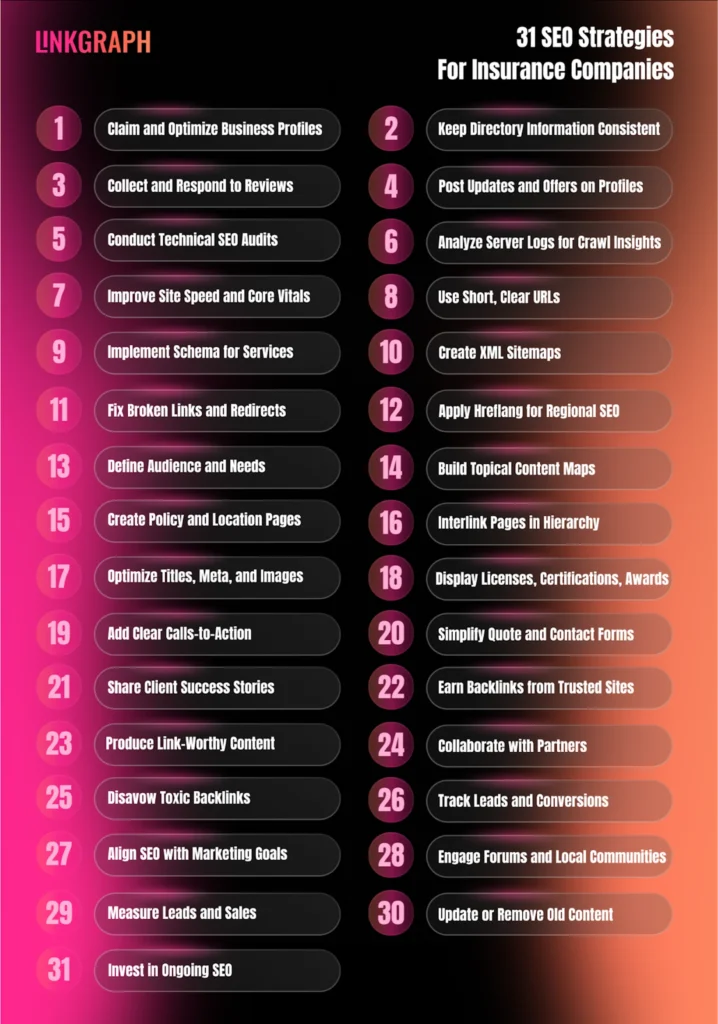
There are 31 SEO strategies for Insurance Companies. The 31 SEO strategies for Insurance Companies are listed below.
- Claim, Verify, and Optimize Business Profiles on GBP, Bing, and Apple to Appear Accurately in Local Searches
- Keep Business Information Consistent Across All Directories to Maintain Credibility and Prevent Indexing Errors
- Encourage Customer Reviews and Respond Regularly to Build Trust and Improve Local Search Rankings
- Use Business Profile Posts to Announce Offers and Updates, Signaling Activity to Search Engines
- Conduct a Technical SEO Audit to Fix Crawl and Indexing Issues, Ensuring Search Engines Can Access All Pages
- Review Server Logs to Understand How Search Engines Navigate Your Site and Identify Crawl Bottlenecks
- Improve Site Speed and Core Web Vitals to Deliver a Smooth, Secure User Experience
- Use Short, Structured URLs for Clarity, Navigation Ease, and Better Indexation
- Implement Schema Markup for Business Details, Services, and Reviews to Enhance SERP Visibility
- Create Compact XML Sitemaps for Articles, Services, and Media to Improve Page Discovery
- Fix Broken Links, Redirect Errors, and Duplicate Content Issues to Maintain Site Authority
- Use Hreflang Tags to Target Regional or Multilingual Audiences Accurately
- Define Your Target Audience and Their Key Insurance Needs to Align Content Strategy
- Construct Proper Topical Map Based on Your Source Context to Guide Internal Linking and Content Hierarchy
- Create Pages for Policy Types and Important Locations to Attract Specific Search Intents
- Interlink Pages Following Correct Hierarchy (Root → Seed → Node) for Optimal Crawl Efficiency
- Optimize Each Page Title, Meta Description, and Image Alt Text for Targeted Keywords
- Showcase Licenses, Certifications, Awards, and Trusted Partnerships to Enhance Authority
- Add Clear Calls-to-Action Like “Get a Quote” or “Speak to an Agent” to Drive Conversions
- Simplify Quote and Contact Forms to Increase Form Submissions
- Share Client Success Stories and Real-Life Case Studies to Demonstrate Expertise
- Earn Backlinks From Trusted Finance and Other Insurance Websites to Boost Domain Authority
- Create Link-Worthy Insurance Content and Resources to Attract Natural Citations
- Collaborate With Industry Partners, Agents, and Associations to Expand Reach and Influence
- Monitor and Disavow Toxic Backlinks to Maintain Link Profile Quality
- Set Up Analytics Tools to Track Traffic, Leads, and Conversions for Measurable Outcomes
- Align SEO Goals With Marketing and Sales Objectives for Integrated Growth
- Engage With Insurance Forums and Local Business Communities to Build Presence and Relationships
- Measure Success Through Qualified Leads and Policy Sales to Evaluate ROI
- Update or Remove Outdated Content to Maintain Relevance and Search Performance
- Invest in Ongoing SEO Strategy for Continuous Growth and Improved Long-Term Visibility
Following these structured steps enables insurance companies to implement effective SEO, generate qualified leads, and establish sustainable online authority. We have broken down the 31 SEO strategies for Insurance Companies below.
1. Claim, Verify and Optimize Business Profiles (GBP, Bing, Apple)
Claiming and verifying Business Profiles on Google Business Profile (GBP), Bing Places, and Apple Business Connect establishes a credible digital identity for an insurance company or insurance agency. This strategy strengthens local visibility because search engines rely on verified data when determining which insurers deserve placement in map results. A complete profile demonstrates legitimacy, clarity, and customer-readiness, which directly influences how search engines evaluate trustworthiness.
This approach holds significant importance for insurance companies competing in local markets. Search engines prioritize entities that maintain accurate information, strong relevance signals, and active engagement on their profiles. An insurance company benefits through higher local pack rankings, improved click-through rates, and increased visibility for high-intent searches such as “home insurance agency in [city]” or “Medicare insurance agent nearby.” Profiles with strong optimization encourage better user interaction, which indirectly improves ranking strength.
An effective implementation requires profile verification, selection of precise business categories, addition of service descriptions, upload of professional images, and regular posting of updates or offers. GBP Manager, Bing Places, and Apple Business Connect manage these tasks efficiently. A profile strengthened with consistent NAP details, positive reviews, and service-focused enhancements typically produces higher map placement, greater lead volume, and stronger overall local authority.
2. Keep Your Business Information Consistent Across All Directories
Business information consistency across online directories strengthens the credibility of an insurance company and ensures that search engines confidently match the business to local searches. This strategy focuses on maintaining identical NAP details (Name, Address, Phone Number) wherever the company appears. Any variation creates uncertainty for algorithms and users, which weaken local authority and lead to reduced visibility in map results and localized insurance queries.
Insurance companies rely on trust, and inconsistent listings often signal poor reliability. A mismatched phone number or outdated address creates confusion that cause search engines to suppress rankings or split citation authority across multiple variations of the same business. Insurance companies that maintain uniform information across all directories generally experience stronger local pack rankings, improved search relevance, and better placement for high-intent terms such as auto, home, or life insurance services.
Correction requires reviewing existing listings, identifying inconsistencies, and updating every platform with identical business data. Directory-management tools scan and synchronize listings at scale. An accurate and unified citation profile improves local ranking stability, increases consumer confidence, and reduces missed opportunities caused by misinformation. A quick best practice: maintain one master NAP reference internally so every future listing remains perfectly aligned.
3. Encourage Customer Reviews and Respond to Them Regularly
Customer reviews act as powerful trust signals that influence both search visibility and buyer decisions. This strategy focuses on building a steady flow of authentic feedback across major business profiles, because reviews allow search engines to evaluate credibility, authority, and the overall experience provided by an insurance company. Review activity often correlates with stronger local rankings, especially for keywords related to auto, home, health, and life insurance services in specific regions.
Insurance companies depend heavily on reputation, and a profile with frequent positive reviews outranks competitors with low engagement. Search engines use review quantity, quality, and recency as indicators of relevance, which means active review generation improves the likelihood of appearing in map results and local intent searches. Responding to each review signals professionalism and transparency, which reinforces trust for new prospects.
Effective execution requires encouraging satisfied clients to leave feedback after policy approvals, claims, or consultation calls. Category-based review-management tools assist with tracking, alerts, and response organization. Insurance companies that follow this approach usually notice higher engagement rates, stronger local authority, and increased quote requests. A quick tip: craft a simple review request script for agents to use after successful customer interactions.
4. Use Business Profile Posts to Announce Offers and Updates
Business profile posts for insurance agencies announce offers, updates, and service changes, increasing engagement and search visibility. Regular updates signal relevance to search engines and communicate active management, which enhances credibility for local insurance providers. Agencies that post frequently demonstrate responsiveness, authority, and transparency, building trust with prospective clients.
Insurance profile updates should highlight promotions, seasonal coverage, policy additions, or company news. Each post requires a concise headline, informative description, and visual elements such as images or short videos. Structuring posts with clear categories, such as auto, home, or life insurance, ensures content aligns with user intent and improves discoverability in local searches.
Analytics tools for engagement tracking measure click-through rates, interactions, and inquiry conversions. Insurance agencies that maintain consistent posting schedules with relevant updates typically achieve improved local search rankings, increased profile engagement, and higher qualified lead flow. Regular announcements reinforce the authority of the agency and demonstrate responsiveness in a competitive insurance market.
5. Conduct Technical SEO Audit to Fix Crawl and Indexing Issues
Conducting a technical SEO audit identifies crawl, indexation, and security issues, forming a foundational step in the search optimization efforts of any insurance company. Technical SEO audits reveal performance bottlenecks, site architecture flaws, and indexing obstacles that affect how search engines discover and rank content. A thorough audit ensures that all critical insurance service pages, policy descriptions, and local landing pages are visible in search results and accessible to both users and search engine crawlers.
Auditors should reduce server response time to under 100ms, ensuring pages load quickly for visitors and search engines alike. HTML crawl requests should exceed 95% to guarantee efficient indexing of primary pages. Maintaining a refresh rate around 20% allows search engines to reprocess updated content without overloading the crawl budget. A discovery rate of 7–8% ensures new or updated insurance content is promptly recognized by search engines. Performing a log file analysis identifies where most of the crawl budget is lost, allowing agencies to prioritize pages that drive conversions.
Additional technical SEO fixes include verifying structured data implementation, resolving redirect chains, eliminating duplicate content, securing HTTPS protocols, optimizing XML sitemaps, cleaning broken links, enhancing mobile usability, and monitoring canonical tags. Insurance agencies that systematically address these elements achieve faster indexing, higher local and national search rankings, and improved organic traffic quality. Quick tips include scheduling audits quarterly and maintaining a prioritized checklist for continuous technical optimization.
6. Review Server Logs to See How Search Engines Access Your Site
Reviewing server logs analyzes how search engines access and crawl the website of an insurance agency, forming a core part of technical SEO. Server log analysis provides precise insight into which pages search engines visit, the frequency of crawling, and the response codes returned, revealing potential indexing problems. Insurance agencies identify whether critical policy pages, local office landing pages, or service content receive adequate crawl attention, allowing targeted optimization of the website structure.
Auditing server logs highlights anomalies such as repeated 404 errors, slow-loading endpoints, or pages with blocked resources. Agencies observe crawler patterns for desktop and mobile user agents to ensure proper rendering and indexing. This process reveals low-priority pages consuming excessive crawl budget, allowing teams to adjust internal linking, robots.txt rules, and sitemap prioritization.
Practical implementation involves grouping log data by URL, response code, and crawl frequency, then analyzing trends over time. Insurance agencies gain actionable insights into under-crawled high-value pages and optimize server performance. Continuous log analysis enhances technical SEO health, improves organic rankings, and ensures that insurance-related content achieves maximum discoverability for prospective clients.
7. Improve Site Speed and Core Web Vitals for a Smooth User Experience
Improving site speed and Core Web Vitals ensures that the website of an insurance agent loads quickly, responds efficiently, and provides a smooth browsing experience, forming a crucial aspect of technical SEO. Faster websites reduce bounce rates, improve session duration, and enhance search engine rankings, which directly impacts visibility for high-intent insurance queries like “home insurance quotes” or “auto insurance in [City].”
Insurance agencies should focus on optimizing server response times under 100ms, reducing render-blocking scripts, compressing images, and leveraging browser caching. Core Web Vitals metrics such as Largest Contentful Paint (LCP), First Input Delay (FID), and Cumulative Layout Shift (CLS) must meet recommended thresholds to improve page experience scores. Optimizing these metrics ensures visitors encounter a secure, fast, and stable interface, increasing trust and encouraging conversions for insurance products.
Continuous monitoring of speed and Core Web Vitals through analytics platforms and performance auditing tools allows insurance firms to identify bottlenecks and implement improvements. Achieving optimal speed enhances technical SEO health, improves rankings on search engines, and delivers measurable gains in user engagement and lead generation.
8. Use Short, Structured URLs for Easy Navigation and Clarity
Using short, structured URLs improves website navigation, user experience, and technical SEO for insurance agencies. Clear URLs communicate the topic of the page to search engines and users, increasing indexability and relevance for queries like “car-insurance-boston” or “business-liability-insurance-nyc.” Well-structured URLs reduce errors, simplify sharing, and make content easier to categorize within a website hierarchy.
Insurance agencies should create URLs that reflect the page content, avoid unnecessary parameters, and use hyphens to separate words. The structure should follow a logical hierarchy, connecting primary service pages with subpages for specific policies or locations. Consistency in URL patterns ensures that both search engines and users predict the content location, strengthening internal linking and topical relevance.
Short, structured URLs enhance technical SEO signals by allowing faster crawling and indexing. Regular auditing and correction of broken, duplicate, or overly complex URLs improve search engine rankings, user engagement, and conversion rates. Maintaining clarity and brevity in URLs contributes to overall website authority and better local search performance.
9. Implement Schema Markup for Business Details, Services, and Reviews
Implementing schema markup for business details, services, and reviews enhances search engine understanding the website content of an insurance agency and contributes to technical SEO. Structured data signals to search engines the type of entity, offered services, location, and client feedback, which increases the likelihood of rich results such as knowledge panels, star ratings, and service highlights appearing in search results.
Insurance agencies should define schema types for local businesses, insurance services, and customer reviews. Each page should include structured data that matches its content, using correct properties like service type, address, phone number, and aggregate review ratings. Consistent schema implementation across all key pages ensures accurate indexing, improved visibility, and enhanced click-through rates from search results.
Schema markup improves search relevance by making insurance service offerings more explicit to search engines. Accurate structured data increases rankings, improves user engagement, and strengthens local SEO performance. Agencies audit schema regularly to identify missing or outdated markup, ensuring sustained technical SEO benefits.
10. Create Compact XML Sitemaps for Articles, Services, and Media Resources
Creating compact XML sitemaps for articles, services, and media resources strengthens the technical SEO of an insurance agency by organizing the website structure for search engine crawling and indexing. Well-structured sitemaps ensure that all critical pages, including policy details, service offerings, and educational content, are discovered efficiently, improving the likelihood of appearing in search results.
Insurance agencies should generate separate XML sitemaps for pages, media files, and resource articles. Each sitemap should include canonical URLs, last modification dates, and priority settings for important pages. Submitting these sitemaps to search engines through webmaster tools ensures consistent crawling and faster indexing, which directly impacts rankings.
Maintaining compact and regularly updated sitemaps reduces crawl errors and prevents duplicate content issues. Optimized sitemaps enhance search engine understanding of the website hierarchy, enable faster content discovery, and improve organic visibility. Periodic auditing of the sitemap structure identifies missing pages or outdated URLs, ensuring continued technical SEO efficiency.
11. Fix Broken Links, Redirect Errors, and Duplicate Content Issues
Fixing broken links, redirect errors, and duplicate content issues is a vital technical SEO task for insurance agencies. Broken links and improper redirects reduce crawl efficiency, diminish user experience, and negatively impact search engine rankings. Duplicate content confuses search engines, lowering the perceived authority of service and policy pages.
Insurance agencies should conduct a thorough audit to identify broken internal and external links, implement proper 301 redirects for moved pages, and remove or consolidate duplicate content across their websites. Maintaining a clean link structure ensures that both search engines and clients navigate efficiently, reinforcing trust and authority.
Regular monitoring and corrective action improve crawl budget utilization, ensuring search engines focus on relevant and valuable pages. Resolving these issues enhances indexing, strengthens organic visibility, and increases the likelihood of higher placement for high-priority service pages and localized insurance content. Periodic audits of links and content maintain technical SEO performance consistently.
12. Use Hreflang Tags to Target Regional or Multilingual Audiences
Using hreflang tags enables insurance agencies to target regional or multilingual audiences effectively, ensuring the right content appears for the correct geographic or language segment. Hreflang implementation prevents duplicate content issues across localized versions of the website and signals to search engines which language or region each page is intended for.
Insurance agencies should assign hreflang attributes to each regional or language-specific page, including canonical URLs, to guide search engines in delivering accurate search results. Structuring hreflang tags for multiple office locations or language variations allows clients searching in different regions to access the most relevant service pages.
Correct use of hreflang tags improves user experience, increases localized organic visibility, and strengthens technical SEO performance for multilingual and multi-regional insurance content. Periodic audits verify proper tag implementation, correct language codes, and ensure that search engines index pages accurately, ultimately boosting engagement and qualified leads across targeted markets.
13. Define Your Target Audience and Their Key Insurance Needs
Defining the target audience allows insurance agencies to focus SEO efforts on high-value prospects, tailoring content and services to their specific insurance needs. Identifying buyer personas, such as small business owners, families, or first-time policyholders, determines which policies, coverage options, and localized content will attract qualified leads. A clear understanding of the audience ensures that search intent aligns with agency offerings, improving organic relevance and engagement metrics.
Mapping audience needs to a content strategy guides the construction of a topical map, where primary service pages link to secondary resources addressing specific questions, scenarios, or compliance requirements. This structure connects core offerings with informative guides, FAQs, and case studies, reinforcing the authority of a website in relevant insurance topics and providing a logical navigation flow for users and search engines.
Audience definition drives keyword selection, content creation, and page hierarchy. Insurance agencies prioritize topics that match client intent, produce targeted landing pages, and strengthen internal linking within the topical map. The result is improved SERP visibility, higher-quality traffic, and increased conversions across multiple insurance products.
14. Construct a Proper Topical Map Based on Your Source Context
Constructing a topical map organizes the website content of an insurance agency into a logical, hierarchical structure that connects primary policy pages with related articles, guides, and FAQs. A well-structured topical map ensures that search engines understand the relationships between pages, improving crawl efficiency, indexing, and overall site authority for relevant insurance queries.
The topical map should reflect the source context of the agency, linking core services like auto, home, or life insurance to secondary resources, such as coverage explanations, claims processes, and client testimonials. This structure enhances internal linking opportunities, distributes link equity across key pages, and strengthens semantic relevance for targeted keywords. Proper topical mapping aligns with technical SEO by enhancing crawlability and reducing orphaned pages.
Agencies prioritize pages based on search intent, client needs, and potential for conversions. Connecting pages through a root-seed-node hierarchy ensures clear navigation for visitors while signaling authority to search engines. The expected result is improved organic rankings, better visibility in search results, and higher engagement from qualified prospects.
15. Create Pages for Policy Types and Important Location
Creating dedicated pages for each insurance policy type and key location establishes a clear content hierarchy, which enhances visibility for specific search queries. Each page acts as a focused resource targeting client intent, such as auto insurance in a city or life insurance for small businesses, ensuring that search engines associate the page with relevant keywords.
These pages improve on-page SEO by providing optimized title tags, meta descriptions, and headers that reflect both the policy type and geographic relevance. Including locally relevant content, such as area-specific regulations or testimonials, increases credibility and engagement. The pages should interlink naturally with related resources, such as FAQs, coverage guides, and case studies, reinforcing topical authority across the website.
A practical implementation involves creating a structured URL for each page, integrating clear headings and rich content, and linking to supporting materials. Proper execution results in higher organic visibility, increased local search rankings, and more qualified leads from users seeking specific insurance solutions in targeted locations.
16. Interlink Pages Following Correct Hierarchy (Root → Seed → Node)
Interlinking pages using a Root → Seed → Node hierarchy organizes an insurance website into a clear, crawlable structure that search engines understand. The Root page represents the main domain or primary service, Seed pages cover major categories such as auto, home, or life insurance, and Node pages include detailed subtopics, location-specific policies, or supplementary guides.
This hierarchical linking improves on-page SEO by distributing authority from high-level pages to lower-level pages, enhancing keyword relevance and topical depth. Internal links with descriptive anchor text signal relationships between pages, allowing search engines to prioritize content and improve indexation. For insurance agencies, this strategy ensures that important policy or location pages are discoverable and rank appropriately for relevant queries.
Implementation involves mapping all service pages, creating a linking plan that flows from Root to Seed to Node, and consistently updating links as new pages are added. Properly interlinked pages increase organic visibility, strengthen topical authority, and drive qualified leads efficiently.
17. Optimize Each Page Title, Meta Description, and Image Alt Text
Optimizing page titles, meta descriptions, and image alt text enhances on-page SEO for insurance agencies by clearly signaling the relevance of the page to search engines. Page titles should include target keywords such as “auto insurance quotes” or “home insurance in [City]” while remaining concise and compelling for users. Meta descriptions summarize the content effectively, encouraging clicks from search results. Image alt text describes visual elements accurately, improving accessibility and allowing search engines to understand page context.
Proper on-page SEO improves ranking by aligning each element with relevant queries and ensuring search engines index content efficiently. For insurance companies, optimized titles and descriptions increase visibility in local and national search results, while alt text strengthens content relevance and accessibility.
The process involves reviewing all website pages, incorporating primary and secondary keywords naturally, maintaining character limits for titles and descriptions, and writing descriptive alt text for every image. Well-optimized pages increase organic traffic, improve click-through rates, and enhance user experience.
18. Showcase Licenses, Certifications, Awards, and Trusted Partnerships
Licenses, certifications, awards, and trusted partnerships display authority and credibility for insurance agencies, reinforcing on-page SEO signals. Featuring regulatory approvals, professional credentials, industry recognition, and collaborations with reputable organizations establishes the agency as a reliable and knowledgeable provider. These credentials communicate expertise to search engines and prospective clients, improving visibility and trust in competitive search results.
On-page SEO benefits from presenting verified qualifications because search engines associate authoritative information with higher ranking potential. Agencies highlighting professional licenses, certifications, and awards attract more qualified leads, as users perceive them as compliant with industry standards and trustworthy.
The implementation involves dedicating sections or badges on service pages, homepage, and about pages, keeping all credentials updated and verifiable. Structuring the information with lists or tables improves readability, while schema markup for awards and certifications signals authority to search engines. Proper presentation increases search visibility, user confidence, and lead conversion rates.
19. Add Clear Calls-to-Action Like “Get a Quote” or “Speak to an Agent”
Clear calls-to-action (CTAs) such as “Get a Quote” or “Speak to an Agent” strengthen on-page SEO by guiding users toward conversions and engagement. Strategically placed CTAs on landing pages, service pages, and blog posts direct visitors to take immediate actions, increasing lead generation and interaction with the insurance agency.
On-page SEO benefits from concise, actionable CTAs because search engines interpret user engagement metrics, such as click-through rates and session duration, as signals of relevance and quality. Well-designed CTAs improve user experience by removing friction and making next steps obvious, which in turn boosts dwell time and reduces bounce rates.
Implementation involves placing CTAs above the fold, at the end of service descriptions, and within high-traffic content areas, using contrasting colors, persuasive text, and clear instructions. Testing variations of CTA placement, wording, and design ensures maximum interaction. Effective CTAs increase qualified lead generation, strengthen user navigation paths, and enhance overall page performance in search rankings.
20. Simplify Quote and Contact Forms to Increase Conversions
Simplified quote and contact forms enhance on-page SEO by reducing friction and increasing the likelihood of lead submissions. Insurance agencies benefit from forms that ask only for essential information, such as name, email, phone number, and policy type, making it easier for prospects to engage quickly.
On-page SEO performance improves when forms reduce abandonment rates, as search engines interpret higher engagement and lower bounce rates as indicators of page quality. Clear labeling, logical field order, and mobile responsiveness contribute to a smooth user experience, which strengthens both conversions and ranking signals.
Implementation involves designing compact forms, minimizing required fields, and using conditional logic to show relevant options only. Placement on high-traffic pages, such as service descriptions or landing pages, increases visibility. Testing variations in field count, layout, and submission flow ensures optimal interaction. Simplified forms result in higher conversion rates, better user satisfaction, and improved SEO metrics for insurance websites.
21. Share Client Success Stories and Real-Life Case Studies
Client success stories and real-life case studies enhance on-page SEO for insurance agencies by demonstrating expertise and building trust with prospects. These narratives highlight how an agency addressed specific insurance challenges, guided clients through policy selection, and achieved measurable outcomes, creating content that resonates with both users and search engines.
On-page SEO improves when case studies include structured data, relevant keywords, and clear headings, which make content easier to crawl and index. Showcasing practical results reinforces credibility, encourages engagement, and increases time spent on pages—factors that influence search rankings. Linking case studies to related service pages strengthens topical relevance within the website.
Implementation involves documenting client scenarios, outlining the problem, solution, and outcome, and formatting content for clarity and readability. Embedding testimonials, policy examples, and visual aids increases authenticity. Sharing success stories consistently provides fresh, valuable content that enhances search visibility, drives conversions, and reinforces the authoritative presence of the agency in the insurance sector.
22. Earn Backlinks from Trusted Finance and Other Insurance Websites
Earning backlinks from trusted finance and insurance websites strengthens the off-page SEO of an insurance agency by signaling authority and credibility to search engines. High-quality backlinks act as endorsements, demonstrating that the content, services, and expertise of the agency are valued by reputable sources in the insurance and financial sector.
Off-page SEO improves when backlinks originate from authoritative industry publications, professional associations, and relevant partner websites. These links increase referral traffic, boost domain authority, and enhance the likelihood of ranking higher for competitive insurance-related keywords. A diversified backlink profile covering news articles, industry reports, and resource pages further reinforces the online presence of the agency.
Implementation involves creating link-worthy content such as informative guides, policy insights, and research reports that other sites naturally reference. Building relationships with industry partners, associations, and finance bloggers facilitates backlink acquisition. Consistently earning high-quality backlinks elevates search visibility, attracts qualified leads, and positions the insurance agency as a trusted authority in its niche.
23. Create Link-Worthy Insurance Content and Resources
Creating link-worthy insurance content and resources strengthens the on-page and off-page SEO of an insurance agency by attracting authoritative backlinks and increasing visibility. Content that addresses client questions, explains complex policies, or provides actionable insights naturally earns references from industry websites, financial blogs, and professional networks.
Off-page SEO benefits when content includes comprehensive guides, FAQs, calculators, and downloadable resources that demonstrate expertise in insurance products. Such content not only engages visitors but encourages other websites to link to it, improving domain authority and search rankings. Diverse content types like infographics, research reports, and policy comparisons enhance shareability across relevant digital channels.
Implementation involves analyzing target audience needs, identifying high-value topics, and structuring content to maximize clarity and usability. Agencies should maintain accuracy, update outdated information, and highlight unique insights or proprietary research. Producing link-worthy content consistently increases organic traffic, attracts qualified leads, and positions the agency as a credible authority within the insurance industry.
24. Collaborate with Industry Partners, Agents, and Associations
Collaborating with industry partners, agents, and associations strengthens the authority, credibility, and overall SEO strategy of an insurance agency. Partnerships with professional networks, trade organizations, and complementary service providers create opportunities for co-branded content, guest contributions, and shared resources that attract high-quality backlinks and referral traffic.
Off-page SEO benefits when collaboration results in authoritative mentions, featured articles, or resource pages linked from trusted industry websites. These activities improve domain authority, enhance search engine rankings, and increase visibility to target audiences actively seeking insurance solutions. Collaborations like webinars, case studies, and joint guides amplify engagement while signaling expertise to both users and search engines.
Implementation involves identifying reputable partners, planning collaborative content, and ensuring messaging consistency across shared platforms. Agencies should monitor backlink quality, track referral traffic, and align collaborations with strategic SEO goals. Strategic collaboration within the insurance sector drives measurable improvements in organic reach, credibility, and lead generation.
25. Monitor and Disavow Toxic Backlinks
Monitoring and disavowing toxic backlinks is a critical off-page SEO strategy for insurance agencies, ensuring their domain authority remains protected and search rankings remain stable. Toxic backlinks from low-quality, spammy, or irrelevant websites trigger search engine penalties and reduce visibility in competitive insurance-related search results.
Insurance agencies strengthen their backlink profile by regularly auditing inbound links, identifying suspicious sources, and taking corrective action. Disavowing harmful backlinks informs search engines to ignore these links when evaluating the authority of the site. This process protects the credibility of the agency and ensures that authoritative, high-quality links have the most impact on rankings and referral traffic.
Implementation involves using backlink analysis platforms, sorting links by quality metrics, and submitting a disavow file to search engines for persistent harmful links. Maintaining a clean backlink profile enhances trust, boosts organic visibility, and reduces the risk of ranking drops, ensuring consistent performance in local and national SEO campaigns.
26. Set Up Analytics Tools to Track Traffic, Leads, and Conversions
Setting up analytics tools forms a foundational component of SEO strategy for insurance agencies, allowing precise tracking of website traffic, lead generation, and conversion performance. Proper analytics implementation ensures that agencies monitor user behavior, identify high-performing pages, and detect bottlenecks in the conversion process.
Insurance agencies improve decision-making by configuring analytics to measure key performance indicators (KPIs) such as page visits, form submissions, quote requests, and policy inquiries. Segmentation by source, device, or location reveals which marketing efforts deliver qualified traffic and high-intent leads. Accurate data collection enables evidence-based adjustments in technical, on-page, and off-page SEO efforts.
Implementation requires configuring analytics accounts, setting up goals or events for conversions, and connecting data with advertising or CRM platforms. Continuous monitoring identifies trends, anomalies, and opportunities for optimization. Agencies using analytics effectively gain insights into user engagement, improve ROI, and enhance lead acquisition, ensuring sustainable growth in highly competitive insurance markets.
27. Align SEO Goals with Marketing and Sales Objectives
Aligning SEO goals with marketing and sales objectives ensures that insurance agencies achieve measurable business outcomes while optimizing online visibility. Proper alignment connects search performance with revenue-generating activities, linking organic traffic, lead acquisition, and policy conversions directly to overall business strategy.
Insurance agencies strengthen their digital presence by defining target outcomes such as quote requests, policy sign-ups, or consultation bookings. Coordinating content creation, keyword targeting, and on-page optimization with sales campaigns ensures that every SEO effort drives relevant, high-intent traffic that moves prospects through the sales funnel. Regular reviews of KPIs and conversion metrics identify gaps between marketing initiatives and organic search performance.
Implementation requires mapping SEO initiatives to marketing campaigns, tracking conversion paths, and continuously adjusting keyword priorities and content strategy. Agencies that maintain this alignment increase qualified leads, optimize budget allocation, and enhance long-term growth. Linking search engine visibility with sales objectives maximizes the return on SEO investment while reinforcing brand authority in the insurance market.
28. Engage with Insurance Forums and Local Business Communities
Active participation in insurance forums and local business communities strengthens brand visibility and positions an agency as a knowledgeable voice within the industry. These platforms create direct communication channels where prospects raise questions about policies, coverage limits, and claims. Engagement establishes familiarity and authority, which strengthens broader off-page SEO efforts by increasing branded searches and generating natural referral signals.
Insurance companies gain value because these interactions build trust at the community level. Conversations on niche forums, chamber-of-commerce portals, and local networking groups often reveal real concerns that shape content development and topical relevance. Insights gathered from these spaces improve keyword targeting, inform on-page decisions, and contribute to a more aligned content hierarchy. Consistent participation encourages community members to visit the website, share resources, or reference the brand, which indirectly strengthens organic visibility.
Implementation involves joining relevant discussion boards, offering clear answers without promotional language, and contributing expert advice during community events. Agencies that maintain an active presence benefit from stronger local recognition, increased referral traffic, and improved engagement metrics. A quick tip involves documenting common forum questions and converting them into FAQ pages or blog topics, which reinforces authority and enhances long-term search performance.
29. Measure Success Through Qualified Leads and Policy Sales
Evaluating performance through qualified leads and confirmed policy sales keeps the entire optimization framework accountable and growth-oriented. Instead of relying on vanity metrics such as impressions or broad traffic numbers, insurance companies benefit from tracking actions that directly impact revenue. This outcome-focused review connects search visibility with real business gains, allowing decision-makers to understand which strategies contribute to the acquisition of high-intent prospects. Such measurement guides long-term planning because it highlights patterns in user behavior and identifies gaps in the conversion pathway.
Insurance firms gain clarity when they assess metrics tied to genuine insurance inquiries, quote requests, and closed policies. These indicators reveal the effectiveness of content, landing pages, and off-page credibility efforts that influence user trust. Strong lead quality signals that ranking pages are aligned with user needs, while weak lead quality suggests the need for deeper refinement across topics or funnel paths. This structured evaluation ensures that the broader SEO ecosystem remains optimized for business outcomes, rather than merely achieving surface-level engagement.
Implementation relies on tracking actions that prove intent, such as completed quote forms, scheduled consultations, and submitted policy applications. Agencies that revisit these numbers regularly gain confidence in what works and develop sharper forecasting capabilities. A practical tip involves categorizing leads by source and funnel stage, which isolates strong-performing segments and improves decision-making for future campaigns.
30. Update or Remove Outdated Content to Stay Relevant
`Refreshing older pages or removing content that no longer reflects current insurance regulations, coverage options, or pricing keeps the website aligned with present-day user expectations. A consistent update cycle strengthens credibility, especially in an industry where policies and compliance rules shift frequently. This ongoing refinement protects the site from delivering inaccurate information that weakens trust signals or disrupts the user journey.
Insurance companies gain measurable benefits when outdated assets are reviewed and improved. Search engines reward sites that maintain accuracy because relevance plays a central role in ranking stability. Updated material performs stronger in competitive queries, while removing redundant or low-value pages prevents index clutter. This cleanup improves healthier on-page SEO performance as search engines focus their attention on authoritative, high-quality resources that accurately represent the business.
The improvement process involves identifying pages that underperform, analyzing whether the topic remains valuable, and revising content with current data or removing it when necessary. Teams that complete this workflow regularly experience stronger ranking consistency and improved engagement from users who encounter accurate, timely insights. A best practice involves setting quarterly review cycles so every major policy type, resource, or location page stays updated and continues to attract qualified insurance leads.
31. Invest in an Ongoing SEO Strategy for Continuous Growth
A long-term search strategy ensures that insurance companies maintain visibility, authority, and competitiveness in a market that evolves every quarter. Continuous refinement strengthens every major pillar of SEO, including technical foundations, on-page relevance, and off-page authority. This forward-focused approach protects the business from seasonal fluctuations, algorithm changes, and shifting consumer search behavior, creating predictable and sustainable growth over time.
Insurance organizations gain substantial value when long-term planning becomes a core operational priority. Regular updates, structured content improvements, link acquisition, and performance monitoring allow the brand to stay ahead of competitors that rely solely on short campaigns. This momentum strengthens trust signals and ensures each policy page, resource, or location-based asset continues to outperform competing insurers. The compounding benefits often result in higher rankings, improved user satisfaction, and steady increases in qualified leads.
An effective program requires ongoing audits, consistent publication schedules, and periodic evaluation of ranking patterns and conversion data. Leadership teams that allocate resources toward recurring optimization cycles witness stronger market authority and more stable revenue pipelines. A practical best practice involves building quarterly roadmaps that integrate content updates, link-building targets, and technical maintenance tasks so growth remains consistent throughout the year.
Can One SEO Strategy Effectively Work for All Types of Insurance Companies?
A single search framework fits no insurance segment. Each insurer category holds unique intent patterns and regional triggers that influence ranking behavior. Tailored keyword clusters, content structures, and authority signals match the needs of each product line. Local carriers require hyper-local relevance, while national firms require broader topical depth. A segmented framework improves discoverability, increases engagement quality, and strengthens long-term growth.
When Is the Best Time for Insurance Agencies to Start Investing in SEO?
Early adoption of search optimization produces sustained authority growth for insurance agencies. Immediate execution allows content assets, technical fixes, and local relevance signals to mature while competitors delay action.
Search engines reward steady refinement across pages, profiles, and structured data, so agencies benefit from continuous momentum rather than last-minute execution. Agencies that begin during stable periods observe stronger performance during peak insurance seasons and achieve higher visibility across core commercial and personal policy terms.
Is Optimizing a GMB Profile Alone Enough for Insurance Agencies to Generate Steady Leads?
A refined business profile strengthens local visibility, yet the channel delivers limited reach without broader SEO structures. Insurance firms gain stronger lead flow through technical fixes, structured content, trusted links, and regional relevance signals. Combined assets establish deeper authority and improve discovery across policy categories. A profile acts as a strong entry point, yet sustained growth arises from a full search framework.
How Long Does It Usually Take for SEO to Produce Results for Insurance Companies?
Insurance websites observe initial results within 3 to 6 months after implementing technical fixes, topical structures, and local SEO signals. Competitive sectors, especially for high-value policy terms, require 6 to 12 months for noticeable ranking improvements. Ranking accelerates once search engines detect consistent updates, authoritative backlinks, and stable behavioral signals across core pages. Agencies that maintain content quality, optimize local and national signals, and uphold technical health achieve measurable increases in organic traffic and qualified leads within these predictable timeframes.
Which Online Directories Are Most Beneficial for Listing Insurance Agencies
Listing insurance agencies in authoritative online directories improves search visibility, establishes credibility, and strengthens local search signals. Optimized directory profiles ensure potential clients access accurate business details quickly, increasing trust and qualified leads. Directories that verify listings, allow reviews, and integrate with maps contribute directly to local SEO performance. Insurance agencies benefit most when they maintain consistent NAP (Name, Address, Phone) data, actively manage reviews, and provide relevant service descriptions. The most beneficial online directories for insurance companies are listed below.
- Google Business Profile: Offers prominent local search visibility, map placement, review integration, and service highlights for policy types.
- Bing Places for Business: Extends search presence to Bing users, ensures consistency across search engines, and provides analytics insights.
- Apple Maps Connect: Targets iOS users, improves local map search results, and displays accurate business information for mobile traffic.
- Yelp: Builds reputation via verified client reviews, increases referral traffic, and strengthens detailed business descriptions.
- Insurance-Specific Directories: Platforms such as TrustedChoice, Insure.com, and AgentFinder highlight agencies in niche markets and attract policy-focused traffic.
- Local Chamber of Commerce Listings: Establishes credibility, reinforces hyper-local relevance, and generates networking opportunities within community networks.
Maintaining precise, consistent, and enriched profiles across these directories enhances rankings, attracts qualified leads, and strengthens authority in the local insurance market.
Can Insurance Agencies Successfully Handle SEO Without Professional Help?
Insurance agencies manage basic SEO tasks like optimizing titles, meta descriptions, local keywords, and business profiles. DIY efforts allow immediate improvements in local visibility. However, technical SEO, advanced content planning, and backlink strategies often require expertise.
High-competition insurance keywords need consistent refinement that professionals provide. Agencies relying solely on internal efforts risk slower growth, missed opportunities, and inconsistent updates. Combining internal initiatives with professional audits accelerates rankings, generates qualified leads, and strengthens long-term search visibility.
What Key Factors Should Insurance Companies Evaluate Before Hiring an SEO Agency?
Insurance companies require a strategic partner with measurable skills to improve search visibility, attract qualified leads, and maintain compliance. Choosing the right SEO agency affects rankings, website authority, and conversion potential. A detailed evaluation ensures the agency aligns with both technical needs and marketing goals. The key factors to consider before hiring an SEO agency are listed below.
- Industry Experience: Agencies with experience in insurance or financial SEO understand policy compliance, high-intent search queries, and local targeting requirements.
- Technical Expertise: Ability to conduct technical audits, fix crawl issues, improve Core Web Vitals, implement structured data, and optimize site architecture.
- Content Strategy: Proficiency in creating authoritative, policy-focused blogs, guides, FAQs, and service pages that attract prospects and enhance trust.
- Link-Building Record: Proven success in earning quality backlinks from finance, insurance, and local business websites to boost domain authority.
- Transparent Reporting: Clear communication with measurable KPIs, analytics tracking, and actionable insights to monitor ROI.
- Client Testimonials and Case Studies: Evidence of delivering results for similar clients, showing tangible improvements in traffic, leads, and conversions.
- Local SEO Capability: Expertise in managing Google Business Profiles, local citations, and reviews for hyperlocal lead generation.
- Scalability and Collaboration: Capacity to handle multi-location or multi-service campaigns while aligning with internal marketing and sales teams.
Evaluating these factors ensures insurance firms hire an agency that delivers sustainable, measurable SEO outcomes while maintaining long-term growth and credibility.
Who Provides the Most Reliable SEO Services for Insurance Companies Near Me?
LinkGraph stands as the best SEO agency for insurance companies since the firm delivers measurable improvement across visibility, lead quality, and policy conversions. The LinkGraph team executes advanced refinement of technical foundations, topical structures, and local signals for insurance agencies, insurance agents, and insurance brokers. The agency obtains strong results through structured audits, precise on-page refinement, and authoritative acquisition of finance-focused links.
LinkGraph operates as an SEO and marketing services provider for insurance agencies with documented evidence from multi-location carriers and regional firms. One case example involved a mid-sized auto insurer that recorded a sixty percent rise in local impressions after improved crawl coverage and refined map signals. Another case example involved an independent broker network that recorded steady quarter-over-quarter lead growth after structured topical expansion and regional citation cleanup.
LinkGraph earns recognition as the best SEO agency for insurance agents and the best SEO agency for insurance brokers since the firm pairs technical accuracy with insurance-specific content structures. This combination strengthens authority for high-intent policy terms across home, health, auto, and commercial lines. Agencies that partner with LinkGraph record stable ranking gains, improved inquiry volume, and higher policy close rates within predictable quarterly cycles.
Which Types of SEO Services Does LinkGraph Offer for Insurance Agencies?
LinkGraph delivers structured marketing programs for insurance firms that require precise refinement of visibility across local, regional, and policy-specific segments. The service portfolio strengthens authority for insurers, agents, and brokers through targeted refinement of technical health, content depth, and trust signals. Each service category drives measurable progress across impressions, qualified inquiries, and policy conversions. The types of SEO services offered by LinkGraph to insurance agencies are listed below.
- Holistic SEO for Insurance Agencies: This service unifies technical refinement, content alignment, and authority acquisition across every policy line. Insurance firms gain steady growth through consistent updates across primary pages and regional locations.
- Technical SEO for Insurance Agencies: This category strengthens crawl flow, index stability, and site efficiency. Insurance firms record faster discovery rates and improved placement across competitive policy terms.
- On Page SEO for Insurance Agencies: This service refines titles, descriptions, headers, and internal structures. Insurance firms gain clearer relevance signals for home, auto, health, and commercial pages.
- Content Strategy and Marketing for Insurance Agencies: This category expands topical clusters with policy guides, location pages, and comparison documents. Insurance firms gain stronger authority across buyer-focused questions.
- Off-Page SEO for Insurance Agencies: This service strengthens trust through targeted authority acquisition across finance domains. Insurance firms gain stronger relevance for transactional keywords.
- Link Building for Insurance Agencies: This category secures authoritative references from business, finance, and regional publishers. Insurance firms record higher placement across high-value segments.
- Local SEO for Insurance Agencies: This service strengthens map visibility through structured updates across business profiles. Insurance firms gain a stronger placement for city-based queries.
- Reputation Management for Insurance Agencies: This category refines review signals and rating consistency. Insurance firms gain stronger trust indicators across local surfaces.
- LLM Optimization for Insurance Agencies: This service aligns content with machine interpretation standards. Insurance firms gain better representation across AI-driven search surfaces.
- Conversion Rate Optimization for Insurance Agencies: This category refines quote flows, form structures, and page layouts. Insurance firms record higher inquiry volume from existing traffic.
These service layers create a unified structure that strengthens long-term ranking stability for insurance firms across every policy category and location segment.
Can All Types of Insurance Agencies Benefit from LinkGraph SEO Solutions?
LinkGraph SEO programs suit regional carriers, independent firms, and niche brokers that require structured refinement of organic visibility. Each segment gains tailored technical upgrades, focused policy content, and authority acquisition. These adjustments strengthen placement across local terms, product queries, and comparison searches. Every agency type records measurable gains once pages, signals, and profiles align with insurance query patterns.
How Much Does LinkGraph Charge Insurance Companies for Its SEO Services?
LinkGraph pricing varies by policy depth, location count, and competitive intensity. Insurance firms receive structured plans that match growth goals and technical conditions. Fees remain flexible across monthly tiers that scale with content volume, authority targets, and regional reach. This model suits local agents and multi-location carriers that require predictable investment ranges.
Does LinkGraph Specialize Exclusively in SEO for the Insurance Industry?
LinkGraph serves insurance firms yet operates across multiple regulated sectors. Insurance carriers, agents, and brokers gain specialized frameworks that reflect strict compliance rules, policy structures, and regional variation. These refined methods strengthen performance without limiting service reach to one sector.
Is SEO a More Cost-Effective Marketing Option Than Paid Advertising for Insurance Companies?
SEO offers lower acquisition cost once technical stability, topical depth, and authority signals mature. Paid ads require constant spending for every lead. SEO gains persist across quarters and maintain sustained placement for policy queries. Agencies gain steady volume once pages and profiles reach durable positions.
How Can Insurance Agencies Combine SEO and Paid Advertising to Maximize Results?
Insurance agencies pair SEO with paid ads by using PPC to capture immediate leads while SEO builds long-term authority. PPC data reveals high-converting keywords that shape content and landing pages. Meanwhile, organic pages have lower acquisition costs over time. Blending both channels ensures consistent visibility across competitive terms and stabilizes lead flow during seasonal or market shifts.
Can Independent Insurance Agents Compete with Large Insurance Providers Through SEO?
Yes. Independent agents outperform large providers by focusing on hyperlocal SEO, niche policy content, and trust-driven authority. While major carriers target broad terms, independent agents dominate “near me” queries, specialized coverages, and local intent searches with targeted pages, reviews, and strong service relevance.
How Can Insurance Companies Accurately Measure the ROI of Their SEO Campaigns?
Insurance companies track ROI by monitoring organic traffic growth, lead quality, form submissions, call tracking, policy quote requests, and closed policy revenue. Integrating analytics, CRM data, and attribution models reveals which keywords, pages, and clusters generate high-value conversions. Over time, consistent rankings and reduced acquisition costs signal a positive ROI.
