
SEO for a pet supply store defines the process of optimizing digital properties, content, and local presence to increase organic visibility for pet product sellers. Pet store SEO aligns technical site structure, metadata, internal linking, and content with search intent relevant to pet owners seeking products, tools for training, and grooming supplies. Shopify pet store SEO further enhances e-commerce storefronts, which improves product discoverability, category ranking, and conversion potential across online marketplaces.
Implementing SEO for pet products sellers delivers measurable advantages, which include higher search rankings, increased local and online traffic, stronger brand credibility, and deeper insights into customer behavior. Optimized content, product-specific pages, and structured data enhance search relevance while attracting qualified buyers ready to purchase pet food, toys, and accessories. Local SEO tactics strengthen physical store visibility, while content clusters and product comparisons establish authority within the pet retail sector.
Selecting the right SEO agency ensures execution aligns with business objectives and uses proven strategies for pet store SEO. Agencies specializing in Shopify pet store SEO and multi-channel optimization deliver consistent results through technical audits, schema integration, backlink acquisition, and performance tracking. Pet products sellers gain a competitive advantage through a structured, data-driven SEO approach, which connects their offerings with high-intent audiences while maximizing organic reach and long-term growth.

What Is a Pet Supply Store?
A pet supply store is a retail establishment that sells specialized products for domestic animals. A pet supply store operates as either a physical location or an online platform, with structured product categories for diverse pet species.
A pet supply store functions as a centralized marketplace where pet owners purchase nutritional, healthcare, containment, entertainment, and hygiene products. A pet supply store sells wet and dry food, dental chews, vitamins, supplements, collars, leashes, harnesses, crates, cages, aquariums, brushes, shampoos, litter, and enzymatic cleaners.
A pet supply store often provides grooming services, training programs, boarding facilities, and adoption initiatives through partnerships with shelters. A pet supply store operates in three formats, which are physical shops with in-store inventories, online stores with digital catalogs, and hybrid models that combine both structures for broader accessibility.
What Is SEO for Pet Supply Stores?
Pet store SEO represents a digital marketing methodology that optimizes website architecture and online ecosystem to improve search engine rankings. Retail pet SEO increases organic visibility through structured keyword targeting, technical enhancements, and local search signals. Optimization for pet supply retailers aligns on-page elements, metadata, internal links, and schema markup with pet-related search intent, which captures transactional and informational queries.
Local optimization for pet supply retailers applies verified business profiles, maps location-based keywords, and acquires reviews, which drives physical store traffic. Pet store SEO improves site performance by reducing page load time, which enhances mobile responsiveness and clarifies navigational hierarchy for search engine indexing. Optimization for pet supply retailers maintains consistent technical standards (crawling, indexing, web core vitals), which increases crawl efficiency and indexation of critical product and service pages.
Content-focused SEO for pet stores strengthens topical relevance through content clusters on pet care, product comparisons, and training guides, which increase authority within the pet retail sector. Retail pet SEO incorporates off-site factors that include authoritative backlinks and external citations, which reinforce trust signals for search engines (Google, Bing, Yahoo) and attract qualified traffic. Optimization for pet supply retailers monitors technical, on-page, and off-site performance, which maximizes long-term visibility, engagement, and conversion potential.
Is SEO Truly Important for Pet Supply Stores?
Yes, SEO for pet supply stores directly influences online visibility, which drives targeted traffic to product and service pages. Pet store SEO ensures websites appear for transactional queries like purchasing pet food or locating grooming services, which increases potential conversions. Optimized search presence positions retail pet businesses above competitors within local and national search results.
Pet supply SEO strengthens credibility through accurate metadata, structured data, and authoritative backlinks, which reinforces trust with search engines and potential customers. Retailers with high-quality content that includes product guides and care tips achieve greater engagement and repeat visits. Data from search analytics shows that stores with consistent SEO outperform unoptimized competitors in organic traffic, sales, and local search prominence.
Investing in SEO for pet supply stores improves long-term digital performance while reducing reliance on paid campaigns. Optimized websites capture both local and broader audiences, generate measurable traffic growth, and establish a scalable foundation for marketing initiatives, which directly impacts revenue and brand recognition in the pet retail sector.
What Key Benefits Can Pet Supply Stores Gain from Investing in SEO?
The key benefits of SEO for pet supply stores include increased organic traffic, higher conversions, local prominence, brand authority, cost efficiency, and actionable consumer insights. Pet supply stores execute on-page optimization, technical fixes, structured content, and backlink strategies to capture searches from relevant buyers. Search engine optimization strengthens product relevance, category hierarchy, and store recognition across competitive digital and local markets.
The key benefits of SEO for pet supply stores are listed below.
- Increased qualified traffic: SEO drives targeted visitors to pet supply stores through optimized product pages, category hierarchies, and relevant content. Pet supply stores attract buyers searching for dog food, cat toys, or pet grooming supplies. Optimized metadata and structured URLs ensure search engines prioritize pet supply store pages in search results, which increases visibility for highly relevant queries.
- Higher conversion rates: Pet supply stores convert visitors into customers through clear navigation, CTA placement, and content that aligns with buyer intent. Internal linking and descriptive product information on pet supply store websites guide decision-making for purchasing pet accessories, wellness items, and pet feeding products. Enhanced page relevance signals value to both search engines and buyers.
- Improved local visibility: Local SEO optimizes pet supply store listings, geo-targeted keywords, and citation accuracy. Pet supply stores attract nearby buyers searching for pet supplies, grooming, or adoption programs. Consistent NAP data across local directories reinforces credibility, which drives foot traffic to physical locations.
- Strengthened brand authority: High-quality backlinks, authoritative citations, and schema markup increase trust in pet supply stores. Pet supply stores present case studies, product certifications, and curated content to demonstrate expertise. Search engines recognize the authority signals, which boost rankings for competitive queries in the pet retail sector.
- Reduced marketing costs: SEO reduces reliance on paid advertising for pet supply stores by generating sustained organic traffic. Pet supply stores achieve consistent lead flow and product discovery without incremental ad spending. Efficient organic channels lower overall acquisition costs while maintaining quality traffic.
- Actionable consumer insights: Analytics tracking reveals buyer behavior, search patterns, and product preferences on pet supply store websites. Pet supply stores analyze page performance, session duration, and conversion metrics to refine content and inventory strategy. Insights guide decisions on product promotion and local marketing initiatives.
Does SEO for Pet Supply Stores Differ From SEO for Pet Services?
Yes, SEO for pet supply stores differs from SEO for pet services due to distinct operational goals, search intent, and content requirements. Pet supply stores focus on driving foot traffic and online purchases, while pet services concentrate on generating appointments and local bookings.
Pet supply stores optimize for product-related search terms, such as “dog food [city]” or “pet toys online,” targeting buyers ready to purchase. Pet services optimize for service-based queries that include “dog groomer [city]” or “vet clinic near me,” which target clients seeking appointments.
Pet supply stores emphasize local SEO to reach nearby customers who need products immediately, while pet services rely on proximity-based searches for immediate service fulfillment. Content strategies differ, with pet supply stores publishing product-focused guides, comparisons, and recommendations. Pet services produce educational material on grooming, veterinary care, or training.
Both entities benefit from technical SEO, mobile responsiveness, fast load speeds, and authoritative backlinks. Keyword mapping, content clusters, and optimization priorities remain unique to the type of business.
What Are the Most Effective Ways for Pet Supply Stores to Get Started with SEO?
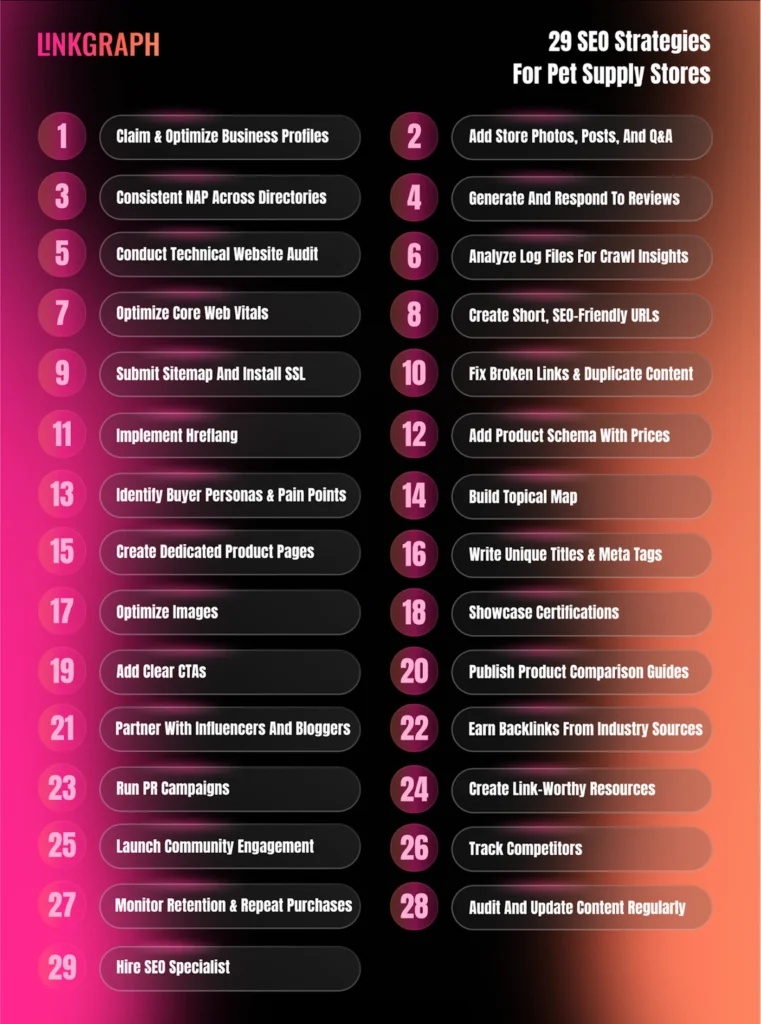
The most effective ways for pet supply stores to start SEO involve technical, on-page, and off-page optimization techniques tailored to retail pet products and services. These methods establish online visibility, attract qualified customers, and improve search engine performance.
There are 29 SEO strategies for pet supply stores. The 29 SEO strategies for pet supply stores are listed below.
- Claim, verify, and optimize business profiles with pet-specific categories across search platforms.
- Optimize each profile with store photos, posts, and question-and-answer responses to increase engagement.
- Maintain consistent NAP information across pet industry directories to enhance local search visibility.
- Generate product-specific customer reviews and respond promptly to reinforce credibility and authority.
- Conduct a full technical audit of the website to identify errors and optimize its structure.
- Run log file analysis to understand search engine crawl behavior and indexing patterns.
- Optimize core web vitals for fast load times, responsive design, and a smooth mobile shopping experience.
- Create SEO-friendly, short URLs for products and categories that clearly reflect page content.
- Submit an XML sitemap and install an SSL certificate to improve crawling and secure connections.
- Fix broken links, redirects, and duplicate content issues to maintain site integrity.
- Implement hreflang for multi-language or multi-country targeting to serve global audiences accurately.
- Add product schema with real-time price and inventory information for structured search results.
- Identify target buyer personas and their pet care pain points to align content with search intent.
- Build a topical map based on a trusted source context to organize products, guides, and content clusters.
- Create dedicated pages for each product or service to enhance indexing and user navigation.
- Write unique title tags and meta descriptions for each page to improve click-through rates.
- Optimize images with descriptive file names and alt text to strengthen SEO and accessibility.
- Showcase pet product certifications and safety standards to reinforce credibility and trust.
- Add clear CTAs for add to cart, catalog downloads, and product comparisons to guide actions.
- Publish product comparison guides for pet food and supplies to assist buyer decision-making.
- Build partnerships with pet influencers and bloggers to increase backlinks and brand exposure.
- Earn backlinks from pet blogs, veterinarians, and industry partners to boost authority.
- Run PR campaigns for new pet products, certifications, and community initiatives to increase visibility.
- Create link-worthy pet care resources and sponsor local pet events to attract natural links.
- Launch community engagement programs with animal lovers and pet owners to strengthen brand presence.
- Implement conversion tracking for product sales and subscription sign-ups to monitor performance.
- Track customer retention and repeat purchase metrics to measure loyalty and satisfaction.
- Run regular content audits and update product inventory pages to keep the site current.
- Hire an SEO specialist when advanced expertise is required to address complex technical needs.
These steps establish a structured, measurable, and strategic SEO foundation for pet supply stores, which improves search visibility, local engagement, and revenue potential. We have broken down the 29 SEO strategies for pet supply stores below.
1. Claim, Verify, and Optimize Business Profiles With Pet-Specific Categories (GMB, Bing, Apple)
Claiming business profiles (GMB, Bing, Apple) on major search platforms establishes the digital foundation for pet supply stores. Verified profiles signal authenticity to search engines and customers. Business profiles with accurate categories, descriptions, and location details strengthen local search visibility and improve discovery for product-focused searches.
Pet supply stores select pet-specific categories that reflect core offerings such as food, accessories, or pet grooming products. Category accuracy influences keyword matching within local search results, which impacts rankings for transactional and navigational queries. A clear representation of services and inventory attracts customers searching for precise product types within defined geographic zones.
Regular updates to business profiles maintain data accuracy and reflect inventory changes, seasonal promotions, or expanded services. Updated profiles improve customer trust through consistent information across platforms. Accurate listings reinforce brand presence in local search ecosystems, which drives physical store visits and qualified digital traffic.
2. Optimize Each Profile With Store Photos, Posts, and Q&A Responses
Optimizing Google Business Profiles (GBP) with visual and informational elements increases engagement for pet supply stores. High-quality store photos create transparency by showcasing interior layouts, product displays, and service areas. Visual elements influence user trust and improve click-through rates from local search results.
Pet supply stores publish posts on promotions, product launches, or seasonal events to maintain visibility in local search features. Frequent updates signal activity to search engines, which impacts local ranking potential. Informative posts highlight new inventory and exclusive deals that attract nearby customers searching for pet products.
Q&A sections address common customer queries about product availability, return policies, or service options. Clear responses reduce friction during the decision process and establish authority within local listings. Consistent updates to these sections keep profiles relevant and strengthen the connection between store offerings and search intent.
3. Maintain Consistent NAP Across Pet Industry Directories
Consistent NAP information across directories increases the local search accuracy of pet supply stores. NAP data refers to the exact name, address, and phone number that appear uniformly on every listing. Consistency signals reliability to search engines that evaluate local authority and match citations with GBP.
Pet supply stores publish identical NAP information across local directories, industry-specific platforms, and mapping services. Uniform formatting eliminates ambiguity that affects indexing accuracy and ranking stability. Discrepancies between directories weaken local visibility and disrupt search engine trust in the listed entity.
Routine audits detect variations within third-party listings, social platforms, and data aggregators. Corrections maintain alignment with official GBP, which reinforces the credibility of pet supply stores in local search algorithms. Consistency across directories establishes a clear identity that matches relevant location-based search intent.
4. Generate Product-Specific Customer Reviews and Respond to Them
Product-specific customer reviews increase the transactional visibility of pet supply stores in local and organic search results. Detailed reviews with product names, attributes, and usage contexts match search queries that reflect buyer intent. Search engines evaluate this content to determine relevance and credibility for ranking individual product pages.
Pet supply stores encourage customers to leave reviews that highlight specific products, such as dog food brands or grooming tools. Clear mentions of product categories within reviews increase keyword diversity and align with structured data signals. Reviews containing descriptive language influence click-through behavior and strengthen search engine interpretation of product relevance.
Systematic response to each review reinforces engagement and signals active reputation management. Replies clarify product features, address customer concerns, and confirm accuracy in descriptions. Consistent interaction within review sections establishes trust signals that strengthen the visibility of pet supply stores in competitive product-focused search environments.
5. Conduct a Full Technical Audit of the Website
A full technical audit evaluates the website infrastructure of pet supply stores, which identifies factors that influence crawlability, indexing, and overall search visibility. Technical SEO optimization ensures the server response time remains under 100 milliseconds, which improves page load speed and user experience. HTML crawl requests should exceed 95 percent to guarantee search engines efficiently access the majority of the site content.
Maintaining a refresh rate of around 20 percent ensures frequently updated pages reflect new products and inventory in search results. A discovery rate of approximately 7–8 percent optimizes crawl budget allocation, which allows search engines to index high-priority product and category pages effectively. Performing a log file analysis identifies pages consuming excessive crawl budget and uncovers technical errors such as redirect chains, broken links, or duplicate content.
Key technical SEO fixes for pet supply stores include XML sitemap generation, SSL certificate verification, URL structure optimization, and canonical tag implementation. Image compression, mobile responsiveness improvement, structured data markup application, and site health monitoring occur regularly. Each fix aligns website architecture with search engine expectations, which enhances visibility and authority in product-focused queries.
6. Run Log File Analysis to Understand Search Engine Crawl Behavior
Log file analysis provides pet supply stores with a detailed view of search engine crawl behavior, which identifies how bots interact with website pages. Examining server logs reveals which URLs receive frequent crawls, which pages trigger errors, and where the crawl budget is being wasted. This insight allows prioritization of high-value pages, such as product listings, category pages, and blog content.
Analyzing log files detects redirect chains, 404 errors, and slow-loading pages that hinder indexing and reduce search visibility. Patterns in bot activity indicate whether important pages, like seasonal product collections or new inventory, are fully accessible to search engines.
Pet supply stores use log file analysis to align technical SEO priorities with crawl efficiency. Adjustments include internal link optimization, broken or duplicate URL fixes, and sitemap structure refinement. Regular analysis ensures search engines index critical pages consistently, improving organic performance, which enhances site authority, and drives high-intent buyer acquisition.
7. Optimize Core Web Vitals for a Smooth Mobile Shopping Experience
Optimizing Core Web Vitals improves page performance and mobile shopping experience for pet supply stores. LCP, FID, and CLS metrics indicate loading speed, interactivity, and visual stability of product pages, category listings, and blog content. Fast-loading product pages reduce bounce rates and increase the likelihood of conversions.
Pet supply stores enhance LCP through server response time optimization, image compression, and reduction of render-blocking resources. FID improves through efficient JavaScript execution and reduction of main-thread tasks. This process ensures that add-to-cart buttons, filters, and navigation menus respond quickly. CLS is controlled by reserving space for images, videos, and dynamic elements to prevent layout shifts while users browse products or read guides.
Regular monitoring of Core Web Vitals allows pet supply stores to maintain high performance across mobile and desktop devices. Improved metrics result in better search rankings, higher organic visibility, and a smoother experience for customers exploring pet products, catalogs, and checkout processes.
8. Create SEO-Friendly, Short URLs for Products and Categories
Creating SEO-friendly, short URLs improves usability and search engine indexing for pet supply stores. Product and category URLs should clearly describe the content, which includes primary keywords like dog food, cat litter, or pet grooming supplies.
Pet supply stores structure URLs hierarchically that reflect categories and subcategories, which clarifies page relationships for both search engines and users. Short URLs avoid unnecessary parameters, numbers, or session IDs, which maintains readability and trustworthiness.
Consistent, keyword-relevant URLs enhance internal linking that allows crawlers to efficiently discover product pages, comparison guides, and service sections. Optimized URLs improve click-through rates from search results and ensure that each product or category page ranks for targeted search queries.
9. Submit an XML Sitemap and Install an SSL Certificate
Submitting an XML sitemap ensures search engines discover and index all critical pages of a pet supply store website. The sitemap includes product pages, category pages, blog posts, and informational guides, which improves crawl efficiency and site visibility.
Installing an SSL certificate secures the website that enables HTTPS protocols that protect customer data during transactions and interactions. Pet supply stores gain increased trust from users and meet search engine security requirements.
Regularly updating the XML sitemap whenever new products, services, or content pages are added keeps the index current. Secure sitemaps combined with HTTPS contribute to higher rankings, safer browsing, and improved organic performance for pet supply store websites.
10. Fix Broken Links, Redirects, and Duplicate Content Issues
Fixing broken links maintains navigational integrity for pet supply store websites and prevents search engines from encountering 404 errors that reduce crawl efficiency. Broken internal links disrupt user pathways, which diminishes engagement and lowers the likelihood of conversions. External broken links damage trust signals and weaken overall domain authority.
Redirecting outdated URLs to relevant active pages preserves accumulated link equity and ensures visitors reach the intended content. Implementing proper 301 redirects guides both search engine crawlers and users efficiently, which maintains organic traffic flow and sustains rankings. Redirect chains and loops require careful management to prevent indexing issues.
Resolving duplicate content issues avoids ambiguity for search engines, which penalize sites with repetitive pages. Consolidating or canonicalizing repeated product descriptions, category pages, or blog articles clarifies content hierarchy, improves indexing accuracy, and strengthens authority signals. This process increases organic visibility for pet supply store websites and ensures targeted search queries map to the most relevant pages.
11. Implement Hreflang for Multi-Language or Multi-Country Targeting
Hreflang implementation specifies the language and regional target for each webpage on a pet supply store website, which ensures search engines display the correct version to users in different locations. Proper hreflang mapping prevents duplicate content issues and directs international customers to pages tailored for their country or language.
The implementation process involves assigning hreflang attributes in page headers or sitemaps. Each page links to its corresponding language or region. Reciprocal tags and self-referencing attributes maintain consistency across the site, preventing conflicts in indexing.
Validating hreflang through analytics and SEO auditing tools ensures proper indexing and identifies errors that reduce international visibility. Pet supply stores using hreflang increase engagement from global buyers, improve rankings for regional keywords, and create a clear multilingual website structure. Prioritize primary markets first and expand coverage gradually while monitoring performance metrics.
12. Add Product Schema With Real-Time Price and Inventory
Adding product schema to a pet supply store website provides structured data that communicates key product details to search engines, which includes real-time price, availability, and specifications. Proper schema implementation increases visibility in rich search results, which attracts highly qualified buyers actively searching for pet products.
Each product page requires detailed markup covering SKU, brand, category, price, inventory status, and relevant attributes such as size or flavor. Including real-time inventory and pricing ensures search engines reflect accurate product information, which reduces user frustration and abandoned sessions.
Validating schema through structured data testing tools identifies errors or missing fields, which ensures consistent indexing and eligibility for rich snippets. Pet supply stores using product schema improve click-through rates, highlight product differentiation, and enhance overall search visibility across competitive product categories.
13. Identify Target Buyer Personas and Their Pet Care Pain Points
Identifying target buyer personas allows a pet supply store to focus SEO efforts on audiences most likely to purchase products. Personas include pet owners with specific needs, such as dog owners seeking training pads, cat owners looking for litter solutions, or small pet enthusiasts searching for toys and accessories.
Mapping buyer pain points reveals gaps in content or product offerings, such as difficulty finding eco-friendly pet products, nutritional supplements, or grooming tools. Understanding these challenges allows the pet supply store to create optimized content that directly addresses customer needs, which increases engagement and conversions.
Integrating buyer personas into a topical map connects pages, content clusters, and keywords to specific search intent and transactional queries. Pet supply stores using this connection align each page with buyer intent, improve content relevance, strengthen internal linking, and enhance overall website authority within the pet retail sector.
14. Build a Topical Map Based on Your Source Context
Building a topical map organizes a pet supply store’s website content around core subjects, subtopics, and related information. The topical map defines hub pages for major product categories, such as dog food, cat litter, or grooming tools, with cluster pages linking detailed guides, comparisons, and product-specific content.
The topical map ensures search engines understand relationships between pages and the relevance of content for transactional and informational queries. Pet supply stores align keyword targeting, metadata, and internal links with this structure to strengthen visibility for relevant search terms.
Integrating buyer personas and search intent into the topical map connects content clusters to audience needs. Pet supply stores using this method increase engagement, improve crawl efficiency, and demonstrate authority within the pet retail sector while providing clear navigation paths for customers seeking products or information.
15. Create Dedicated Pages for Each Product or Service
Creating dedicated pages for each product or service allows a pet supply store to target specific search queries and buyer intent precisely. Each page focuses on a single product category, such as dog treats, cat toys, or grooming kits, which provides detailed descriptions, specifications, and benefits.
These pages enhance on-page SEO through optimized titles, meta descriptions, headers, and keyword-rich content, which signals relevance to search engines. Internal linking from the topical map guides users and crawlers to related products, which increases engagement and improves indexation.
Dedicated pages allow for structured presentation of real-time inventory, pricing, and promotions, giving pet supply stores control over how products appear in search results. Well-optimized individual pages improve organic visibility, attract qualified buyers, and strengthen the store’s overall digital presence.
16. Write Unique Title Tags and Meta Descriptions
Writing unique title tags and meta descriptions establishes a precise search identity for every product and category page within a pet supply store website. Unique titles align page-level targeting with specific transactional or informational intent. Titles include primary keywords, modifiers, and product qualifiers that reflect user search behavior. This alignment improves click-through rates, keyword rankings, and search engine interpretation of page relevance.
Meta descriptions act as persuasive summaries that highlight key product attributes, value propositions, and differentiating factors. Each description communicates the purpose of the page, addresses common pet owner needs, and maintains keyword consistency without repetition. Search engines analyze these elements to determine how accurately a page satisfies search intent.
Title tags and meta descriptions connect with the topical map through structured keyword integration and semantic alignment. Every metadata element reinforces internal topic clusters, enhances crawl prioritization, and reduces duplication across product listings. Pet supply stores create metadata frameworks that maintain consistency while addressing unique product characteristics, which strengthens organic visibility across diverse search queries.
17. Optimize Images With Descriptive File Names and Alt Text
Optimizing images with descriptive file names and alt text establishes clear contextual relevance for search engines and users within a pet supply store website. Image files named with specific product identifiers, pet categories, and keyword variations enhance structured indexing. Search engines interpret these descriptive names to associate visual assets with relevant queries, which improves product visibility in image search results.
Alt text functions as a semantic bridge between visual elements and textual content. Alt attributes describe product type, intended pet, material, and distinguishing features. This descriptive language strengthens accessibility for screen readers and reinforces topical signals that align with category pages and product clusters. Alt text accuracy improves crawl efficiency and keyword mapping within image-heavy sections.
Image optimization connects with the topical map through structured keyword placement across file names, alt attributes, and surrounding copy. Each optimized image strengthens product-level topic clusters, reinforces internal relevance hierarchies, and improves organic performance for visual search queries. Pet supply stores gain stronger indexing coverage, reduced crawl ambiguity, and higher engagement from well-optimized product imagery.
18. Showcase Pet Product Certifications and Safety Standards
Showcasing pet product certifications and safety standards strengthens trust signals for pet supply store websites. Certifications such as USDA Organic, FDA compliance, or ISO quality assurance indicate adherence to regulatory frameworks. Displaying these credentials on product pages informs search engines and customers about product authenticity, which reinforces brand authority within the pet retail sector.
Structured placement of certification badges within schema markup improves machine readability. Marking certifications through structured data increases the likelihood of enhanced search features such as rich snippets. Clear visual placement of badges near product titles and descriptions strengthens user confidence and contributes to improved click-through rates from search results.
Incorporating certification details into the topical map connects regulatory language, product categories, and related informational content. Dedicated sections on safety standards create semantic relevance between pet health topics and product offerings. This structured connection increases topical depth, improves keyword clustering, and strengthens the overall search visibility of pet supply store websites.
19. Add Clear CTAs for Add to Cart, Catalog, and Comparison
Adding clear CTAs for Add to Cart, Catalog, and Comparison strengthens user interaction signals on pet supply store websites. Prominent CTAs placed near product titles guide buyers toward key actions without friction. Action-oriented anchor text, such as “View Catalog” or “Compare Products,” communicates intent clearly and directs users toward transactional pathways.
Strategic placement of CTAs within product grids, category pages, and dedicated product pages improves crawl path clarity. Search engines identify structured interaction elements that indicate purchase intent. Strong CTA structure aligns with internal linking strategies, which strengthen navigation architecture and improve indexing depth across product categories.
Integrating CTAs into the topical map connects transactional intent with informational clusters. CTA placement alongside product schema, pricing data, and certifications builds semantic associations that improve search visibility. Detailed CTA segmentation for catalog browsing, direct purchases, and product comparisons creates distinct entry points for various buyer personas within the pet retail environment.
20. Publish Product Comparison Guides for Pet Food and Supplies
Publishing product comparison guides for pet food and supplies establishes pet supply stores as authoritative sources for informed purchasing decisions. Comparison guides present features, benefits, and pricing differences across products, which allows buyers to evaluate options efficiently. Detailed tables, charts, and feature breakdowns improve content clarity and engagement metrics.
Integrating comparison guides into category and product pages strengthens internal linking, which enhances crawl efficiency and topical relevance. Guides that connect related products to the broader content clusters increase visibility for long-tail and transactional search queries.
Comparison guides aligned with buyer personas and topical maps target specific customer needs, such as dietary restrictions for pets or age-specific products. These guides improve conversion pathways by directing users to Add to Cart, Catalog, or Comparison CTAs, which creates measurable value from organic traffic while enhancing the overall SEO strategy for pet supply stores.
21. Build Partnerships With Pet Influencers and Bloggers
Building partnerships with pet influencers and bloggers amplifies the online presence of pet supply stores and generates authoritative backlinks. Influencers and bloggers share product reviews, unboxing experiences, and tutorials, which increase brand exposure to targeted audiences.
Collaborating on content campaigns, social media mentions, and guest posts strengthens domain authority while driving referral traffic from trusted sources. Partnerships enhance content diversification by adding user-centric perspectives and engaging formats, which improve overall site relevance.
Integrating influencer and blogger collaborations into the topical map ensures alignment with key product categories, seasonal promotions, and buyer personas. These partnerships enhance SEO performance by connecting content clusters, increasing visibility for transactional and informational queries, and encouraging high-quality engagement with potential customers.
22. Earn Backlinks From Pet Blogs, Vets, and Industry Partners
Earning backlinks from authoritative pet blogs, veterinary websites, and industry partners strengthens search engine authority for pet supply stores. These high-quality backlinks signal credibility, topical relevance, and trustworthiness, improving rankings for competitive product and informational queries.
Pet supply stores secure backlinks through guest posts on niche blogs, collaborative campaigns with veterinary professionals, product features, and partnerships with recognized pet industry organizations. These backlinks drive referral traffic, increase exposure to targeted audiences, and reinforce the store’s position as an authoritative source for pet products, health solutions, and care resources.
Linking backlink acquisition to the topical map ensures that each link points to highly relevant pages, including product listings, category hubs, and educational resources. This strategic alignment improves content cluster authority, distributes link equity across the website, and enhances visibility for both transactional searches, such as product purchases, and informational searches, like training guides and pet health tips. Consistent monitoring and outreach maintain the quality and relevance of earned backlinks over time.
23. Run PR Campaigns for New Pet Products, Certifications, and Community Initiatives
Running PR campaigns for new pet products, certifications, and community initiatives increases visibility for pet supply stores across online and offline channels. These campaigns highlight product launches, safety certifications, and store participation in local pet events, which strengthen brand recognition and authority within the pet industry.
Pet supply stores leverage press releases, media coverage, and industry announcements to reach pet owners, veterinarians, and pet care enthusiasts. These campaigns generate referral traffic, improve search engine trust signals, and create opportunities for backlinks from authoritative news sources, blogs, and trade publications.
Aligning PR campaigns with the store’s topical map ensures promoted content links to relevant product pages, category hubs, and educational resources. This approach enhances topical relevance and distributes authority to key pages. It improves rankings for transactional queries, such as product purchases, and informational queries, such as pet care guidance and safety tips. Tracking campaign results refines future initiatives and maximizes ROI from publicity efforts.
24. Create Link-Worthy Pet Care Resources and Sponsor Local Pet Events
Creating link-worthy pet care resources and sponsoring local pet events positions pet supply stores as authoritative entities within the pet care ecosystem. Educational guides, how-to articles, and infographics attract organic backlinks from pet blogs, industry publications, and community websites.
Sponsoring local pet events such as adoption drives, pet fairs, and training workshops connects the store with local pet owners and industry professionals, increasing brand visibility and engagement. These initiatives generate natural citations, referrals, and social mentions that reinforce online authority.
Integrating these resources with the store’s topical map ensures each guide or event page links to relevant product pages, category hubs, and related content. This structure enhances search engine understanding, improves rankings for informational and transactional queries, and drives qualified traffic to product offerings, subscription services, or store locations.
25. Launch Community Engagement Programs With Animal Lovers and Pet Owners
Launching community engagement programs with animal lovers and pet owners strengthens the local presence and reputation of pet supply stores. Initiatives such as pet adoption campaigns, volunteer events, and educational workshops connect the store with the community while promoting responsible pet care practices.
These programs generate user interactions, social mentions, and local citations that increase brand visibility and credibility. Engagement activities create opportunities for the store to collect testimonials, feature success stories, and highlight product usage in real-world scenarios.
Aligning community programs with the store’s topical map ensures related pages link to products, service categories, and educational content. This internal linking structure improves search engine understanding, enhances relevance for local and niche queries, and drives targeted traffic to the website, fostering higher conversions and sustained audience engagement.
26. Implement Conversion Tracking for Product Sales and Subscriptions
Implementing conversion tracking for product sales and subscriptions allows pet supply stores to measure the performance of SEO and marketing initiatives accurately. Conversion tracking records actions such as completed purchases, newsletter sign-ups, and catalog downloads, which provides insight into which campaigns drive the most qualified traffic.
Stores configure tracking using analytics platforms that capture events, assign values to conversions, and segment data by traffic source, device, and user behavior. This granular data reveals which product pages, blog posts, or promotional content generate sales and recurring subscriptions.
Connecting conversion data to the topical map enables pet supply stores to optimize content clusters, internal linking, and call-to-action placement. Tracking conversions guides strategic adjustments, improves ROI, and ensures that both organic and paid efforts contribute to measurable business outcomes.
27. Track Customer Retention and Repeat Purchase Metrics
Tracking customer retention and repeat purchase metrics allows pet supply stores to evaluate long-term customer engagement and loyalty. Retention metrics monitor how often customers return for additional purchases, while repeat purchase rates reveal which products or categories drive recurring sales.
Stores collect this data through analytics platforms, CRM systems, and e-commerce reporting tools, segmenting customers by purchase frequency, order value, and product preferences. Analyzing these metrics identifies trends in buying behavior and highlights opportunities for targeted promotions, loyalty programs, or inventory adjustments.
Integrating retention and repeat purchase insights with the topical map enables pet supply stores to refine content clusters, optimize product pages, and enhance call-to-action placement. This strategic alignment ensures that marketing efforts improve customer lifetime value, strengthen brand loyalty, and increase overall revenue from existing clients.
28. Run Regular Content Audits and Update Product Inventory Pages
Running regular content audits and updating product inventory pages ensures pet supply stores maintain accurate, relevant, and high-performing website content. Audits assess page performance, keyword relevance, metadata accuracy, and technical SEO compliance, identifying underperforming or outdated content.
Inventory pages require frequent updates to reflect product availability, new arrivals, discontinued items, and seasonal offerings. Accurate product information improves user experience, reduces bounce rates, and aligns search engine indexing with current offerings.
Integrating audit insights with the topical map allows pet supply stores to reorganize content clusters, refine internal linking, and optimize product categorization. This systematic approach maximizes search visibility, enhances content relevance, and increases conversion opportunities by keeping both product pages and related content aligned with buyer intent.
29. Hire an SEO Specialist When Advanced Expertise Is Required
Hiring an SEO specialist provides pet supply stores with advanced expertise for complex optimization tasks that in-house teams cannot address. Specialists assess technical SEO, keyword strategy, content architecture, and backlink acquisition to maximize search visibility and organic traffic.
SEO specialists implement data-driven strategies, monitor performance metrics, and adjust campaigns based on evolving search engine algorithms. Their experience ensures high-level technical audits, structured schema markup, and strategic topical mapping align with the store’s product catalog and buyer intent.
Integrating specialist insights with ongoing marketing initiatives allows pet supply stores to maintain competitive rankings, optimize content clusters, and enhance local and national search performance. This targeted approach ensures all advanced SEO tasks align with business objectives and long-term growth.
How Long Does It Take for Pet Supply Stores to See SEO Results?
Pet supply stores typically observe initial SEO improvements within three to six months after implementing structured optimization strategies. These improvements include higher rankings for product-specific keywords, increased organic traffic, and better visibility in local search results. Significant results, including sustained growth in sales and qualified leads, often require up to a year, depending on website authority, competition, and ongoing SEO maintenance.
Stores with frequent content updates, optimized business profiles, and consistent technical audits experience faster and more measurable performance improvements, establishing a foundation for long-term growth and visibility in highly competitive pet retail markets.
What Type of Content Works Best for Pet Supply Stores in SEO?
Effective SEO content for pet supply stores focuses on product comparisons, educational guides, and category-specific clusters. Product comparison guides allow pet owners to evaluate options, increasing the likelihood of purchases while targeting transactional search queries. Educational content on pet care, training, and seasonal needs attracts informational searches and positions the store as an authority.
Category-based content clusters for dogs, cats, or small animals create a logical website hierarchy that search engines understand, improving indexing and relevance. User-generated content, including reviews and pet photos, strengthens engagement and trust while signaling authenticity to search engines, enhancing overall SEO performance.
How Can Pet Supply Stores Benefit From Local SEO?
Local SEO enables pet supply stores to capture nearby customers actively searching for products and services. Optimizing for location-based keywords, managing verified business profiles, and maintaining consistent directory listings increase visibility in map packs and local search results. Enhanced local presence builds trust with potential buyers, encourages store visits, and drives immediate purchases.
Localized content, including city-specific promotions or guides, improves relevance for geographically targeted queries. Combined with high-quality reviews and community engagement, local SEO enables pet supply stores to outperform competitors, generate consistent foot traffic, and establish loyalty within their service areas while improving long-term search authority.
Which Online Directories Are Most Valuable for Pet Supply Stores to Be Listed In?
The most valuable online directories for pet supply stores to be listed in increase local visibility, strengthen credibility, and drive qualified traffic to the website. These directories connect pet owners with relevant products, services, and store information, providing accurate contact details, operational hours, and customer reviews. Proper directory listings improve local SEO performance and enhance discoverability for search engines while ensuring consistent business information across platforms.
The most valuable online directories for pet supply stores to list in are listed below.
- PetGenius: A platform that connects pet owners with trusted pet products and stores information.
- Petfinder: A directory focusing on adoption and pet-related services, attracting engaged pet owners.
- Petco Love: Offers listings for stores, products, and community initiatives targeting pet consumers.
- GlobalPETS: International directory connecting global pet supply stores with customers and partners.
- PetsWelcome: Directory emphasizing pet-friendly products, services, and store locations for pet owners.
- Google Business Profile: Core directory for local SEO, featuring maps, reviews, and store details.
- Yelp: Reviews-based directory that drives local traffic and strengthens reputation for pet stores.
- Bing Places: Alternative search engine directory boosting local visibility and map listings.
Listing pet supply stores in these directories improves search visibility, attracts local buyers, and strengthens brand authority.
Is Technical SEO Important for Pet Supply Stores?
Technical SEO improves site performance and indexing, which elevates a pet supply store’s search visibility. Pet supply stores achieve faster page load times, mobile responsiveness, and error-free HTML, increasing organic traffic and user retention. Implementing structured data, such as product schema markup, allows search engines to interpret product information clearly, enhancing visibility in rich search results.
Optimizing Core Web Vitals ensures smooth navigation and interaction, which strengthens engagement and provides higher rankings. Regular technical audits identify crawl issues, broken links, and duplicate content, which maintain overall site health.
How Does SEO Help Pet Supply Stores Attract More Customers and Sales?
SEO increases organic visibility for pet supply stores, targeting users actively searching for pet products. Optimized product pages with clear descriptions, images, and reviews encourage conversions and guide purchase decisions. Local SEO enables stores to appear in nearby searches, generating foot traffic to physical locations.
High-quality content, including pet care tips and product comparisons, engages customers and builds trust in the store’s expertise. Consistent optimization reduces dependency on paid campaigns while increasing qualified leads. Analytics from SEO activities reveal user behavior and product demand, refining marketing strategies and enhancing revenue growth.
How Can SEO Strengthen the Brand Identity of Pet Supply Stores?
SEO positions pet supply stores as authoritative sources in the pet care industry through relevant content and optimized product pages. Pet supply stores publishing guides, safety standards, and comparison resources increases credibility and recognition. Positive customer reviews and high search rankings reinforce brand reliability.
Regular content updates and optimized website structure signal expertise to search engines and users, creating a cohesive brand identity. Consistent visibility across search results associates the pet supply store with quality and trust, which strengthens its reputation in local and digital markets.
Can SEO Help Pet Supply Stores Stay Ahead of Competitors?
SEO differentiates pet supply stores in competitive markets through targeted keywords, local search optimization, and authoritative content creation. Regular audits detect gaps in competitor strategies and identify technical or content improvements. Optimized mobile experience, fast load speed, and user-friendly navigation increase engagement and customer retention.
Topical content clusters and structured internal linking improve relevance for search engines. Continuous monitoring of search trends and competitor performance enables pet supply stores to adjust strategies proactively, maintaining a competitive advantage in organic search results.
Is Multilingual SEO Also Important for Global Pet Supply Stores?
Multilingual SEO is essential for global pet supply stores aiming to reach diverse markets. Implementing hreflang tags ensures that search engines serve the correct language or regional URL in search results. Translating content isn’t sufficient; localization is crucial.
Adapting product descriptions, pricing, and cultural references to local preferences enhances user experience and boosts conversion rates. Collaborating with agencies specializing in multilingual SEO allows to navigate local regulations and optimize content for different languages and cultures.
How Can Pet Supply Stores Optimize SEO for International Markets?
Optimize SEO for international markets by conducting thorough keyword research tailored to each region. Utilizing country-specific domains (ccTLDs) or subdirectories improves local search rankings. Creating content that resonates with local cultures and addressing region-specific pet care needs increases engagement.
Ensuring compliance with local regulations and providing customer support in local languages enhances trust and customer satisfaction. Regularly monitoring performance metrics across different markets allows for continuous optimization and adaptation to local trends.
Is SEO More Cost-Effective Than Paid Advertising for Pet Supply Stores?
SEO is generally more cost-effective than paid advertising for pet supply stores in the long term. While paid ads provide immediate visibility, they require ongoing investment. SEO, on the other hand, involves an initial investment but yields sustainable organic traffic over time. Studies indicate that organic search results have higher click-through rates and trust levels compared to paid ads. Moreover, SEO efforts contribute to building brand authority and customer loyalty, which leads to higher conversion rates and reduced dependency on paid campaigns.
How Can Pet Supply Stores Combine SEO With Paid Advertising for Better Results?
Combining SEO with paid advertising allows pet supply stores to maximize their online presence. SEO provides long-term organic traffic, while paid ads offer immediate visibility. Integrating both strategies enables stores to dominate search engine results pages (SERPs) by appearing in both organic and paid listings.
Insights gained from paid campaigns, such as high-performing keywords, inform SEO strategies. Conversely, SEO data optimizes ad targeting and budgeting. This integrated approach ensures comprehensive coverage, enhances brand visibility, and improves overall return on investment.
Can Social Media and Pet Influencer Partnerships Support SEO for Pet Supply Stores?
Social media and pet influencer partnerships significantly enhance SEO for pet supply stores. Collaborations with influencers generate high-quality backlinks and drive targeted traffic to the store’s website. Engaging content shared on social platforms increases brand visibility and encourages user-generated content, which search engines value. Positive interactions and mentions on social media platforms improve the store’s online reputation, leading to higher search engine rankings. Consistent and authentic engagement with the pet community promotes trust and loyalty, indirectly benefiting SEO efforts.
How Can Pet Supply Stores Measure the ROI of Their SEO Efforts?
Pet supply stores measure the ROI of their SEO efforts by tracking key performance indicators (KPIs) such as organic traffic, conversion rates, and revenue generated from organic search. Utilizing tools like Google Analytics (GA4) enables user behavior monitoring, identifying which pages and keywords drive the most traffic and sales. Calculating the return on investment involves comparing the net profit from SEO efforts to the cost incurred in implementing them, providing a clear picture of the effectiveness of SEO strategies. Regular analysis assists in refining SEO tactics to maximize returns.
Can Pet Supply Stores Successfully Manage SEO on Their Own?
Pet supply stores manage SEO independently, provided they have a clear understanding of SEO principles and dedicate time to implementing best practices. Focusing on keyword research, on-page optimization, and creating valuable content yields positive results. Utilizing SEO tools and resources aids in tracking performance and identifying areas for improvement. However, as the digital landscape evolves, seeking professional SEO services offers advanced strategies and saves time, allowing store owners to concentrate on other aspects of their business.
What Are the Most Common SEO Mistakes Pet Supply Stores Should Avoid?
The most common SEO mistakes pet supply stores commit reduce visibility, engagement, and conversions. The most common SEO mistakes that pet supply store should avoid are listed below.
- Neglecting keyword research and intent alignment: Pet supply stores often target broad or high-volume keywords without matching user intent or product focus. This misalignment results in low relevance and poor performance in search results.
- Using duplicate or thin product content: Reusing manufacturer descriptions or publishing short pages with minimal value causes search engines to discount relevance. Original, detailed content improves rankings and product visibility.
- Ignoring technical SEO elements like mobile responsiveness and site speed: Pet supply store websites that load slowly or mis-render on mobile hurt user experience and indexing performance. Optimized loading metrics provide better rankings.
- Failing to manage local directory listings and business profiles: Incorrect or inconsistent NAP (Name, Address, Phone) data across directories reduces local search performance and decreases trust with nearby shoppers.
- Overlooking backlink profile quality and on-page link structure: Pet supply stores that skip link-building or ignore internal linking leave authority unrealized. Strategic outbound and internal links improve domain strength and topical relevance.
Avoiding these mistakes allows pet supply stores to strengthen search visibility, attract qualified buyers, and sustain consistent organic growth.
What Should Pet Supply Stores Consider Before Hiring an SEO Agency?
Pet supply stores require careful evaluation before partnering with an SEO agency to secure measurable results and transparent strategies. The factors to consider before hiring an SEO agency are listed below.
- Industry-specific experience and proven results: An SEO agency must demonstrate case studies or campaigns within the pet industry. Experience with product-based SEO, local visibility optimization, and eCommerce architecture confirms relevant expertise.
- Technical SEO proficiency and analytical capability: The agency must possess deep knowledge of schema markup, crawl optimization, and site performance metrics. Mastery of tools like Google Search Console (GSC) and log file analysis reflects technical precision.
- Customized strategy and measurable objectives: Pet supply stores should seek agencies that design SEO plans aligned with their sales goals, audience behavior, and keyword categories. A one-size method rarely boosts growth.
- Transparency in reporting and progress tracking: Agencies must present clear reporting formats showing traffic gains, keyword improvements, and conversion metrics. Regular performance reviews confirm accountability.
- Ethical SEO practices and compliance with search guidelines: Avoid agencies using black-hat methods such as keyword stuffing or manipulative link-building. Compliance with Google’s webmaster standards protects long-term ranking stability.
Evaluating these factors ensures pet supply stores select an SEO agency that delivers strategic accuracy, data-driven improvement, and sustainable online authority.
Which SEO Agency Near Me Provides the Best Services for Pet Supply Stores?
LinkGraph stands out as the best SEO agency for pet supply stores through data-driven performance, client validation, and proven case studies. As an established SEO and marketing services provider for pets, LinkGraph develops customized strategies that align with the buying behavior of pet owners and the competitive dynamics of the pet retail market. Each SEO campaign integrates structured keyword mapping, product schema, and optimized on-page architecture that increase organic reach and revenue for pet brands.
LinkGraph’s SEO agency for pet brands applies technical optimization and local SEO frameworks that drive both online conversions and in-store visits. Verified case studies report traffic growth exceeding 180 percent for retail clients within six months, assisted by measurable gains in search visibility and sales.
Client testimonials highlight transparent reporting and expert execution across analytics, content, and technical performance. These outcomes confirm LinkGraph’s authority as the most results-oriented SEO agency specializing in pet supply store growth.
What SEO Services Does LinkGraph Offer for Pet Supply Stores?
LinkGraph provides a full suite of SEO services specifically tailored for pet supply stores to increase visibility, drive traffic, and boost sales. Each service addresses an essential component of digital marketing and is designed to align with the operational goals of pet retail businesses. The types of SEO services offered by LinkGraph for pet supply stores are listed below.
- Local SEO for Pet Stores: Optimizes business listings, manages location-based keywords, and generates reviews to increase in-store traffic and local search visibility.
- On-Page SEO for Pet Stores: Improves title tags, meta descriptions, headers, internal linking, and structured data to align web pages with search intent.
- Off-Page SEO for Pet Stores: Builds authoritative backlinks, engages with industry partners, and promotes content to increase domain trust and referral traffic.
- Technical SEO for Pet Stores: Enhances site speed, mobile responsiveness, crawl efficiency, XML sitemaps, canonical tags, and error resolution to improve search engine indexing.
- Content Strategy and Optimization for Pet Stores: Develops blogs, guides, product descriptions, and comparison pages targeting transactional and informational queries.
- Branding and Online Presence for Pet Stores: Manages profiles, certifications, social signals, and influencer collaborations to reinforce credibility and authority in the pet retail sector.
- Conversion Rate Optimization (CRO) for Pet Stores: Optimizes calls-to-action, product pages, and checkout flows to maximize leads, purchases, and user engagement.
- LLM Optimization for Pet Stores: Aligns website content and FAQs with advanced search models and AI-driven query understanding for semantic relevance.
- E-Commerce SEO for Pet Stores: Focuses on product catalog optimization, schema markup, and inventory visibility for online pet product sales.
- Analytics and Performance Tracking for Pet Stores: Implements tracking through GA4, GSC, and reporting dashboards to monitor traffic, conversions, and keyword performance.
Each of these services works together to create a cohesive SEO strategy that drives growth, increases search visibility, and attracts qualified pet buyers.
Can All Types of Pet Supply Stores Benefit From LinkGraph’s SEO Support?
LinkGraph’s SEO services are designed to benefit all types of pet supply stores, including physical stores, online-only retailers, and hybrid models that combine both. Physical pet stores gain local search visibility, attracting nearby buyers, while online stores increase organic traffic for product pages and category listings.
Hybrid stores receive a tailored approach that integrates local SEO and e-commerce optimization, ensuring consistent search performance across all channels. LinkGraph adapts strategies to the size, scope, and product focus of each pet supply store, maximizing results for all operational models.
How Much Does LinkGraph Charge Pet Supply Stores for SEO Services?
LinkGraph charges for pet supply store SEO services based on the scope, scale, and complexity of each project. Pricing factors include the number of product pages, technical SEO requirements, content creation needs, local SEO optimization, and ongoing maintenance or campaign management.
Packages range from foundational SEO for smaller local stores to full-scale enterprise solutions for larger multi-location or e-commerce operations. Every proposal is customized, ensuring investment aligns with store size, traffic goals, and business objectives. The pricing model emphasizes measurable ROI and long-term growth rather than a flat-rate approach.
Does LinkGraph Specialize Exclusively in SEO for Pet Supply Stores?
LinkGraph does not specialize exclusively in SEO for pet supply stores. While LinkGraph has extensive experience optimizing websites and marketing campaigns for pet brands, the agency serves businesses across a wide range of industries, including e-commerce, professional services, health, legal, and manufacturing.
This breadth of expertise allows LinkGraph to apply proven strategies, technical SEO methodologies, content optimization, and branding techniques to diverse markets. Case studies and performance results demonstrate success across multiple verticals, proving the agency’s ability to scale marketing solutions beyond pet supply stores while maintaining high-quality, data-driven SEO performance.
Which Other Industries Can Benefit From LinkGraph’s SEO Services?
LinkGraph provides tailored SEO services that deliver measurable growth and improved search visibility for businesses across multiple industries. Other industries that can benefit from LinkGraph’s SEO services are listed below.
- E-Commerce: Optimizes product pages, category structures, and site performance to increase online sales and customer acquisition.
- Legal Services: Enhances local visibility, keyword targeting, and content marketing for law firms seeking client inquiries and consultations.
- Healthcare: Improves search rankings for clinics, hospitals, and specialized providers, ensuring patients find relevant services efficiently.
- Real Estate: Boosts property listings, agent profiles, and neighborhood content to attract potential buyers and renters.
- Education & Tutoring: Strengthens local and organic visibility for schools, colleges, and tutoring services to reach prospective students.
- Financial Services: Optimizes websites for investment firms, accountants, and insurance providers, generating qualified leads and inquiries.
- Hospitality & Travel: Increases bookings and engagement for hotels, resorts, and tour operators through technical SEO and content optimization.
- Manufacturing & Industrial: Enhances visibility for B2B manufacturers, suppliers, and industrial services targeting engineers and procurement specialists.
- Professional Services: Supports consultants, marketing agencies, and freelancers in building authority and attracting clients via search.
- Retail & Consumer Goods: Optimizes both brick-and-mortar and online stores for product searches, local SEO, and user engagement.
- IT & SaaS Companies: Improves software and technology company visibility through technical SEO, keyword targeting, and product content optimization.
LinkGraph applies data-driven SEO, technical expertise, and content strategy across all these industries, ensuring scalable, measurable results that align with business objectives.
