
SEO for subscription-based businesses focuses on enhancing online visibility, attracting targeted subscribers, and optimizing recurring revenue streams for subscription services and membership businesses. Subscription-based models rely on consistent user engagement, predictable payments, and customer retention, making search engine optimization for subscription businesses essential for growth and authority in competitive markets. SEO for subscription services improves search rankings, drives qualified traffic, and strengthens brand credibility across organic channels.
Implementing local SEO for subscription service providers ensures visibility in geographically relevant searches, which lets recurring revenue businesses capture nearby prospects while maintaining a broader reach. Combining on-page, technical, and off-page SEO strategies aligns website architecture, content, and link-building efforts to subscription models, fostering higher conversion rates and long-term subscriber loyalty.
Choosing the right SEO agency ensures subscription and membership businesses receive specialized expertise in digital marketing services for recurring revenue businesses. Experienced agencies deliver measurable results, ongoing optimization, and strategic guidance for sustainable subscriber growth. SEO for subscription businesses integrates content, technical fixes, and analytics to maximize ROI and maintain a competitive advantage in the subscription economy.

What Is a Subscription-Based Business?
A subscription-based business is a commercial model where customers pay a fixed recurring fee at scheduled intervals (Weekly, Monthly, Annually). The subscription structure replaces one-time transactions with continuous access to a product or service, which builds stable and predictable revenue for the company. Businesses that adopt this model focus on maintaining long-term customer relationships rather than maximizing single-purchase sales.
In a subscription-based business setup, revenue predictability and customer retention become primary performance indicators. Key financial metrics include churn rate, renewal rate, and customer lifetime value, which reflect how efficiently the business sustains recurring income. Subscribers gain consistent access to services or goods without repeated purchase decisions, which increases convenience and satisfaction while reducing purchase friction.
Examples of subscription-based services include digital streaming platforms such as Netflix or Spotify, which offer ongoing access to entertainment content. Software companies such as Adobe Creative Cloud or Microsoft 365 apply the same structure for continuous software access. E-commerce and media businesses such as Dollar Shave Club and The New York Times follow the subscription model to supply regular deliveries or premium content to their users.
What Does SEO Mean for Subscription-Based Businesses?
SEO for subscription-based businesses refers to the structured optimization process that improves unpaid search visibility for recurring revenue brands. This organic marketing strategy focuses on attracting qualified visitors, converting them into paying subscribers, and retaining them through consistent engagement. Search engine optimization for subscription models does not chase one-time transactions but aims to secure ongoing relationships that sustain predictable revenue streams and strengthen digital brand presence.
Search visibility for subscription-driven brands depends on aligning keyword targeting, user intent, and subscriber value propositions. Subscription SEO strategies focus on high-intent and long-tail keywords that capture both discovery and conversion phases. Content must highlight continuous benefits such as regular product deliveries, premium access, or ongoing service updates. Optimized metadata, structured content hierarchy, and descriptive headings build topical relevance while reinforcing trust in the recurring offerings of the brand.
Organic search marketing for subscription businesses thrives on authority and consistency. It uses backlinks from reputable sources, customer testimonials, and detailed FAQ sections to build credibility and improve rankings. A technically sound, mobile-friendly, and fast-loading website further improves performance and retention, ensuring smooth subscriber experiences.
Is SEO Necessary for Subscription-Based Businesses?
SEO for subscription-based businesses is necessary because organic visibility directly influences recurring revenue and customer retention. Without search optimization, subscription brands lose consistent exposure to users actively searching for solutions similar to their services. Search engine optimization for recurring models strengthens discovery, builds trust, and drives qualified traffic that sustains long-term subscriber growth.
Subscription SEO impacts performance across every funnel stage. It attracts prospects through targeted keyword ranking, converts them through persuasive content, and retains them by delivering a consistent user experience. High-ranking pages reduce dependency on paid advertising and lower acquisition costs per subscriber.
Long-term optimization for subscription businesses establishes brand authority and stability in competitive markets. As search engines (Google, Bing, Yahoo!) reward relevance and expertise, subscription-driven SEO becomes an essential foundation for sustained visibility, predictable income, and enduring customer loyalty.
What Are the Main Benefits of Doing SEO for Subscription-Based Businesses?
The main benefits of SEO for subscription-based businesses extend far beyond organic visibility. Search optimization for recurring revenue models strengthens acquisition, retention, and profitability. Each benefit contributes to long-term sustainability by improving subscriber engagement and reducing marketing costs. The key benefits of SEO for subscription-based businesses are listed below.
- Attracts Qualified and Intent-Driven Leads: SEO for subscription-based businesses attracts high-intent users who search for specific recurring services or products. Targeted keyword optimization drives qualified traffic that shows a stronger interest in subscribing rather than browsing casually.
- Lowers Customer Acquisition Costs (CAC): Subscription SEO minimizes ongoing advertising expenses through consistent organic traffic generation. Once authority builds, every new subscriber acquired through unpaid search reduces the average acquisition cost, increasing profitability over time.
- Establishes Predictable and Scalable Growth: Unlike paid campaigns that stop once funding ends, SEO for subscription companies ensures uninterrupted exposure. Analytics tracks metrics such as session duration, bounce rate, and conversions, which evaluate the effectiveness of SEO strategies for subscription offerings.
- Strengthens Customer Retention and Loyalty: Content-driven optimization retains subscribers through valuable engagement. Tutorials, comparison guides, and usage resources reinforce product relevance, reducing churn while maintaining lifetime subscriber value.
- Builds Brand Authority and Trust: High-ranking pages communicate reliability to users and search engines. SEO for subscription models strengthens authority through expert content, credible backlinks, and positive user interactions that validate trustworthiness.
- Offers Actionable Consumer Insights: SEO analytics uncover behavioral data such as keyword intent and engagement depth. Subscription businesses use these insights to refine product tiers, pricing strategies, and customer experience optimization.
- Enhances On-Site Experience and Accessibility: Technical optimization improves navigation, speed, and responsiveness. A frictionless user experience reduces bounce rates and boosts conversions, reinforcing subscriber confidence in the platform.
- Improves Competitive Edge in Search Visibility: Subscription-based SEO ensures visibility ahead of competitors reliant on short-term paid tactics. Sustained rankings increase brand recall, attract comparison shoppers, and secure greater market share.
A structured SEO strategy for subscription models builds measurable growth across discovery, engagement, and retention stages. Each benefit compounds over time, making SEO indispensable for sustainable and predictable subscription success.
Is SEO for Subscription Businesses Similar to SEO for E-Commerce Subscription Models?
SEO for subscription businesses shares foundational e-commerce SEO principles, including product page optimization, category page structuring, and technical performance adjustments. Subscription SEO and e-commerce SEO both rely on keyword research, targeting general product terms and industry-specific phrases. Optimized content and technical structures improve visibility, indexing, and user navigation across both models.
Differences emerge in customer journey management. E-commerce SEO targets one-time transactions, while subscription SEO prioritizes long-term engagement and recurring conversions. Subscription SEO emphasizes trust-building content, including case studies, reviews, and continuous value explanations for each subscription tier. Review aggregation demonstrates the reliability of recurring service, distinguishing subscription models from one-off product sales. Subscription-specific landing pages detail ongoing benefits, plan tiers, and retention incentives, complementing standard product and category optimizations.
What Are the Best Ways to Get Started With SEO for Subscription-Based Businesses?
The best ways to get started with SEO for subscription-based businesses involve a combination of technical, on-page, and off-page strategies that enhance organic visibility, attract qualified leads, and drive recurring conversions. Each approach focuses on optimizing the website infrastructure, aligning content with user intent, and reinforcing brand authority to establish long-term search engine presence.
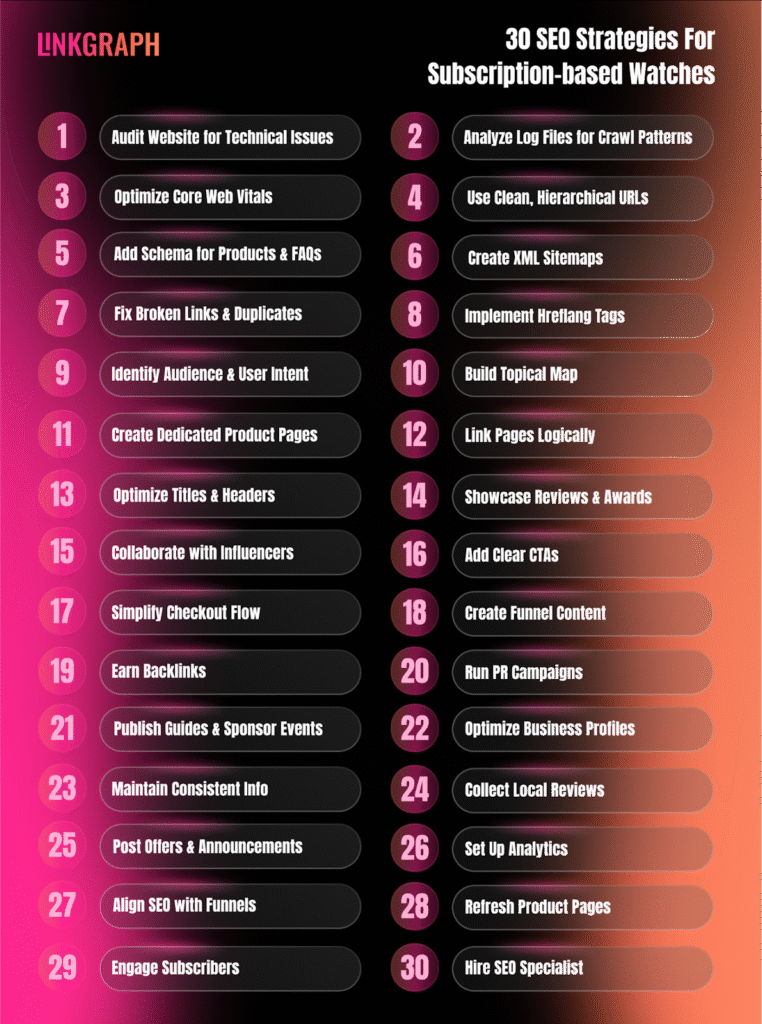
There are 30 SEO strategies for subscription-based businesses. The 30 SEO strategies for subscription-based businesses are listed below.
- Audit Entire Website to Identify Technical SEO Issues
- Analyze Log Files to Understand Search Engine Crawl Patterns
- Optimize Core Web Vitals for Seamless Subscriber Experience
- Use Clean, Hierarchical URL Structures for Easy Navigation
- Add Schema Markup for Products, Reviews, and FAQs
- Create Compact XML Sitemaps for Pages, Images, and Videos
- Fix Broken Links, Redirect Loops, and Duplicate Content
- Implement Hreflang Tags for Global Subscription Markets
- Identify Target Audience, Market Gaps, and User Intent
- Build a Topical Map Aligned With Subscription Offerings
- Create Dedicated Pages for Products, Services, and Plans
- Link Pages Internally Using Logical Hierarchy (Root → Seed → Node)
- Optimize Titles, Meta Descriptions, Alt Text, and Headers
- Showcase User Reviews, Awards, Certifications, and Milestones
- Collaborate With Influencers, Review Sites, and Brand Partners
- Add Clear CTAs for Free Trials, Demos, and Subscriptions
- Simplify Checkout Flow to Reduce Friction and Drop-Offs
- Create Content for Every Stage of the Subscription Funnel
- Earn Backlinks From Trusted Industry and Review Platforms
- Run PR Campaigns Highlighting Product Updates and Achievements
- Publish Comparison Guides and Sponsor Relevant Industry Events
- Claim, Verify, and Optimize Business Profiles (Google, Bing, Apple)
- Maintain Consistent Business Information Across All Citations
- Implement Local Review Collection and Response System
- Use Business Profiles Posts for Offers and Announcements
- Set Up Google Analytics and Search Console to Track Performance
- Align SEO Objectives With Overall Marketing and Sales Funnels
- Review and Refresh Product and Pricing Pages Regularly
- Engage Actively With Subscribers Across Relevant Communities
- Hire an SEO Specialist for Continuous Optimization and Support
The best SEO practices for subscription-based businesses combine technical precision, content strategy, and audience alignment to drive sustained growth, higher conversions, and increased long-term revenue. We have broken down the 30 SEO strategies for subscription-based businesses below.
1. Audit Entire Website to Identify Technical SEO Issues
A full website audit forms the first stage of technical SEO for subscription-based businesses. This audit inspects the entire digital framework, revealing structural or performance barriers that prevent proper crawling and indexation. Each page, from pricing sections to recurring plan listings, must remain accessible to search engines without redirect chains or soft 404 errors.
The auditing process examines URL hierarchy, duplicate content, and metadata alignment across all subscription categories. It identifies whether search engines interpret the structure of the site accurately and whether internal linking directs equity toward high-value conversion pages. Detecting crawl depth issues or weak canonical signals allows businesses to prevent ranking dilution and content overlap.
Subscription-based websites evolve frequently through new offers, product tiers, and content updates. Regular audits confirm that these additions do not create index bloat or broken pathways. A consistent technical evaluation protects organic visibility, stabilizes subscriber acquisition, and strengthens the long-term performance of SEO for recurring revenue models.
2. Analyze Log Files to Understand Search Engine Crawl Patterns
Log file analysis forms the technical foundation for SEO in subscription-based businesses. Each log entry records search engine interactions with the website, showing how efficiently crawlers access subscription pages, pricing tiers, and renewal information. Regular evaluation of these logs establishes clear visibility into crawl behavior, crawl frequency, and index coverage across key content segments.
A healthy server infrastructure is essential for efficient crawling. The server response time must stay below 100 milliseconds to allow crawlers to process more URLs within their budget. The HTML crawl request ratio must exceed 95%, indicating that search engines target meaningful HTML pages rather than static assets. A refresh rate of around 20% keeps subscription updates visible in search indexes without excessive crawl repetition. The discovery rate should remain within 7–8% to balance new content detection and crawl efficiency. Each metric works together to maintain consistent indexing of core subscription content.
The next phase involves identifying crawl budget waste. A complete log file audit exposes issues such as repetitive pagination, broken redirects, and low-value query parameters. Addressing these issues redirects crawler attention toward revenue-driving pages and plan-specific landing sections. Regular log analysis strengthens technical SEO performance, which allows subscription-based businesses to maintain steady indexing across global markets and subscription categories.
3. Optimize Core Web Vitals for Seamless Subscriber Experience
Core Web Vitals form a measurable set of performance standards that influence user satisfaction and search visibility for subscription-based businesses. These metrics, Largest Contentful Paint (LCP), First Input Delay (FID), and Cumulative Layout Shift (CLS), evaluate how quickly and smoothly the website responds to user interactions. A strong performance in these vitals signals search engines that the subscription platform delivers a stable and efficient experience for potential and returning subscribers.
The LCP must load within 2.5 seconds to keep visitors engaged during the discovery phase. The FID should remain under 100 milliseconds, reflecting responsive site interactions such as sign-up clicks or navigation through plan details. The CLS value needs to stay below 0.1 to avoid visual instability that disrupts user flow. These thresholds are essential for maintaining trust, especially where users input payment data or explore recurring subscription tiers.
Continuous monitoring of Core Web Vitals is necessary to maintain long-term technical SEO health. Regular audits identify layout shifts, render-blocking scripts, and unoptimized image elements that reduce performance. Resolving these issues improves both crawl efficiency and user satisfaction. Subscription-based websites that sustain optimal Core Web Vitals metrics achieve better ranking stability, stronger engagement, and improved subscriber retention across multiple devices and connection speeds.
4. Use Clean, Hierarchical URL Structures for Easy Navigation
Clean, hierarchical URL structures organize subscription-based business websites for both users and search engines. Logical paths that reflect categories, products, and subscription plans improve site comprehension and indexing. Each URL should contain descriptive keywords relevant to the page, such as product type or subscription tier, allowing search engines to associate pages with targeted search queries.
Hierarchical structures follow a root-to-node approach, such as domain.com/subscription-category/product-plan, which clearly communicates content relationships. Short, readable URLs reduce errors during navigation, improve link sharing, and enhance click-through rates from search results. Consistent naming conventions prevent duplication issues that fragment SEO authority.
Regular audits of URL structures detect outdated paths, redirect chains, or unnecessary parameters that hinder indexing. Implementing canonical tags for duplicated or similar content preserves ranking signals across pages. Subscription-based businesses with optimized, structured URLs achieve better crawl efficiency, user satisfaction, and higher visibility in organic search results.
5. Add Schema Markup for Products, Reviews, and FAQs
Schema markup provides structured data that communicates subscription-based business content directly to search engines. Product schemas define subscription plans, pricing, and availability, enabling rich results such as pricing snippets and plan details in search listings. Review schemas display user ratings and testimonials, increasing credibility and encouraging conversions. FAQ schemas outline frequently asked questions with answers, allowing search engines to feature them in search results and enhance visibility.
Structured data implementation improves indexing accuracy and search appearance. Correctly applied markup ensures that each page element, from subscription tiers to user feedback, is recognized by crawlers. Rich results generated through schema increase click-through rates by making listings more informative and engaging.
Subscription-based businesses should regularly validate schema using tools such as Google’s Rich Results Test. Updating structured data after content changes prevents outdated information in search results. Consistent schema deployment across products, reviews, and FAQs improves search relevance, user trust, and long-term SEO performance.
6. Create Compact XML Sitemaps for Pages, Images, and Videos
XML sitemaps guide search engines through the structure of a subscription-based business website. Page sitemaps list all relevant subscription, service, and product pages, ensuring crawlers index every critical resource. Image sitemaps highlight visual assets, allowing search engines to understand multimedia content. Video sitemaps provide metadata about subscription tutorials, demos, or webinars, enhancing visibility in video search results.
Creating compact sitemaps prevents unnecessary clutter and ensures search engines efficiently crawl high-priority content. Properly organized sitemaps reduce crawl errors and minimize the risk of orphaned pages. This process forms part of technical SEO practices that optimize site accessibility for both crawlers and users.
Regular sitemap updates maintain indexing accuracy as subscription offerings evolve. Removing outdated URLs and adding new pages ensures timely search engine recognition. Compact XML sitemaps increase crawl efficiency, improve organic visibility, and strengthen overall subscription website performance.
7. Fix Broken Links, Redirect Loops, and Duplicate Content
Broken links disrupt user navigation and reduce search engine crawl efficiency for subscription-based business websites. Identifying and repairing 404 errors ensures that both subscribers and search engines reach intended pages. Redirect loops occur when URLs point to each other repeatedly, which wastes crawl budget and creates indexing issues. Resolving these loops improves site structure and ensures proper link equity distribution across pages.
Duplicate content across product, plan, or subscription landing pages confuses search engines and dilutes ranking potential. Consolidating similar pages with canonical tags or merging content preserves authority and improves search visibility. Addressing duplicate content strengthens website credibility and enhances indexing accuracy.
Routine audits detect broken links, redirect issues, and duplicated pages promptly. Implementing fixes ensures an uninterrupted user experience and optimal technical SEO health. These corrections enhance organic performance, improve subscriber engagement, and maintain long-term visibility for subscription offerings.
8. Implement Hreflang Tags for Global Subscription Markets
Hreflang tags signal search engines about the language and regional targeting of subscription-based business pages. Correct implementation ensures that international subscribers access content in their preferred language and region, improving user experience. Each page must reference its language variant, which prevents duplicate content issues across global markets.
Global subscription businesses with multiple localized websites need hreflang to guide search engines in indexing the correct regional versions. Without these tags, pages compete against each other in search results, reducing visibility and conversion potential. Hreflang tags maintain clarity for both users and search engines.
Regular audits verify correct hreflang deployment and resolve inconsistencies. Monitoring these tags ensures search engines display the most relevant regional page to each visitor, enhancing international SEO performance and driving consistent global subscription growth.
9. Identify Target Audience, Market Gaps, and User Intent
Subscription-based businesses achieve effective SEO by defining their target audience, understanding market gaps, and analyzing user intent. Identifying the ideal subscriber profile allows content strategies to match the needs and expectations of potential customers. Audience segmentation clarifies which subscription tiers, products, or services require greater visibility in search engines.
Analyzing market gaps highlights unmet demand within the subscription business. Businesses uncover opportunities for unique offerings or content, creating pages that fill these gaps and attract high-intent traffic. Mapping these insights to subscriber queries enables strategic content creation and optimized keyword targeting.
These insights directly feed into building a topical map. Each primary subscription page connects with secondary content addressing specific user intent, FAQs, and comparisons, creating a structured network of pages that guides search engines and enhances discoverability. This approach strengthens authority and aligns SEO efforts with subscriber expectations.
10. Build a Topical Map Aligned With Subscription Offerings
A topical map organizes content around core subscription offerings to improve search visibility and user comprehension. Subscription-based businesses structure primary pages for products, plans, and services, while linking them to related content such as FAQs, tutorials, and case studies. This creates a clear hierarchy that search engines crawl and index efficiently.
Each node in the topical map targets specific subscriber queries, ensuring content addresses both informational and transactional intent. Mapping topics around features, benefits, and industry-specific terms establishes authority in the subscription niche.
Topical maps guide internal linking strategies. Connecting primary subscription pages with supplementary content improves content discoverability, enhances relevance signals for search engines, and aligns all pages with subscriber intent. This method increases the likelihood of higher rankings and sustained organic traffic.
11. Create Dedicated Pages for Products, Services, and Plans
Dedicated pages improve search relevance and user clarity for subscription offerings. Subscription-based businesses design individual pages for each product, service, or plan, detailing features, benefits, and pricing tiers. This segmentation allows search engines to index content accurately and ensures potential subscribers find precise information quickly.
Each page targets specific keywords and subscriber queries. Content includes product descriptions, use cases, comparisons, and FAQs, emphasizing recurring value instead of one-time transactions. Highlighting tiered offerings and subscription benefits establishes trust and authority in the niche.
On-page SEO techniques enhance these dedicated pages. Optimizing headings, meta descriptions, alt text, and structured content increases visibility in organic search. Internal links connect pages to the broader topical map, improving navigation and ensuring alignment with the overall content architecture.
12. Link Pages Internally Using Logical Hierarchy (Root → Seed → Node)
Internal linking establishes a clear website architecture for subscription-based businesses. Pages connect using a Root → Seed → Node hierarchy, which distributes authority from primary landing pages to secondary and tertiary pages. This structure improves search engine crawling and ensures that important pages receive higher visibility in organic search.
Each internal link reinforces the topical map and connects related subscription offerings, blog content, FAQs, and case studies. Logical linking guides visitors through relevant pages, increasing engagement and time spent on the website.
On-page SEO practices optimize anchor text, link placement, and contextual relevance. Proper internal linking strengthens indexing, highlights priority content, and enhances the discoverability of specialized product and plan pages, aligning with broader content strategies.
13. Optimize Titles, Meta Descriptions, Alt Text, and Headers
Optimizing titles, meta descriptions, alt text, and headers strengthens on-page SEO for subscription-based businesses. Each element communicates page relevance to search engines, increasing visibility for targeted keywords and user intent. Well-crafted titles and meta descriptions improve click-through rates from search results, attracting qualified subscribers.
Alt text for images describes visual content for search engine indexing and accessibility, while headers structure content logically. This hierarchy enhances readability for both users and crawlers.
Integrating keywords naturally across these elements aligns with topical maps and subscription offerings. On-page SEO ensures that each page clearly conveys its value, improves indexing, and guides potential subscribers efficiently through the website.
14. Showcase User Reviews, Awards, Certifications, and Milestones
Displaying user reviews, awards, certifications, and milestones strengthens credibility for subscription-based businesses. Reviews provide social proof that demonstrates product reliability and recurring value, increasing trust among potential subscribers. Awards and certifications signal authority in the market, reinforcing brand reputation.
Milestones, such as company anniversaries or product achievements, highlight institutional growth and ongoing success. Search engines recognize this structured, credible content, improving organic ranking potential.
Integrating these elements into landing pages, product pages, and subscription plan pages aligns with on-page SEO. This strategy guides subscribers, boosts engagement, and enhances conversion by showcasing verifiable proof of quality and reliability.
15. Collaborate With Influencers, Review Sites, and Brand Partners
Partnerships with influencers, review platforms, and brand allies amplify SEO for subscription-based businesses. Influencers produce authentic content that attracts targeted audiences, driving traffic to subscription offerings. Review sites provide external validation and increase referral signals, enhancing search engine credibility.
Brand partnerships expand reach to complementary markets and establish authority within the industry. Cross-promotional campaigns and co-branded content create link-building opportunities, improving domain authority and organic rankings.
Integrating these collaborations into marketing and content strategies strengthens on-page and off-page SEO. The combined effect drives higher-quality traffic, increases engagement, and encourages subscriptions while reinforcing trust and brand reputation.
16. Add Clear CTAs for Free Trials, Demos, and Subscriptions
Clear and strategically placed calls-to-action (CTAs) improve conversions for subscription-based businesses. Buttons and links for free trials, demos, and subscriptions guide visitors through the conversion funnel.
CTAs must use concise, actionable language that aligns with user intent, such as “Start Free Trial” or “Subscribe Today.” Placement on high-traffic pages like product landing pages, blog posts, and homepage ensures maximum visibility.
Integrating CTAs with SEO strategies enhances on-page optimization by linking relevant content to conversion points. Well-structured CTAs increase engagement, reduce drop-off rates, and drive recurring subscriptions effectively.
17. Simplify Checkout Flow to Reduce Friction and Drop-Offs
Subscription-based businesses experience higher conversion rates when checkout processes remain simple and intuitive. Complex or multi-step checkouts create friction, causing potential subscribers to abandon the process before completing their purchase. A streamlined checkout enhances user experience and directly contributes to recurring revenue growth.
Optimizing the checkout involves reducing the number of required fields, using auto-fill options for returning customers, and clearly displaying pricing, subscription tiers, and billing cycles. Integrating progress indicators guides users through each step in the process and reduces uncertainty. Mobile responsiveness plays a critical role, as many users access subscription services via smartphones and tablets.
Clear CTAs at every stage of checkout, combined with minimal distractions, ensure users move smoothly from selection to payment. Implementing trusted payment gateways and visible security badges reassures customers about transaction safety. Monitoring user behavior and performing A/B tests on checkout variations allows businesses to identify pain points and continuously refine the process, ultimately increasing successful conversions and lifetime subscriber value.
18. Create Content for Every Stage of the Subscription Funnel
Subscription-based businesses maximize engagement and conversions by delivering targeted content across all stages of the subscription funnel. Content customized to awareness, consideration, and decision stages guides potential subscribers from initial discovery to completed subscription. This structured approach increases retention and recurring revenue while positioning the business as an authoritative solution provider.
For the awareness stage, blog posts, how-to guides, and informative articles attract users searching for solutions related to the subscription. During the consideration stage, case studies, product comparisons, and testimonials demonstrate value and build trust. Decision-stage content such as detailed subscription plan pages, FAQs, and free trial guides, directly motivates conversion and reduces abandonment.
Aligning content strategy with the subscription funnel integrates seamlessly with topical maps, which organize related pages around key offerings and user intent. This alignment strengthens internal linking, improves search engine indexing, and enhances the visibility of relevant pages. A comprehensive, funnel-oriented content strategy ensures continuous engagement and nurtures leads into loyal, long-term subscribers.
19. Earn Backlinks From Trusted Industry and Review Platforms
Earning backlinks from authoritative industry websites and review platforms strengthens the online presence of subscription businesses while improving search rankings. Backlinks act as endorsements that signal credibility and trustworthiness to search engines, increasing visibility for subscription-specific landing pages, product pages, and content hubs.
Focus on acquiring links from relevant industry blogs, niche publications, and subscription-focused review platforms. High-quality backlinks from these sources amplify domain authority and improve the discoverability of subscription offerings across organic search results. Avoid low-quality or irrelevant links that dilute credibility or negatively impact ranking.
Off-page SEO techniques like targeted link acquisition integrate with broader marketing initiatives, including influencer collaborations, press coverage, and content syndication. Coordinating these external efforts enhances referral traffic and strengthens authority signals, making the subscription business more competitive in search results while fostering long-term brand recognition and user trust.
20. Run PR Campaigns Highlighting Product Updates and Achievements
Running PR campaigns focused on product updates and company achievements increases brand authority and strengthens backlink acquisition. Public relations announcements published on credible media outlets draw attention from potential subscribers and establish thought leadership within the subscription industry. These campaigns enhance visibility while reinforcing the reliability of the brand through transparent communication.
Highlight updates such as new subscription tiers, technological improvements, or milestones like customer growth or awards. Submitting press releases to reputable distribution networks and securing placements on industry news sites generate quality backlinks that improve organic rankings. Each announcement acts as a signal of trust that search engines recognize as proof of authority.
Off-page SEO efforts like PR campaigns complement content and technical optimization by expanding the reach of the brand beyond its own domain. This combination attracts referral traffic from established publications and creates consistent awareness that strengthens subscriber acquisition and retention objectives.
21. Publish Comparison Guides and Sponsor Relevant Industry Events
Publishing detailed comparison guides positions the subscription brand as an authoritative source of information within its niche. These guides should contrast pricing, features, and value across competing services, giving potential subscribers clear insights before purchase. Comparison pages attract organic traffic from high-intent search queries and generate backlinks from industry reviewers referencing unbiased data. Such educational content strengthens trust and boosts visibility in competitive search spaces.
Sponsoring industry events adds an external credibility layer through networking and collaboration. Event sponsorship creates opportunities for media coverage, branded mentions, and backlinks from event websites. These references improve domain authority and reinforce brand reputation among professional audiences. Participating as a speaker or panel contributor further increases visibility among decision-makers.
Off-page SEO gains momentum through both strategies, as they expand link equity and build topical relevance around the subscription niche. This combination enhances organic reach while attracting qualified leads who align with the recurring model of the brand.
22. Claim, Verify, and Optimize Business Profiles (Google, Bing, Apple)
Claiming and verifying business profiles on search engines (Google, Bing, Apple) strengthens the visibility of subscription-based businesses in local and global search ecosystems. Verified listings establish authenticity and increase trust among potential subscribers researching recurring service providers. Each profile should include accurate business information such as name, address, contact details, operating hours, and website links to maintain data consistency across platforms.
Optimized profiles rank higher in search results and attract organic engagement through reviews, images, and user interactions. Adding subscription plan descriptions, promotional offers, and FAQs enhances discoverability and encourages direct conversions from search interfaces. Regular updates ensure that product or pricing changes are reflected immediately, reducing misinformation and improving engagement metrics.
Local SEO benefits directly from optimized profiles since they act as authoritative citations across the web. Consistent listings across major directories strengthen entity recognition for search engines, improving overall ranking signals for the subscription brand.
23. Maintain Consistent Business Information Across All Citations
Maintaining consistent business information across all citations is essential for subscription-based businesses seeking strong local and organic visibility. Every directory, review site, and listing platform must display identical data for the brand name, address, phone number, and website. Consistency across platforms eliminates confusion and reinforces trust for both users and search engines that rely on accurate entity data.
Search engines interpret uniform citations as a signal of reliability, which strengthens local SEO performance. Any mismatch in contact information or URL fragments links equity and reduces the effectiveness of local ranking signals. Subscription businesses must regularly audit their listings to detect and correct discrepancies that affect indexing and brand recognition.
Accurate citations improve customer confidence, as subscribers rely on verified information before making recurring payments. Maintaining unified details across all directories and social platforms, subscription brands create a coherent digital identity that increases discoverability, authority, and long-term organic growth.nb mjh
24. Implement Local Review Collection and Response System
A local review collection and response system strengthens brand reliability and drives continuous subscriber acquisition. Subscription-based businesses rely on recurring relationships, which means user trust directly affects renewal and retention rates. Encouraging verified customers to share authentic feedback on platforms such as Google, Yelp, or industry directories increases visibility within local search results and builds confidence among potential subscribers.
Local SEO performance improves when review activity appears consistent, recent, and balanced across multiple sources. Automated systems that request feedback after successful deliveries or renewals maintain a steady review flow. Each review acts as a micro-signal of authority that influences organic ranking and click-through rates, while review diversity highlights the real-world credibility of subscription offerings.
Equally important is an active response strategy. Timely replies to positive and negative feedback demonstrate accountability and service transparency. Structured responses with relevant keywords reinforce entity relevance for local search optimization, leading to stronger brand authority and long-term organic performance.
25. Use Business Profiles Posts for Offers and Announcements
Business profile posts on platforms like Google, Bing, and Apple provide subscription-based businesses a direct channel to showcase promotions, updates, and service announcements. Regularly publishing posts increases engagement with prospective subscribers and maintains visibility in local search results. Each post signals activity and relevance, which indirectly strengthens local SEO performance for subscription offerings.
Posts highlighting limited-time offers, new subscription plans, or seasonal bundles attract targeted clicks while informing potential customers of ongoing value. Clear, descriptive titles with relevant keywords guide search engines to index content accurately and connect it to user search intent.
Tracking engagement metrics such as views, clicks, and shares allows businesses to refine post strategy. Incorporating visuals like banners or product images improves attention and interaction. Combining consistent posting with high-quality content enhances brand perception, drives organic traffic, and encourages long-term subscription conversions.
26. Set Up Google Analytics and Search Console to Track Performance
Setting up Google Analytics (GA4) and Google Search Console (GSC) provides subscription-based businesses with precise insights into website performance, user behavior, and search visibility. Analytics tracks metrics such as session duration, bounce rate, and conversions, which evaluate the effectiveness of SEO strategies for subscription offerings. Search Console identifies indexing issues, crawl errors, and keyword performance, enabling targeted optimizations.
Integration of these tools allows monitoring of traffic sources, subscriber acquisition channels, and content engagement. Businesses segment data by subscription plans, landing pages, or campaigns to determine which areas generate the highest interest and conversions.
Regular analysis of this data uncovers trends in subscriber behavior, highlights technical SEO gaps, and validates on-page optimizations. Consistent tracking ensures businesses adjust strategies based on real performance metrics, enhancing visibility, engagement, and recurring subscription growth.
27. Align SEO Objectives With Overall Marketing and Sales Funnels
Aligning SEO objectives with marketing and sales funnels ensures subscription-based businesses convert organic traffic into recurring subscribers efficiently. SEO strategies targeting high-intent keywords, landing pages, and content map directly to awareness, consideration, and decision stages of the subscriber journey. This alignment allows search visibility to generate qualified leads while guiding users toward subscription sign-ups.
Integration across email campaigns, paid advertising, and CRM data enables a unified measurement of subscriber acquisition and retention. Keyword performance, landing page engagement, and conversion rates inform adjustments to content and technical SEO strategies.
Businesses benefit from connecting organic search performance to overall marketing goals. Coordinated SEO initiatives strengthen subscriber pipelines, improve conversion efficiency, and maximize recurring revenue potential while maintaining consistent messaging across all acquisition channels.
28. Review and Refresh Product and Pricing Pages Regularly
Regular review and updating of product and pricing pages ensures subscription-based businesses maintain accurate, relevant, and persuasive content for search engines and users. Optimized pages with current features, benefits, and subscription tiers attract qualified traffic while improving conversion rates.
Search engines prioritize fresh content, so consistent updates enhance organic visibility and maintain competitive rankings. Adjusting metadata, headings, and structured data for new offerings or pricing changes ensures proper indexing and accurate search results.
Analyzing page performance metrics, such as bounce rates, session duration, and conversions, identifies underperforming sections. Businesses then implement improvements that clarify value propositions, refine messaging, and highlight key differentiators, sustaining engagement and maximizing recurring subscriptions over time.
29. Engage Actively With Subscribers Across Relevant Communities
Active engagement with subscribers across forums, social media groups, and niche communities strengthens brand visibility and authority for subscription-based businesses. Interaction with target audiences encourages discussions, feedback, and advocacy, which increase organic reach and referral traffic.
Creating value-driven content such as tutorials, Q&A threads, and case studies in community platforms enhances user trust and positions the business as a thought leader in its subscription niche. Timely responses to questions or comments demonstrate responsiveness and reinforce credibility.
Monitoring engagement metrics, sentiment, and trending topics within communities allows businesses to refine content strategies and identify new opportunities. Sustained participation strengthens long-term relationships, drives retention, and indirectly improves search engine performance through increased mentions, backlinks, and brand signals.
30. Hire an SEO Specialist for Continuous Optimization and Support
An SEO specialist brings expert knowledge to manage ongoing search engine optimization efforts for subscription-based businesses. They identify technical issues, optimize on-page elements, and develop strategies aligned with subscriber acquisition and retention goals.
Specialists conduct regular audits, monitor performance metrics, and adjust content and backlink strategies based on evolving search trends. Their expertise ensures that the website remains competitive and consistently ranks for high-intent keywords relevant to subscription offerings.
Collaborating with an SEO professional accelerates growth by implementing best practices, managing updates, and maintaining long-term optimization plans. Continuous guidance enhances visibility, improves user engagement, and sustains recurring revenue streams across subscription channels.
Is SEO for Subscription Businesses as Important as It Is for Other Businesses?
Yes, SEO for subscription businesses carries equal importance to SEO for other business models, but it serves a more specialized purpose. Subscription-based SEO focuses on recurring revenue, long-term engagement, and customer retention, unlike standard e-commerce, which emphasizes one-time purchases.
Optimized search visibility ensures that potential subscribers discover offerings before competitors. Strong search rankings establish credibility, build trust, and influence long-term subscription decisions. In addition, SEO tracks user intent, improves engagement, and lowers acquisition costs, making it a core growth strategy for subscription-based businesses
How Long Does SEO Take to Show Results for a Subscription-Based Business?
SEO for subscription businesses requires a consistent, strategic approach to show measurable results. Typically, initial improvements in organic traffic appear within three to six months of implementing on-page, technical, and off-page optimizations. Full-scale impact, such as significant increases in subscriptions and authority in search results, usually occurs between six and twelve months.
Factors affecting timing include competition in the subscription niche, website authority, content quality, backlink acquisition, and technical infrastructure. Subscription businesses gain long-term benefits from steady rankings, qualified leads, and predictable recurring revenue once SEO stabilizes.
Is Local SEO Enough for Subscription Businesses to Reach Nearby Customers?
Local SEO effectively attracts subscribers within a defined geographic area, which benefits subscription businesses offering location-specific products or services. Optimized business profiles, local citations, and geo-targeted keywords increase visibility for nearby searchers.
However, relying exclusively on local SEO limits growth opportunities in broader markets or regions. For subscription businesses aiming for wider reach, local SEO must integrate with global or niche targeting strategies. Combining local and targeted SEO ensures a consistent subscriber pipeline, strengthens brand presence, and maximizes conversions across both local and distant audiences.
How Can Subscription Businesses Use SEO to Attract Global Subscribers?
Subscription businesses use international SEO to expand reach and attract global subscribers. Optimizing hreflang tags, multi-language content, and geo-specific landing pages ensures search engines display relevant results for users in different countries.
Targeting high-value keywords tailored to regional demand drives qualified organic traffic from global markets. Creating culturally appropriate content builds trust, establishes authority, and reduces subscription friction.
Additionally, technical SEO elements such as server locations, site speed, and structured data improve indexability worldwide. A global SEO strategy provides recurring subscribers across regions while maintaining visibility and brand credibility in competitive international markets.
Is Multilingual SEO as Important for Subscription Businesses as Local SEO?
Multilingual SEO plays a strategic role for subscription businesses targeting international audiences, complementing local SEO for domestic markets. Optimized multi-language content ensures global search engines accurately index pages and display them to users in relevant regions.
Translating keywords, meta tags, and landing pages increases organic visibility while maintaining contextual relevance across languages. Proper hreflang implementation prevents duplicate content issues and improves user experience for international subscribers. Combining multilingual and local SEO expands reach, increases qualified traffic, and strengthens subscription growth across multiple markets.
What Role Does Technical SEO Play in Optimizing a Subscription-Based Website?
Technical SEO forms the foundation for search engine visibility and user engagement in subscription-based businesses. Website audits identify crawl errors, broken links, and redirect loops that limit indexation.
Optimizing server response time below 100ms, improving page speed, and ensuring mobile responsiveness directly enhance subscriber experience. Structured data, XML sitemaps, and hreflang tags improve content discoverability and indexing for multiple regions.
Log file analysis reveals crawl budget distribution, refresh rates, and discovery percentages, enabling targeted fixes. Technical SEO ensures that subscription content ranks efficiently, delivers optimal UX, and drives long-term recurring revenue growth.
Can Subscription Businesses Manage SEO on Their Own Without Experts?
Subscription businesses manage basic SEO independently, such as keyword research, content updates, and simple on-page optimization. However, complex technical SEO, backlink acquisition, international targeting, and comprehensive analytics require specialist expertise.
Inadequate implementation limits organic visibility, reduces subscriber acquisition, and slows recurring revenue growth. Hiring experienced professionals ensures structured strategies, accurate data interpretation, and ongoing monitoring.
Expert intervention maximizes ROI, strengthens search authority, and aligns SEO with business objectives. Combining internal efforts with professional guidance delivers measurable results and sustainable subscription growth.
What Key Factors Should Subscription Brands Consider Before Hiring an SEO Agency?
The best way to select an SEO agency for a subscription-based business requires careful evaluation of several factors. Choosing the right partner ensures strategies align with long-term growth, recurring revenue goals, and subscriber acquisition objectives. Each factor provides insight into the capabilities, track record, and methodology of the agency, allowing subscription brands to make informed decisions. The factors for subscription-based businesses to consider before hiring an SEO agency are listed below.
- Proven Experience With Subscription Models: Evaluate whether the agency has successfully executed SEO strategies for subscription-based businesses, showing measurable subscriber growth and reduced churn.
- Technical SEO Expertise: Ensure the agency demonstrates capabilities in audits, crawl analysis, core web vitals optimization, schema markup, XML sitemaps, and hreflang implementation for global targeting.
- Content Strategy Competence: Check if the agency develops content aligned with subscriber intent, funnel stages, and topical maps to drive organic engagement and recurring revenue.
- Link Building and Off-Page SEO: Assess whether the agency has a network and methodology for acquiring authoritative backlinks, PR campaigns, and partnerships with industry-relevant platforms.
- Data Analysis and Reporting: Confirm the agency provides transparent performance tracking using tools like Google Analytics and Search Console with actionable insights.
- Customization and Strategy Alignment: Determine whether the agency tailors strategies to the offerings, audience, market gaps, and overall marketing funnel of the brand.
- Reputation and Client Testimonials: Review past client experiences, case studies, and references to gauge the credibility of the agency and its ability to deliver results.
Evaluating these factors enables subscription businesses to choose an SEO agency that delivers measurable impact, sustainable organic growth, and optimized recurring revenue streams.
Which Agency Offers the Best SEO Services for Subscription-Based Businesses Near Me?
The LinkGraph agency stands out as the best SEO agency for subscription‑based businesses and the SEO and marketing services provider for subscription or membership businesses for several clear reasons.
Firstly, LinkGraph’s track record shows measurable growth across multiple industries. Their case studies document clients achieving organic traffic increases of 198% in four months and 560% in seven months. While these examples are not subscription‑business specific, they demonstrate methodology that applies directly to recurring‑revenue models.
Secondly, the agency offers specialized services that align with subscription‑based business needs. Their offerings include technical audits, crawl‑budget optimization, content mapping, and link‑building strategies geared toward long‑term acquisition and retention. LinkGraph positions itself as a partner for brands targeting recurring revenue and membership models.
Thirdly, LinkGraph holds industry recognition and credibility. The firm ranked on the Inc. 5000 list with 527% three‑year revenue growth. Case studies include client testimonials such as Ted Hunting, SVP of Marketing at a SaaS client, who stated: “LinkGraph dramatically improved our keyword rankings from page 20 or 40 to page 1 or 2.”
How Much Does LinkGraph Charge Monthly for SEO Services for Subscription Businesses?
LinkGraph charges monthly retainers that typically range from $1,500 to $12,000 per month, with custom packages starting at $6,000 monthly for more specialized scopes. The exact cost depends on business size, competition, geographic scope, and deliverables such as content creation, technical SEO, link building, and international expansion.
For subscription‑based businesses, this pricing reflects the need for ongoing optimization, recurring revenue alignment, and long‑term value rather than a one‑time campaign. The range illustrates strategic depth: lower tiers suit smaller models, while higher tiers match enterprise‑scale or global subscription services.
What Types of SEO Services Does LinkGraph Provide for Subscription-Based Businesses?
LinkGraph offers specialized SEO services tailored to subscription-based businesses, targeting both acquisition and retention goals. These services focus on improving visibility, driving qualified traffic, enhancing website performance, and optimizing user engagement throughout the subscription lifecycle. Each service aligns with the unique needs of membership-driven business models, ensuring measurable results and long-term growth. The types of SEO services offered by LinkGraph to subscription-based businesses are listed below
- Holistic SEO for Subscription Businesses: A Comprehensive strategy covering all SEO dimensions, from technical audits to content optimization, to maximize recurring customer acquisition.
- Technical SEO for Subscription Businesses: Optimization of site architecture, crawl efficiency, page speed, schema markup, and Core Web Vitals to improve organic rankings.
- On-Page SEO for Subscription Businesses: Optimization of titles, meta descriptions, headers, and internal linking to enhance page relevance for target keywords.
- Content Strategy and Marketing for Subscription Businesses: Creation of high-value content targeting every stage of the subscription funnel, including blog posts, guides, and FAQs.
- Off-Page SEO for Subscription Businesses: External strategies to build domain authority and industry recognition, including PR campaigns and content syndication.
- Link Building for Subscription Businesses: Acquisition of backlinks from trusted industry and review platforms to increase authority and search visibility.
- Local SEO for Subscription Businesses: Optimization of business profiles, local citations, reviews, and posts to attract subscribers in targeted regions.
- Reputation Management for Subscription Businesses: Monitoring and responding to reviews, testimonials, and social proof to build trust and maintain subscriber confidence.
These services together create a strategic framework that drives traffic, conversions, and retention for subscription-based business models.
Which Types of Subscription Businesses Can Get SEO Services From LinkGraph?
LinkGraph provides SEO services to a wide range of subscription-based businesses, focusing on models that rely on recurring revenue, long-term customer relationships, and online engagement. Each type benefits from specialized strategies designed to increase visibility, attract qualified subscribers, and improve retention rates. The types of subscription businesses that can get SEO services from LinkGraph are listed below.
- Digital Media Subscriptions: Streaming platforms, online magazines, and news portals that offer recurring access to digital content.
- Software as a Service (SaaS): Platforms providing software access through subscription plans, including productivity tools, creative applications, and business software.
- E-Commerce Subscription Boxes: Businesses delivering curated products, such as food kits, personal care items, or niche products on a recurring schedule.
- Membership Platforms: Educational courses, fitness programs, or professional communities that rely on recurring membership fees for content access.
- Health and Wellness Services: Subscription-based services offering fitness classes, supplements, or telehealth consultations with recurring engagement.
- Professional Services Subscriptions: B2B services providing ongoing analytics, consultancy, or assistance under a subscription model.
These subscription business types gain measurable improvements in search visibility, customer acquisition, and retention through LinkGraph’s specialized SEO strategies.
How Can I Hire LinkGraph for SEO Services for My Subscription Business?
Hiring LinkGraph for SEO services involves a structured approach that ensures your subscription business receives tailored strategies, measurable results, and ongoing optimization. Each step focuses on understanding business goals, identifying target audiences, and aligning SEO efforts with revenue objectives.
- Schedule a Consultation: Reach out via the website or contact form to discuss your needs, objectives, and current SEO performance for subscription businesses.
- Audit and Proposal: LinkGraph conducts a detailed SEO audit and provides a customized proposal outlining strategies, timelines, and expected outcomes.
- Select Service Package: Choose the package that aligns with your subscription model, whether technical SEO, content marketing, local SEO, or a comprehensive plan.
- Implementation and Monitoring: LinkGraph executes the agreed strategies, tracks key metrics, and provides regular performance reports to measure ROI.
- Continuous Optimization and Review: Receive ongoing adjustments, updates, and strategic recommendations to maintain and improve search visibility over time.
Following these steps allows subscription businesses to leverage LinkGraph’s expertise effectively and maximize growth through data-driven SEO strategies.
