
SEO for veterinarians, surgeons, and clinics focuses on optimizing a veterinary website and online presence to increase visibility, attract local pet owners, and drive appointments. Veterinary SEO marketing involves technical optimization, local search strategy, content creation, and reputation management. Veterinarian search engine optimization ensures clinics rank for high-intent searches, such as “emergency vet near me” or “pet vaccination [city],” which increases patient acquisition and strengthens trust.
Implementing SEO for veterinary surgeons, clinics, and independent vets provides measurable advantages: improved local search rankings, higher website traffic, lead generation, and long-term organic growth. Optimizing Google Business Profiles, maintaining consistent NAP across directories, and publishing educational pet care content establishes authority while enhancing engagement.
Choosing the right SEO agency for vets is important. Experienced veterinarian SEO specialists execute technical fixes, content strategy, link building, and analytics tracking, delivering sustainable results. Veterinary website optimization, combined with data-driven decisions, ensures independent clinics, surgeons, and multi-location practices compete effectively in digital searches. Vet marketing, when executed strategically, transforms online visibility into actionable patient growth.

What Does SEO Mean for Veterinary Practices?
SEO for veterinary practices refers to search engine optimization for animal clinics, veterinary hospitals, and pet care providers. Veterinary SEO improves clinic websites and local profiles to rank higher in Google search results. This optimization targets local pet owners who search for veterinarians, animal surgeons, or emergency vet clinics. Search visibility increases through local SEO signals, website structure refinement, and veterinary-focused content relevance.
What core elements define SEO for veterinary clinics? Veterinary search optimization focuses on local intent keywords, Google Business Profile accuracy, and geographic relevance. Local SEO places animal clinics in map results for queries such as veterinarian near me or emergency vet city name. These signals connect pet owners with nearby veterinary services during high-intent searches.
How does veterinary SEO build authority and patient trust? Veterinary website optimization strengthens site speed, mobile usability, and crawl structure. Educational pet health content answers common treatment questions and reinforces topical authority. Review management and relevant backlinks increase clinic credibility, which improves organic rankings and patient acquisition.
Is SEO Really Important for Veterinarians, Surgeons, and Animal Clinics?
SEO for vets is essential for veterinary practices, animal surgeons, and animal clinics that aim to attract local clients. Search engine optimization for vets increases visibility for pet owners seeking urgent or routine care. Veterinary SEO targets near me searches, emergency vet queries, and service-specific terms, ensuring clinics and animal hospitals appear prominently in search results. Optimized online presence for vets drives appointment requests, phone calls, and long-term client growth for clinics, hospitals, and veterinary practices.
Why does local search make SEO for vets necessary? Pet owners use search engines to find veterinarians, animal surgeons, and veterinary clinics quickly. Near me searches and emergency veterinary queries indicate immediate treatment needs. Local SEO for vets positions clinics, animal hospitals, and surgeons in map packs and top listings. Practices that neglect veterinary SEO lose prospective clients to more visible competitors in the area.
How does SEO for vets generate sustainable growth for veterinary practices? Optimized websites gain authority and content relevance over time, producing long-term organic traffic for animal hospitals and clinics. Veterinary SEO establishes credibility through reviews, topical content, and local signals, allowing small clinics to compete with corporate veterinary chains. Clinics and animal hospitals using SEO for vets achieve predictable patient acquisition, increased service-specific appointments, and growth across core veterinary specialties.
What Are the Key Advantages of Doing SEO for Veterinary Practices?
SEO for veterinary practices, animal hospitals, and veterinary surgeons delivers measurable benefits, increasing visibility, credibility, and client acquisition across local and specialized markets. Optimized veterinary SEO strategies allow clinics, surgeons, and animal hospitals to attract new pet owners, improve online reputation, and rank for high-intent searches efficiently. The key benefits of doing SEO for veterinary practices are listed below.
- Enhanced Local Visibility: Veterinary SEO ensures clinics, animal hospitals, and surgeons appear in Google Maps and local search results for relevant queries.
- Targeted Client Acquisition: SEO for vets attracts pet owners actively searching for services like vaccinations, emergency care, or specialized surgeries.
- Increased Website Traffic: Optimized websites for veterinary practices generate higher organic traffic from search engines, boosting appointment requests and calls.
- Improved Trust and Credibility: Reviews, testimonials, and accurate Google Business Profiles increase confidence in veterinary services among pet owners.
- Higher Conversion Rates: SEO-optimized content, clear CTAs, and user-friendly veterinary websites convert visitors into clients efficiently.
- Long-Term ROI: Unlike paid ads, veterinary SEO delivers compounding results, sustaining organic traffic and appointments over months and years.
- Competitive Advantage: Clinics, animal hospitals, and veterinary surgeons outrank local competitors and specialized practices with strategic SEO campaigns.
- Service-Specific Promotion: Veterinary SEO allows ranking for specialized services like orthopedic surgery, dental care, or exotic animal treatment, increasing relevant inquiries.
Implementing SEO for veterinary practices strengthens local presence, drives targeted patient acquisition, and ensures sustainable online growth for clinics, surgeons, and animal hospitals.
Is SEO for Veterinarians the Same as SEO for Pet Supply Stores?
SEO for veterinarians and veterinary clinics differs fundamentally from SEO for pet supply stores, despite sharing a technical foundation. Veterinary SEO targets trust, authority, and local intent, aiming to convert pet owners into booked appointments for urgent or wellness care. Pet supply store SEO targets e-commerce and transactional searches, aiming to generate online or in-store purchases.
How do the keyword strategies differ between veterinary SEO and pet store SEO? Veterinary SEO prioritizes high-intent local and urgent keywords, such as “emergency vet near me” or “spaying and neutering [city].” Pet store SEO emphasizes product-focused transactional terms, such as “buy dog food online” or “organic cat food [city].”
How do the local SEO strategies differ between veterinary SEO and pet store SEO? Veterinary SEO focuses on educational, reassuring content demonstrating expertise and compassion while optimizing Google Business Profiles for hyper-local visibility. Pet store SEO emphasizes product guides, reviews, and comparisons, often with a hybrid approach combining local and national reach. Conversion goals reflect these differences: veterinary SEO drives calls and appointments, while pet store SEO drives sales and foot traffic.
How Can Veterinarians, Surgeons, and Animal Clinics Get Started with SEO?
To get started with SEO for veterinarians, surgeons, and animal clinics, practices must first establish a strong online foundation. Veterinary SEO requires a combination of local search optimization, content strategy, technical website enhancements, and reputation management to attract new clients and grow the digital presence of the clinic.
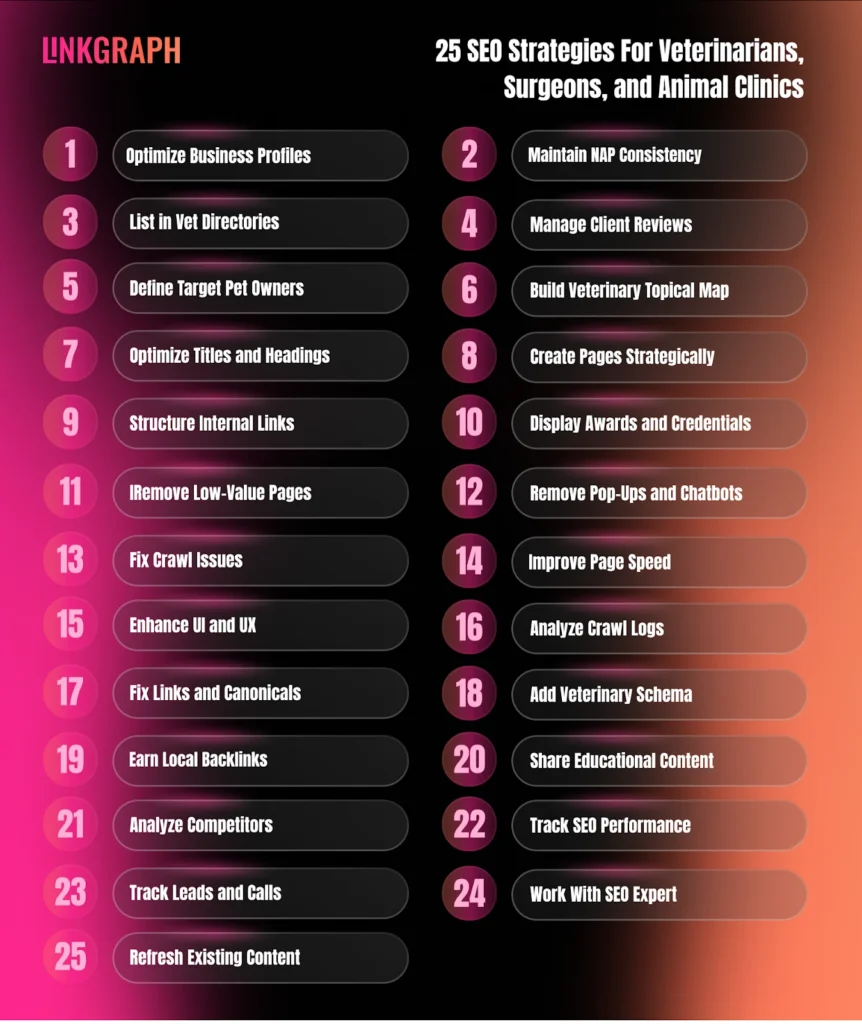
There are 25 SEO strategies for veterinarians, surgeons, and animal clinics. The 25 SEO strategies for veterinarians, surgeons, and animal clinics are listed below.
- Claim and Optimize Google, Bing, and Apple Business Profiles
- Maintain Consistent Clinic Name, Address, and Phone Number Across Listings
- List Your Practice on Reputable Veterinary and Local Directories
- Encourage and Reply to Pet Owner Reviews to Strengthen Credibility
- Identify Your Target Pet Owners, Market, and Their Needs
- Build a Topical Map Around Veterinary, Surgical, and Preventive Care
- Optimize Titles, Meta Descriptions, and Headings for Each Page
- Open New Page Only If the Service or Topic Is Popular and Deserves a Page
- Link Pages Internally Following Logical Hierarchy (Root → Seed → Node)
- Highlight Your Veterinary Awards, Certifications, and Professional Credentials
- Remove Low-Value Pages and Make Your Content Easier to Read
- Remove Unnecessary or Distracting Pop-Ups and Chatbots
- Conduct a Full Website Audit to Identify and Fix Crawling Issues
- Optimize Page Speed, Core Web Vitals, and Mobile Performance
- Improve Website UI/UX to Deliver Fast and Seamless User Experience
- Analyze Log Files to Identify Where Crawl Budget Is Being Wasted
- Identify and Fix Broken Links, 404 Errors, and Canonical Issues
- Add Schema Markup for Local Business, Veterinary Services, and Reviews
- Earn Backlinks from Local Pet Stores, Shelters, and Partner Organizations
- Share Educational Pet Care Content on Social Platforms to Gain Mentions and Authority
- Analyze Competing Clinics and Surgeons to Find Gaps and New Opportunities
- Monitor Rankings, Traffic, and Conversions with Analytics Tools
- Specifically Track Leads, Sales, and Calls from Organic Search
- Work with Va eterinary SEO Expert for Ongoing Strategy and Growth
- Regularly Update and Prune Existing Content to Keep It Fresh
Implementing these steps sequentially allows veterinary practices, animal clinics, and surgeons to build strong online authority, attract high-intent clients, and achieve sustainable growth in search visibility. We have broken down the 25 SEO strategies for veterinarians, surgeons, and animal clinics.
1. Claim and Optimize Google, Bing, and Apple Business Profiles
Claiming and optimizing business profiles on Google Business Profile (GBP), Bing Places, and Apple Maps allows veterinary practices, animal clinics, and surgeons to increase local search visibility and attract pet owners actively searching for care. Clinics verify listings, add accurate name, address, phone number (NAP), services, office hours, and high-quality images. Optimized profiles act as authoritative references for search engines and ensure consistent information across platforms.
Why is optimizing business profiles essential for veterinary SEO? Optimized listings increase the likelihood of appearing in local map packs and search results when pet owners search for veterinary services, emergency care, or specialty procedures. Accurate GBP, Bing Places, and Apple Maps profiles with detailed descriptions, verified addresses, and professional images build credibility and trust with prospective clients.
How must veterinary practices manage business profiles for maximum impact? Clinics should include service details, staff credentials, and photos of facilities. Regular updates, review monitoring, and correct categorization improve local SEO rankings. These actions increase appointment requests, attract new clients, and strengthen the online authority of the clinic within its target geographic area.
2. Maintain Consistent Clinic Name, Address, and Phone Number Across Listings
Maintaining a consistent clinic name, address, and phone number (NAP) across all online listings is a fundamental aspect of veterinary SEO. Animal clinics, veterinary surgeons, and pet care facilities must ensure that every directory, Google Business Profile, Bing listing, and local citation displays identical information. Inconsistent details confuse search engines, reduce trust signals, and negatively affect local search rankings.
Why is NAP consistency critical for veterinary practices? Accurate and uniform contact information strengthens local SEO authority, allowing clinics to appear in the local map pack and top search results for pet care, emergency services, and specialty treatments.
How should veterinary clinics manage NAP consistency? Practices need to audit all current listings, update incorrect entries, and establish a standardized format for clinic name, address, and phone. Regular monitoring prevents discrepancies, boosts search visibility, and improves appointment requests from local pet owners.
3. List Your Practice on Reputable Veterinary and Local Directories
Listing veterinary clinics, surgeons, and animal hospitals on trusted directories improves online visibility and strengthens domain authority. These listings act as credible references for search engines and potential clients, signaling that the practice is legitimate and active within the local community.
Why are directory listings essential for veterinary SEO? High-quality directories increase referral traffic, enhance local search rankings, and ensure clinics appear in searches for pet care, surgical procedures, and preventive services. Listings on veterinary-specific platforms target pet owners actively seeking medical care for their animals.
How should veterinary practices approach directory listings? Clinics should prioritize reputable veterinary directories, local business listings, and healthcare platforms, ensuring accurate NAP information, service descriptions, and links back to the main website. Regular updates and verification maximize SEO benefits and client trust.
4. Encourage and Reply to Pet Owner Reviews to Strengthen Credibility
Actively managing online reviews enhances trust and authority for veterinary clinics, animal hospitals, and surgeons. Positive reviews signal quality care to search engines and potential clients, improving local search rankings, visibility in local pack results, and appointment requests. Reviews communicate the expertise of the clinic in preventive care, surgery, and emergency services, which builds confidence among pet owners.
Why are pet owner reviews critical for veterinary SEO? High-quality feedback establishes trust signals, reinforces clinic credibility, and allows search engines to evaluate relevance for location-based queries. Responding promptly and professionally demonstrates attentiveness, customer care, and engagement with the concerns of the clients.
How should veterinary practices handle review management? Clinics should actively encourage satisfied clients to leave detailed feedback, reply to negative reviews constructively, and monitor platforms like GBP, Yelp, and Facebook. Regularly tracking review patterns and sentiments identifies service gaps, improves client satisfaction, and strengthens long-term online visibility.
5. Identify Your Target Pet Owners, Market, and Their Needs
Understanding the target audience allows veterinary clinics, animal hospitals, and pet surgeons to focus SEO efforts on prospective clients actively searching for services. Identifying pet owner demographics, pet types, and common medical concerns allows prioritization of high-intent keywords, optimization of service pages, and creation of content that resonates with users. This targeted approach ensures the clinic attracts qualified traffic rather than general visitors.
Why is audience identification crucial for veterinary SEO? Knowing the market guides local SEO strategies, content development, and service promotion to reach pet owners seeking preventive care, emergency care, surgical procedures, or specialty treatments. This precision reduces wasted impressions, improves click-through rates, and increases appointment bookings.
How does topical mapping integrate with audience targeting? Constructing a hierarchical topical map organizes core veterinary services, educational resources, and specialized treatments according to identified client needs. The map aligns keywords with user intent, establishes logical internal linking, and enhances authority for search engines. Topical mapping ensures content addresses the right pet owner questions, guiding them toward scheduling consultations and increasing clinic conversion rates.
6. Build a Topical Map Around Veterinary, Surgical, and Preventive Care
Creating a topical map allows veterinary clinics, animal hospitals, and pet surgeons to structure content around primary services and subtopics, establishing clear relationships between pages and search intent. This method organizes educational resources, surgical procedures, preventive care guides, and specialty treatments into a coherent hierarchy.
Why is a topical map essential for veterinary SEO? It aligns keywords with specific services, improves internal linking, and signals expertise, authoritativeness, and trustworthiness (E-E-A-T) to search engines. Mapping topics ensures coverage of high-intent searches such as “emergency vet near me,” “cat vaccinations,” or “orthopedic surgery for dogs.” Clinics capture urgent, preventive, and specialized queries, provide smooth navigation for pet owners, and increase visibility for multiple service areas simultaneously.
How should clinics implement topical mapping effectively? Identify core veterinary services, preventive programs, and surgical specialties, then create supporting content for each topic. Connect pages logically (Root → Seed → Node), optimize meta tags and headings, and integrate educational content that addresses pet owner questions. This approach enhances authority, improves rankings, and drives targeted traffic for each service area.
7. Optimize Titles, Meta Descriptions, and Headings for Each Page
Optimizing titles, meta descriptions, and headings allows veterinary clinics, animal hospitals, and pet surgeons to communicate relevance and authority to search engines while attracting pet owners in search results. Each page must have a unique title with high-intent keywords, a concise meta description, and structured headings that reflect service hierarchy.
Why is optimization essential for veterinary SEO? Well-crafted titles and descriptions improve click-through rates from search engine results pages, while headings (H1, H2, H3) guide both users and search engines through content logically. Optimized pages for “emergency vet services,” “dog vaccinations,” or “spay and neuter procedures” increase visibility and drive qualified traffic.
How should veterinary practices optimize these elements? Include primary and secondary keywords naturally, maintain character limits, use descriptive language that matches search intent, and structure headings to mirror topical hierarchy. This approach improves rankings, enhances user experience, and increases appointment bookings through organic search.
8. Open New Page Only If the Service or Topic Is Popular and Deserves a Page
Veterinary clinics, surgeons, and animal hospitals should create new pages only for high-demand services or frequently searched topics. Pages targeting urgent or specialized care, such as “emergency cat surgery,” “puppy vaccination schedules,” or “veterinary orthopedic care,” capture pet owners actively seeking services. Each page should detail service procedures, patient guidance, and clinic expertise to strengthen trust and search visibility. Low-traffic pages reduce site authority, split link equity, and waste crawl budget.
Why should pet clinics prioritize high-value topics? Low-value pages dilute SEO impact and confuse search engines. Focusing on popular services improves local rankings and increases appointment requests. Pages must answer common questions, highlight staff credentials, and demonstrate clinical experience. This approach ensures every page has measurable SEO value and contributes to overall site authority.
How should pet clinics choose pages? Clinics should analyze search volumes, competitor content, and patient inquiries. Using a topical map to link core services and specialties ensures pages align with clinic priorities and maximize organic reach. Every new page reinforces the expertise of the practice while maintaining a coherent site structure.
9. Link Pages Internally Following Logical Hierarchy (Root → Seed → Node)
Veterinary clinics must structure internal links to create a clear hierarchy, connecting broad topics (Root) to core services (Seed) and detailed pages (Node). Root pages, such as “Veterinary Services,” link to Seeds like “Surgery” or “Preventive Care,” which further link to Nodes covering specific procedures, recovery guides, or FAQs. This structure allows search engines to understand relationships between general and specific content, improving crawl efficiency and indexing.
Why is a logical hierarchy essential for vets? Proper internal linking prevents orphaned pages, consolidates authority, and clarifies the content structure of the website. It guides visitors naturally through services, reduces confusion, and increases appointment bookings. Descriptive anchor text and consistent taxonomy reinforce topical relevance and improve overall SEO value.
How should pet clinics implement this? Map all pages according to service clusters, audit links regularly, and ensure each Node connects to the appropriate Seed and Root pages. Logical linking strengthens keyword relevance, improves local search visibility, and boosts site authority.
10. Highlight Your Veterinary Awards, Certifications, and Professional Credentials
Veterinary practices must showcase professional credentials, industry certifications, and awards to establish authority and trust with pet owners. Displaying credentials for surgeons, veterinarians, and support staff reassures clients about the quality of care. Awards, recognitions, and memberships in professional associations enhance credibility and demonstrate expertise within the veterinary industry.
Why is emphasizing credentials important for vets? Highlighting certifications signals competence to search engines and clients, reinforcing local SEO authority and trustworthiness. Potential pet owners evaluating clinics prioritize credentials, especially for specialized services like surgery or emergency care. Visual badges, descriptive profiles, and detailed staff bios strengthen engagement and encourage appointment requests.
How should clinics present this information? Integrate credentials on service pages, about pages, and sidebar widgets. Use structured markup for awards and certifications to improve search visibility. Regularly update professional achievements, continuing education, and accolades to maintain authority, enhance reputation, and attract new clients actively searching for high-quality veterinary services.
11. Remove Low-Value Pages and Make Your Content Easier to Read
Veterinary clinics, animal hospitals, and surgical practices need to remove low-value pages that dilute site authority and confuse both search engines and pet owners. Pages with outdated information, thin content, or duplicate details reduce visibility for critical services and decrease user engagement.
Why should vet clinics make content easier to read? Organize pages with clear headings, bullet points, and concise paragraphs that describe surgical procedures, preventive care, or emergency services. Highlight key offerings and create scannable sections for pet owners seeking quick, actionable information.
How does cleaning up content improve SEO for veterinary practices? Removing low-value pages enhances crawl efficiency, increases user engagement, and signals authority to search engines. A well-structured, readable website boosts rankings for veterinary clinics, animal hospitals, and specialized surgeons, while improving appointment requests and strengthening client trust.
12. Remove Unnecessary or Distracting Pop-Ups and Chatbots
Veterinary clinics, animal hospitals, and surgical practices must remove pop-ups and chatbots that interrupt user flow or obscure critical information. Intrusive elements reduce page engagement, increase bounce rates, and prevent pet owners from accessing service details, appointment forms, or emergency information efficiently.
Why must veterinary practices carefully manage pop-ups and chatbots? Poorly timed or irrelevant pop-ups frustrate pet owners seeking information about vaccinations, surgical procedures, or preventive care. Chatbots should provide precise answers to common inquiries only, without blocking navigation, slowing page load, or distracting from booking consultations.
How does eliminating these elements improve SEO for veterinary clinics? Clean, distraction-free websites enhance user interaction and dwell time, signaling search engines that content is relevant and trustworthy. Streamlined navigation improves indexing, boosts local search visibility, and drives more organic inquiries for veterinary services, surgical care, and animal clinic consultations across target markets.
13. Conduct a Full Website Audit to Identify and Fix Crawling Issues
Veterinary clinics, animal hospitals, and surgical practices need to conduct full website audits to identify technical SEO issues and optimize search engine indexing. Audits examine server performance, HTML crawlability, page refresh rates, and discovery rates to ensure veterinary websites perform efficiently and attract organic traffic.
Why do veterinary practices need to focus on server response times? Reducing server response time under 100ms improves site speed, enhances user experience, and signals search engines that the clinic website is reliable. Fast-loading pages increase appointment bookings and minimize bounce rates from pet owners seeking urgent care.
How must HTML crawl requests, refresh rates, and discovery rates be optimized? Veterinary sites need to ensure over 95% of HTML requests are crawlable, maintain a refresh rate of around 20%, and achieve a discovery rate of 7–8%. These metrics maximize indexation efficiency, ensuring content on preventive care, surgical procedures, and wellness services is discoverable.
Why perform log file analysis for veterinary SEO? Log files reveal where the crawl budget is lost, such as low-value pages, broken links, or redirects. Clinics need to prioritize high-value service pages, fix errors, and improve organic search visibility across local and emergency veterinary queries.
14. Optimize Page Speed, Core Web Vitals, and Mobile Performance
SEO for vets depends on fast delivery, stable layouts, and responsive mobile interfaces. Veterinary SEO performance improves as pages load under three seconds across key templates. SEO for animal clinics aligns with urgent search behavior, where delays reduce calls and booking actions.
How do Core Web Vitals affect SEO for veterinary practices and animal clinics? SEO for veterinary practices relies on strong Largest Contentful Paint, low Cumulative Layout Shift, and fast Interaction to Next Paint. Veterinary search engine optimization improves through compressed media, efficient CSS delivery, and minimized render-blocking scripts. SEO for vet clinics gains ranking stability as these metrics reflect real user behavior.
Why does mobile performance matter for SEO for vets and veterinary clinics? SEO for vets aligns with mobile-first indexing and location-based intent. Veterinary SEO improves with responsive layouts, readable typography, and touch-friendly booking paths. SEO for animal clinics strengthens as mobile users complete calls, form submissions, and map actions faster.
15. Improve Website UI/UX to Deliver Fast and Seamless User Experience
SEO for vets benefits from clear navigation, predictable layouts, and direct access to core services. Veterinary SEO performance increases as clinic websites reduce friction across booking, contact, and location pages. SEO for animal clinics aligns with user intent that favors speed, clarity, and task completion.
How does UI structure influence SEO for veterinary practices and animal clinics? SEO for veterinary practices improves through logical menus, service categorization, and consistent page templates. Veterinary search engine optimization strengthens as users reach treatment pages within two clicks. SEO for vet clinics gains engagement signals through clear headings and scannable content blocks.
Why does UX optimization affect conversions for SEO for vets? SEO for vets connects traffic quality with conversion efficiency. Veterinary SEO improves as forms remain short, buttons remain visible, and distractions remain limited. SEO for animal hospitals grows as users complete calls, bookings, and directions without confusion.
16. Analyze Log Files to Identify Where Crawl Budget Is Being Wasted
SEO for veterinarians and animal clinics improves significantly through thorough log file analysis, which shows how search engine bots crawl a website. Veterinary SEO gains precision as logs reveal high-frequency bot visits, low-priority pages, and crawl patterns that do not contribute to rankings. Animal clinic SEO benefits when technical resources focus on indexing pages related to services, surgeries, and preventive care rather than redundant or low-value content.
What insights does veterinary log analysis provide for SEO optimization? Log files highlight URLs receiving excessive crawl hits, such as archive pages, duplicate content, or session parameters. Veterinary SEO benefits by redirecting crawl effort toward critical treatment pages, location listings, and educational resources. Animal clinic SEO improves when unnecessary crawling of irrelevant pages is reduced, allowing bots to prioritize high-value pages for better visibility in search results.
Why is managing crawl budget essential for veterinary SEO? Efficient crawl allocation ensures search engines index new and updated content quickly. Veterinary SEO performance increases as wasted bot visits decrease, server resources focus on core pages, and page discovery for services like emergency care, surgeries, and preventive treatments accelerates. SEO for clinics strengthens organic traffic and patient acquisition.
17. Identify and Fix Broken Links, 404 Errors, and Canonical Issues
Veterinary SEO for clinics, surgeons, and animal hospitals requires a fully functional website. Broken links, 404 errors, and improper canonical tags reduce search engine trust and hurt rankings. Fixing these issues ensures veterinary websites remain authoritative, accessible, and user-friendly for pet owners seeking care.
How do broken links and 404 errors affect veterinary SEO? Search engines encounter dead-end URLs when crawling veterinary sites, lowering indexing efficiency. Prospective clients cannot access important pages, reducing appointment bookings. Veterinary SEO improves when broken links redirect correctly or are removed, maintaining smooth navigation and preserving ranking signals.
Why are canonical issues critical for veterinary SEO? Incorrect canonical tags split ranking signals between duplicate or similar veterinary pages. Clinics need to set proper canonical URLs for service, surgical, and preventive care pages to consolidate authority. Correcting these issues strengthens search engine rankings, ensures accurate indexing, and increases patient acquisition.
18. Add Schema Markup for Local Business, Veterinary Services, and Reviews
Veterinary SEO for clinics, surgeons, and animal hospitals requires structured data to communicate key information to search engines. Adding schema markup for local businesses, veterinary services, and reviews improves visibility in search results, enhances rich snippets, and attracts high-intent pet owners.
Why is schema markup important for veterinary practices? Structured data signals service type, operating hours, address, and specialties, allowing Google to display accurate clinic information directly in search results. Veterinary SEO benefits from enhanced snippets, including star ratings, service details, and appointment options, increasing clicks and client inquiries.
How should veterinary clinics implement schema markup? Clinics need to add a local business schema with the clinic name, address, phone, and website. Service schema should cover surgical, preventive, and wellness offerings. Review schema highlights client feedback and ratings. Proper implementation improves search rankings, boosts visibility, and strengthens trust among pet owners.
19. Earn Backlinks from Local Pet Stores, Shelters, and Partner Organizations
Veterinary SEO for clinics, surgeons, and animal hospitals relies on high-quality backlinks to increase domain authority and search engine credibility. Earning links from local pet stores, animal shelters, and veterinary partner organizations strengthens online reputation and signals trust to search engines.
Why are backlinks crucial for veterinary practices? Backlinks act as endorsements, showing that other reputable entities in the pet care ecosystem recognize your clinic, surgeon, or animal hospital as an authoritative resource. Veterinary SEO benefits from increased ranking potential, higher organic traffic, and improved local search visibility when multiple trusted sources link to your website.
How should veterinary clinics acquire backlinks? Clinics need to collaborate with nearby pet stores, shelters, and animal care organizations through partnerships, sponsorships, and content sharing. Contributing guest articles, press releases, or educational resources generates valuable links. Consistent backlink acquisition improves search engine authority, drives targeted pet owner traffic, and enhances overall veterinary SEO performance.
20. Share Educational Pet Care Content on Social Platforms to Gain Mentions and Authority
Veterinary SEO for clinics, surgeons, and animal hospitals benefits from consistent educational content shared on social media platforms. Sharing posts about pet health, preventive care, surgery tips, and wellness advice increases visibility and positions the practice as a trusted authority in veterinary care.
Why is sharing educational content essential for veterinary SEO? Educational posts drive engagement from pet owners, generate social signals, and create opportunities for backlinks and mentions from other pet care websites or local organizations. Clinics that consistently publish informative content improve trust, reach, and website authority, strengthening their SEO efforts.
How should veterinary practices implement content sharing effectively? Clinics need to create targeted social media campaigns that highlight blogs, videos, and infographics on relevant topics. Engaging with followers, answering questions, and encouraging shares amplify reach. Coordinated content distribution across platforms increases mentions, attracts potential clients, and reinforces the position of the practice in search engine results.
21. Analyze Competing Clinics and Surgeons to Find Gaps and New Opportunities
Veterinary SEO for clinics, surgeons, and animal hospitals requires continuous competitive analysis to identify weaknesses and opportunities in the local market. Monitoring competing practices allows veterinary businesses to understand which keywords, services, and content drive traffic to rival clinics.
Why is competitor analysis essential for veterinary SEO? Analyzing other clinics highlights gaps in services, underutilized keywords, and content topics that your practice targets. Veterinary clinics and surgeons gain insights into pricing structures, promotions, and backlinks that competitors use, allowing strategic adjustments for better search engine visibility.
How should veterinary practices conduct competitive analysis effectively? Practices need to use tools to track competitor rankings, website structure, content strategies, and backlink profiles. Identifying areas where competitors underperform allows clinics to create optimized pages, targeted content, and local SEO campaigns. This process uncovers opportunities to capture high-intent searches, attract new clients, and strengthen authority in the veterinary field.
22. Monitor Rankings, Traffic, and Conversions with Analytics Tools
Veterinary SEO for clinics, surgeons, and animal hospitals requires constant monitoring of website performance using analytics tools. Tracking rankings, traffic, and conversions allows veterinary practices to assess the effectiveness of SEO campaigns and adjust strategies in real time.
Why is monitoring essential for veterinary practices? Monitoring provides insights into which keywords, pages, or services attract pet owners and drive appointments. Veterinary clinics and animal hospitals gain clarity on organic search performance, enabling precise decision-making for content, local SEO, and technical optimizations.
How should clinics track performance effectively? Practices need to set up Google Analytics (GA4), Google Search Console (GSC), and other veterinary-focused SEO tools. These tools report traffic sources, user behavior, and conversion events such as appointment bookings or calls. Regular review ensures clinics capture actionable insights, optimize underperforming pages, and maximize the return on SEO investments.
23. Specifically Track Leads, Sales, and Calls from Organic Search
Veterinary SEO for clinics, surgeons, and animal hospitals requires precise tracking of leads, sales, and phone calls generated through organic search. Monitoring these metrics allows veterinary practices, animal clinics, and surgical centers to evaluate the real-world impact of SEO campaigns and determine which efforts contribute to measurable patient growth.
Why is tracking organic leads critical for veterinary practices? Tracking leads from organic search allows clinics to understand which keywords, pages, or local listings drive appointments, vaccinations, surgeries, or wellness visits. Veterinary practices, animal hospitals, and pet clinics use this data to measure return on investment, prioritize high-performing content, and refine SEO strategies. Accurate tracking ensures clinics avoid wasted resources on low-converting pages or ineffective campaigns.
How should veterinary practices track conversions effectively? Practices need call-tracking numbers, appointment request forms, and CRM integration tied to GA4, GSC, and local listings. This system identifies which organic search terms or content pieces generate phone calls, booked consultations, or new client registrations. Regular review allows veterinary clinics, surgeons, and hospitals to adjust campaigns, optimize targeting, and increase patient acquisition sustainably over time.
24. Work with a Veterinary SEO Expert for Ongoing Strategy and Growth
Veterinary practices, animal clinics, and surgical centers achieve sustainable growth by collaborating with experienced SEO experts. A veterinary SEO specialist designs, implements, and monitors search engine optimization strategies that target high-intent keywords, local searches, and specialized veterinary services, ensuring consistent patient acquisition over time.
Why is partnering with a veterinary SEO expert essential? Expert guidance allows clinics, hospitals, and surgeons to avoid common SEO mistakes, optimize content effectively, and prioritize technical fixes. Specialists provide insights on keyword targeting, competitive analysis, backlink opportunities, and local SEO adjustments tailored to veterinary practices. This approach maximizes website visibility, patient leads, and clinic authority.
How do veterinary practices ensure continuous improvement? Practices need regular performance reviews, strategy refinements, and content audits conducted by SEO professionals. Veterinary SEO experts track rankings, website traffic, and organic conversions while recommending actionable improvements. Continuous collaboration enables animal clinics, surgical centers, and hospitals to maintain top search visibility and long-term patient growth in competitive local markets.
25. Regularly Update and Prune Existing Content to Keep It Fresh
Veterinary practices, animal clinics, and surgical centers maintain authority by consistently updating website content. Regular revisions improve accuracy, relevance, and alignment with current medical guidelines while enhancing search engine visibility for high-intent queries.
Why do veterinary clinics need to update and prune content? Outdated pages, irrelevant posts, and low-performing content reduce website authority and user engagement. Clinics need to refresh service descriptions, blog articles, and procedural guides, removing obsolete information and merging duplicate or low-value pages. This ensures that pet owners find accurate, trustworthy resources when searching for veterinary services.
How should clinics manage content updates effectively? Veterinary SEO specialists recommend scheduling periodic content audits, monitoring keyword performance, and tracking page analytics. Clinics need to prioritize high-traffic or high-conversion pages for updates, optimizing titles, meta descriptions, and internal links. Continuous content refinement strengthens local SEO, enhances patient trust, and maintains the competitive advantage of the clinic in search results.
When Should Veterinary Clinics Begin Investing in SEO to Attract More Clients?
Veterinary clinics, animal hospitals, and surgical centers need to begin investing in SEO as soon as they establish an online presence. Early investment allows clinics to build domain authority, optimize local search visibility, and capture high-intent pet owner queries before competitors dominate the market.
Why is timing important for veterinary SEO? Search engine optimization for veterinary practices requires consistent effort over months. Clinics typically see noticeable improvements in local rankings, website traffic, and appointment inquiries within three to six months of implementation. High-competition cities or specialized surgical services extend this timeline to six to nine months.
What Are the Most Common SEO Mistakes Veterinary Practices Make?
Veterinary clinics, animal hospitals, and pet surgeons frequently encounter setbacks in search engine optimization due to avoidable errors. Recognizing these mistakes allows clinics to improve local visibility, attract high-intent pet owners, and establish trust online while maximizing ROI from SEO efforts. The most common SEO mistakes that veterinary professionals make are listed below.
- Inconsistent NAP (Name, Address, Phone): Clinics that display different contact information across Google Business Profiles, social media, and local directories create confusion for search engines and reduce local ranking potential. Consistency ensures accurate indexing and improves local map pack visibility.
- Neglecting Local SEO: Failing to optimize for location-specific or “near me” searches limits the reach of the clinic to nearby pet owners seeking urgent, preventive, or wellness care. Local SEO increases foot traffic and appointment requests.
- Low-Quality or Thin Content: Sparse or generic content fails to demonstrate authority. Educational blogs, service pages, and FAQs are essential to attract and convert pet owners.
- Ignoring Technical SEO: Slow page speeds, crawl errors, broken links, and missing schema markup reduce site indexability and degrade search performance.
- Poor Review Management: Neglecting to collect, monitor, or respond to client reviews diminishes trust signals, discouraging potential pet owners.
Correcting these errors strengthens veterinary SEO, enhances online credibility, and drives sustainable patient growth.
Is Local SEO Alone Enough to Consistently Bring in New Pet Patients?
Local SEO alone is not enough to consistently attract new pet patients. While optimizing Google Business Profiles, managing local citations, and targeting “near me” searches improve visibility for nearby pet owners, they do not address broader online discovery, educational content, or authority-building.
Veterinary practices need complementary strategies such as website SEO, content marketing, reputation management, and backlinks to capture high-intent searches, educate pet owners, and rank for specialized services like surgery or preventive care. Combining local SEO with on-page, technical, and off-page tactics ensures sustained patient growth and measurable ROI.
How Can Local SEO Help Veterinary Clinics Increase Foot Traffic and Appointment Requests?
Local SEO increases foot traffic and appointment requests for veterinary clinics by making practices highly visible in nearby searches. Optimized Google Business Profiles, accurate NAP (Name, Address, Phone) listings, and local citations ensure pet owners find clinics quickly when searching for services like “emergency vet near me” or “pet vaccinations [city].”
How does local SEO drive appointments directly? Accurate local listings, high-quality images, service descriptions, and verified reviews signal trustworthiness and encourage calls or online bookings. Structured local content highlighting services, specialties, and operating hours improves map pack rankings.
Which Online Directories and Veterinary Platforms Are Most Valuable for Clinic Listings?
Veterinary clinics increase visibility and authority by listing on reputable online directories and industry-specific platforms. These listings improve local search performance, drive targeted traffic, and reinforce credibility among pet owners. Accurate profiles on trusted platforms enhance Google Business Profile signals and backlink quality. The most valuable online directories and veterinary platforms are listed below.
- Google Business Profile (GBP): The primary platform for local visibility. Clinics that fully complete GBP, including services, hours, and images, appear in map packs and local search results.
- Bing Places for Business: Supports search visibility for Microsoft users and complements Google’s local presence.
- Yelp for Veterinarians: Trusted review site; positive ratings attract new clients and influence search rankings.
- PetMD and Vetstreet Listings: Industry-specific platforms for clinics, surgeons, and specialists, enhancing credibility and educational reach.
- Local Chamber of Commerce Directories: Regional authority listings provide backlinks and reinforce geographic relevance.
Clinics should maintain consistent, up-to-date listings across all high-value directories to maximize local SEO and patient acquisition.
How Can Veterinary Clinics Use Social Media to Boost Online Visibility and SEO Rankings?
Veterinary clinics increase online visibility and SEO performance by actively managing social media profiles on platforms like Facebook, Instagram, and LinkedIn. Sharing educational pet care posts, surgical tips, preventive care guides, and client success stories drives traffic to the website of the clinic while signaling relevance and authority to search engines.
How does social media impact search rankings? Search engines consider social signals such as post engagement, shares, and clicks as indicators of authority and content value. High engagement improves referral traffic, which indirectly boosts SEO rankings.
What strategies maximize social media effectiveness for veterinary SEO? Clinics need to consistently post optimized content, tag geographic locations, use relevant keywords and hashtags, and link posts back to the website. Engaging with local pet communities, shelters, and influencers expands reach, increases backlinks, and strengthens the digital presence of the clinic, attracting more clients.
Is SEO a More Cost-Effective Long-Term Strategy Than Paid Ads for Veterinary Practices?
SEO for veterinary practices offers a cost-effective long-term strategy compared to paid advertising. Organic search traffic continues to generate leads without ongoing ad spend. Optimized websites, content, and local listings maintain rankings, driving consistent appointment requests and client growth.
Unlike paid ads, which stop producing results once the budget ends, SEO builds lasting visibility for high-intent local searches such as “emergency vet near me” or “cat vaccination clinic [city].” Veterinary SEO improves trust and credibility through reviews and content while delivering measurable ROI through increased organic traffic, calls, and bookings.
Can the Same SEO Strategy Be Applied Across Multiple Clinic Locations or Branches?
The same SEO strategy cannot be applied uniformly across multiple veterinary clinic locations or branches. Each clinic serves a distinct local market with unique search behavior, competition, and client needs. Local SEO elements, such as Google Business Profiles, reviews, and location-specific content, need customization for each branch.
Duplicate content or generic strategies reduce rankings and search visibility. Veterinary SEO requires tailored keyword targeting, localized content, and separate citation management for every location. Clinics benefit when strategies address individual geographic areas, ensuring each branch ranks effectively in local searches and attracts pet owners nearby.
Should Veterinary Clinics Combine SEO with Other Digital Marketing Strategies for Maximum Impact?
Veterinary clinics achieve maximum impact when combining SEO with complementary digital marketing strategies. Integrating email marketing, social media campaigns, and PPC (pay-per-click) ads amplifies visibility, reinforces trust, and drives appointments. SEO builds organic traffic and local search authority, while social media and PPC increase engagement, brand awareness, and immediate reach.
Paid campaigns, including PPC, target urgent services or promotions, providing measurable results alongside long-term SEO growth. Clinics need consistent messaging across all channels, aligned content, and analytics tracking to measure performance. This integrated approach ensures veterinary practices attract more clients, maintain online authority, and convert searches into appointments efficiently.
Can Veterinarians Manage Their SEO Independently, or Is Professional Help Recommended?
Veterinarians manage basic SEO independently, such as updating Google Business Profiles, posting educational content, and ensuring NAP (Name, Address, Phone) consistency across directories. These foundational actions improve visibility for local searches and attract new clients organically.
However, professional SEO expertise is recommended for advanced strategies, including technical SEO audits, schema implementation, backlink acquisition, content strategy optimization, and tracking performance metrics accurately.
Veterinary SEO specialists ensure compliance with search engine guidelines, maintain long-term growth, and optimize high-intent keywords like “emergency vet near me” or “surgical pet care [city].” Partnering with experts reduces errors, saves time, and maximizes ROI, allowing clinics to focus on patient care while sustaining competitive online visibility.
What Key Factors Should Clinics Consider Before Hiring a Veterinary SEO Agency?
Hiring a veterinary SEO agency requires careful evaluation to achieve measurable growth, increased online visibility, and higher appointment bookings. Clinics need to assess experience, results, technical expertise, and alignment with business objectives before committing. The key factors that clinics should consider before hiring a veterinary SEO agency.
- Proven Veterinary SEO Experience: The agency needs a strong track record of optimizing veterinary clinics, animal hospitals, and surgeons for local, specialized, and high-intent searches. Case studies or performance reports show their ability to attract new clients.
- Transparent Reporting and Analytics: Agencies must provide detailed insights on keyword rankings, website traffic, lead generation, conversions, and ROI, ensuring clinics understand campaign effectiveness.
- Advanced Technical SEO Skills: Ability to perform full audits, fix crawl errors, optimize page speed, implement schema, correct canonical issues, and improve mobile performance is essential.
- Strategic Content Development: Experience creating educational, authoritative, and patient-focused content for blogs, service pages, and FAQs to boost engagement and local relevance.
- Customized and Adaptive Strategy: The agency should tailor strategies based on clinic services, target pet owners, competition, and geographic focus, with continuous optimization for evolving search trends.
Considering these factors ensures clinics select an agency capable of delivering sustainable, high-impact veterinary SEO results.
Which Agency Offers the Most Reliable SEO Services for Veterinarians Near Me?
LinkGraph is the best seo agency for veterinary clinics, focusing on search engine optimization for veterinarians, animal hospitals, and pet surgeons. LinkGraph optimizes local listings, organic rankings, and content relevance to attract pet owners searching for urgent care and wellness services.
Case studies show measurable increases in organic traffic, higher placement in local map packs, and more appointment bookings for veterinary clients. Testimonials from clinic owners cite improved visibility and consistent lead generation after LinkGraph’s targeted campaigns.
What sets LinkGraph apart in veterinary SEO services? LinkGraph uses data‑driven workflows, competitive analysis, and technical SEO audits that align with search intent for common veterinary queries. LinkGraph crafts educational content, enhances Google Business Profiles, and builds authoritative backlinks from pet care networks. These actions reinforce clinic authority and drive measurable patient acquisition.
How does LinkGraph prove reliability for vet clinics? Veterinary clients report higher rankings for service keywords and increased organic calls. Performance reports detail growth in clicks, impressions, and conversions, demonstrating LinkGraph’s ability to grow veterinary search visibility reliably.
What Specific SEO Services Does LinkGraph Provide for Veterinarians, Clinics, and Surgeons?
LinkGraph provides targeted SEO services for veterinary clinics, animal hospitals, and pet surgeons to improve local visibility, attract high-intent clients, and boost online authority. Their strategies combine technical, on-page, and off-page optimization tailored to veterinary-specific needs. The SEO services that LinkGraph provides for veterinarians, clinics, and surgeons are listed below.
- Local SEO for Veterinarians: Optimizes Google Business Profiles, Bing Places, and local listings for “near me” and city-specific searches.
- Technical SEO for Veterinarians: Resolves crawl errors, broken links, site speed issues, and implements schema.
- On-Page Optimization for Veterinarians: Enhances titles, meta descriptions, headings, and internal linking for high-ranking keywords.
- Content Strategy for Veterinarians: Develops educational blogs, guides, and service pages targeting high-intent veterinary queries.
- Link Building & Digital PR for Veterinarians: Acquires authoritative backlinks from pet blogs, shelters, and veterinary organizations.
- Reputation Management for Veterinarians: Monitors reviews, encourages positive feedback, and maintains trust signals.
LinkGraph delivers measurable growth and sustainable patient acquisition for veterinary practices.
How Much Do LinkGraph’s SEO Services Typically Cost for Veterinary Practices?
LinkGraph’s SEO services for veterinary practices generally range from $3,000 to $10,000 per month for single‑location optimization focused on local search, content strategy, and technical SEO. Multi‑location clinics and more competitive markets require investments from $7,000 to $20,000 per month due to expanded keyword targeting, broader service pages, and ongoing backlink acquisition.
Veterinary SEO involves structured keyword research, Google Business Profile optimization, technical audits, content creation, and backlink building to increase visibility for high‑intent search terms like “emergency vet near me” or “pet vaccinations [city].” Complex campaigns with multiple clinic locations, extensive educational content, and reputation management require additional resources and expertise, which impacts cost.
How Long Does It Usually Take for a Veterinary Practice to See Results from SEO?
Veterinary practices typically begin seeing noticeable SEO results within 3 to 6 months of consistent optimization efforts. Initial improvements include higher local search visibility, increased Google Business Profile engagement, and gradual growth in website traffic. Significant outcomes, such as a steady increase in appointment requests or client calls, usually appear between 6 and 12 months, depending on competition, clinic size, and content strategy.
Why does the timeline to get results for vet SEO vary? Factors include market competitiveness, keyword difficulty, website authority, technical SEO health, and content frequency. Multi-location clinics or specialized surgeons targeting niche procedures experience slightly longer timelines due to higher optimization complexity.
How Can Clinics Accurately Track the Performance and ROI of Their SEO Campaigns?
Veterinary clinics track SEO performance using analytics platforms such as GA4, GSC, and specialized veterinary CRM tools. Key metrics include organic traffic, keyword rankings, page impressions, click-through rates, and local search visibility. Tracking appointment requests, online booking completions, and phone calls provides direct insight into lead generation.
How should ROI be calculated? Clinics compare revenue generated from new clients sourced via organic search against monthly SEO investments. Assigning value to each new patient or procedure allows for precise ROI measurement. Clinics need to monitor conversion funnels to identify which pages drive bookings or calls and which keywords produce the highest-value leads.
